Electronics 1992
Pioneer
The only CD changers that take 3 ads to explain.
FROM THE PRINTED PAGEOriginal ad copy
OCR transcription from the archived page. Scanning and reading-order errors may remain.
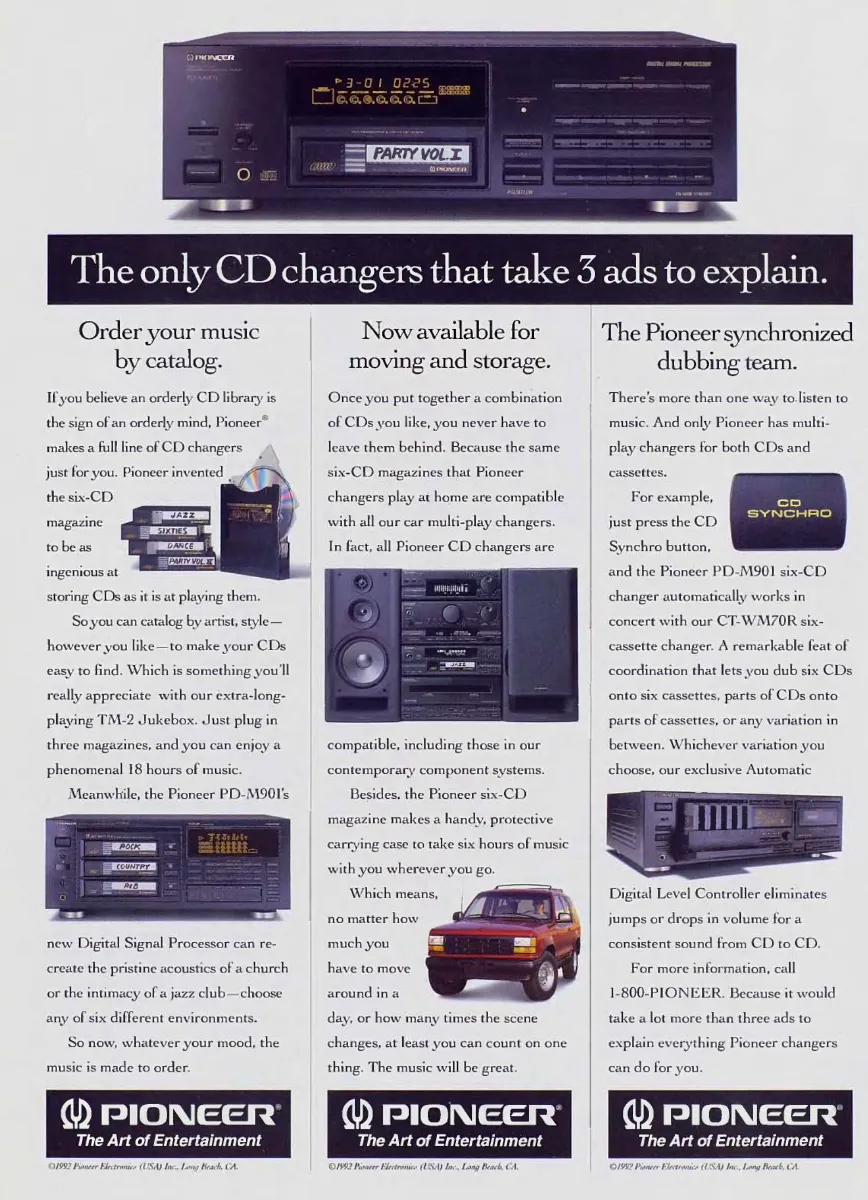
PIONEER PARTY VOL.I The only CD changers that take 3 ads to explain. Order your music by catalog. If you believe an orderly CD library is the sign of an orderly mind, Pioneer® makes a full line of CD changers just for you. Pioneer invented the six-CD magazine to be as ingenious at storing CDs as it is at playing them. JAZZ SIXTIES DANCE PARTY VOL.I So you can catalog by artist, style—however you like—to make your CDs easy to find. Which is something you'll really appreciate with our extra-long-playing TM-2 Jukebox. Just plug in three magazines, and you can enjoy a phenomenal 18 hours of music. ROCK COUNTRY R&B Meanwhile, the Pioneer PD-M901's new Digital Signal Processor can re-create the pristine acoustics of a church or the intimacy of a jazz club—choose any of six different environments. So now, whatever your mood, the music is made to order. PIONEER® The Art of Entertainment ©1992 Pioneer Electronics (USA) Inc., Long Beach, CA. Now available for moving and storage. Once you put together a combination of CDs you like, you never have to leave them behind. Because the same six-CD magazines that Pioneer changers play at home are compatible with all our car multi-play changers. In fact, all Pioneer CD changers are compatible, including those in our contemporary component systems. Besides, the Pioneer six-CD magazine makes a handy, protective carrying case to take six hours of music with you wherever you go. Which means, no matter how much you have to move around in a day, or how many times the scene changes, at least you can count on one thing. The music will be great. PIONEER® The Art of Entertainment ©1992 Pioneer Electronics (USA) Inc., Long Beach, CA. The Pioneer synchronized dubbing team. There's more than one way to listen to music. And only Pioneer has multi-play changers for both CDs and cassettes. CD SYNCHRO For example, just press the CD Synchro button, and the Pioneer PD-M901 six-CD changer automatically works in concert with our CT-WM70R six-cassette changer. A remarkable feat of coordination that lets you dub six CDs onto six cassettes, parts of CDs onto parts of cassettes, or any variation in between. Whichever variation you choose, our exclusive Automatic Digital Level Controller eliminates jumps or drops in volume for a consistent sound from CD to CD. For more information, call 1-800-PIONEER. Because it would take a lot more than three ads to explain everything Pioneer changers can do for you. PIONEER® The Art of Entertainment ©1992 Pioneer Electronics (USA) Inc., Long Beach, CA.
Commentary
I start with the handwritten-looking label in the machine: “PARTY VOL.I.” Before the specifications arrive, someone has already decided what this music is for. Below it, three columns turn a product range into three manageable tasks: organizing a collection, carrying it between places, and copying it into another format. Each column receives its own Pioneer signature, making the headline’s “3 ads” visible on the page.
The six-disc magazine is the object holding the argument together. On the left it is a miniature catalog, with tabs for jazz, the sixties and dance. In the middle it becomes luggage, moving from a home system to a car. On the right, the CD changer works with a cassette changer so selected music can cross another boundary. Pioneer is selling coordinated ownership: each compatible component makes the others more convenient to use.
The numbers reveal what convenience means here. Three magazines promise eighteen hours without repeated disc changes; one magazine carries six hours away from home. A separate processor offers the imagined acoustics of a church or jazz club. These are different benefits—less handling, portability and a chosen sound environment—and the column structure prevents them from becoming one undifferentiated specification list. The synchronization button then compresses a complicated recording procedure into a single visible control.
The little genre labels are the detail I would keep beside a modern playlist screen. Selecting music was also a physical act: loading discs, identifying containers and taking the right objects along. For listeners now using streaming libraries, a playlist can follow an account between devices without six albums being carried in a magazine. The desire to maintain a mood survives; the work of making it portable has changed.
For a young copywriter, “Order your music by catalog” joins classification to the language of shopping, while “moving and storage” borrows a phrase from the removals business. “Works in concert” gives the dubbing explanation a musical verb without obscuring the function. The opening claim excuses a long advertisement by promising three organized explanations. The final line escalates it: even these three supposedly cannot cover everything. That boast works as structure because the page has already delivered specific examples.
Pioneer dates its founding to 1938. Its present corporate business centers on car electronics and automotive solutions; it became part of CarUX Group in December 2025. The car photograph therefore connects this domestic audio advertisement to a field that remains central to the company.
Listening across locations remains a recognizable customer need. The six-disc magazine and coordinated cassette dubbing belong to the physical-media system shown here. The transferable idea is to explain compatibility through a person’s journey: finding the music, taking it along, and making it usable on the next machine.