Electronics 1985
Tomy
Tell him where to go.
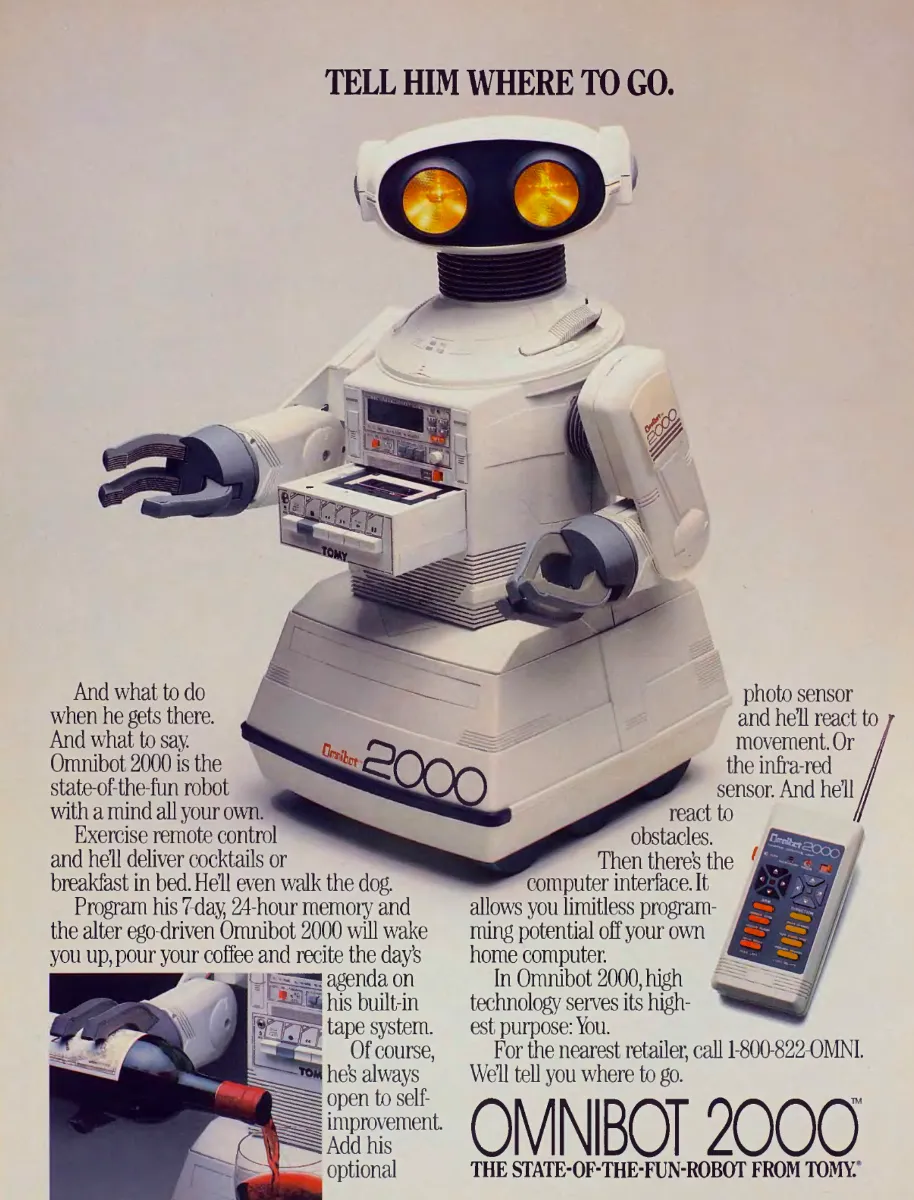
FROM THE PRINTED PAGEOriginal ad copy
OCR transcription from the archived page. Scanning and reading-order errors may remain.
TELL HIM WHERE TO GO. Omnibot 2000 TOMY And what to do when he gets there. And what to say. Omnibot 2000 is the state-of-the-fun robot with a mind all your own. Exercise remote control and he’ll deliver cocktails or breakfast in bed. He’ll even walk the dog. Program his 7-day, 24-hour memory and the alter ego-driven Omnibot 2000 will wake you up, pour your coffee and recite the day’s agenda on his built-in tape system. Of course, he’s always open to self-improvement. Add his optional photo sensor and he’ll react to movement. Or the infra-red sensor. And he’ll react to obstacles. Then there’s the computer interface. It allows you limitless programming potential off your own home computer. In Omnibot 2000, high technology serves its highest purpose: You. For the nearest retailer, call 1-800-822-OMNI. We’ll tell you where to go. OMNIBOT 2000™ THE STATE-OF-THE-FUN-ROBOT FROM TOMY.®
Commentary
I followed the robot’s arm to the inset photograph, where a bottle tips toward a glass. The large portrait offers a companion with amber eyes; the small picture offers a task completed. Between them sits the real attraction of this Omnibot 2000 advertisement: possessing a little piece of the future that can perform hospitality on command.
The headline’s bossiness is carefully qualified by the copy. This machine has “a mind all your own.” The customer supplies the intentions, programs the memory and exercises remote control. The tape system is visible in its chest, so the claim that it can recite an agenda has a material explanation. The ad gives the robot a personality without actually describing an independent mind.
Then the qualifications become a shopping list. A photo sensor and an infra-red sensor are optional; a computer interface promises further programming. That distinction is easy to lose beneath the breakfast-in-bed fantasy. Read closely, the page sells an expandable hobby as well as household service. “Limitless” is the advertiser’s enthusiasm, not a demonstrated specification. Even walking the dog is presented as a claim rather than shown in this scan.
The built-in tape makes the time comparison unusually concrete. A spoken daily agenda here is something the owner prepares for a machine to play. The imagined convenience still depends on advance work, just as the elegant drink service depends on someone arranging the bottle and glass. The ad makes preparation disappear from the emotional picture while leaving its mechanisms visible in the product photograph.
For young copywriters, “Tell him where to go” shows a familiar phrase doing two jobs: playful dismissal becomes a literal instruction. The closing retailer line repeats it with the roles reversed. “State-of-the-fun” borrows a technological cliché and redirects it toward enjoyment. These devices work together because both put the customer in charge; the wordplay is attached to the product’s control mechanism.
TOMY traces its beginnings to Eiichiro Tomiyama’s toy workshop in 1924 and records its 2006 merger with Takara in its corporate history. Its current Omnibot page still frames robots as a way to encounter technology through play, within a broader toy business.
That invitation to experiment remains more convincing than a promise to abolish housework. The cassette, dedicated remote and optional sensors place this particular future firmly in 1985. What still resonates is the pleasure of making an object respond—and the marketer’s opportunity to turn that response into a character.