Electronics 1985
Pioneer
Most video systems treat you as if you were deaf.
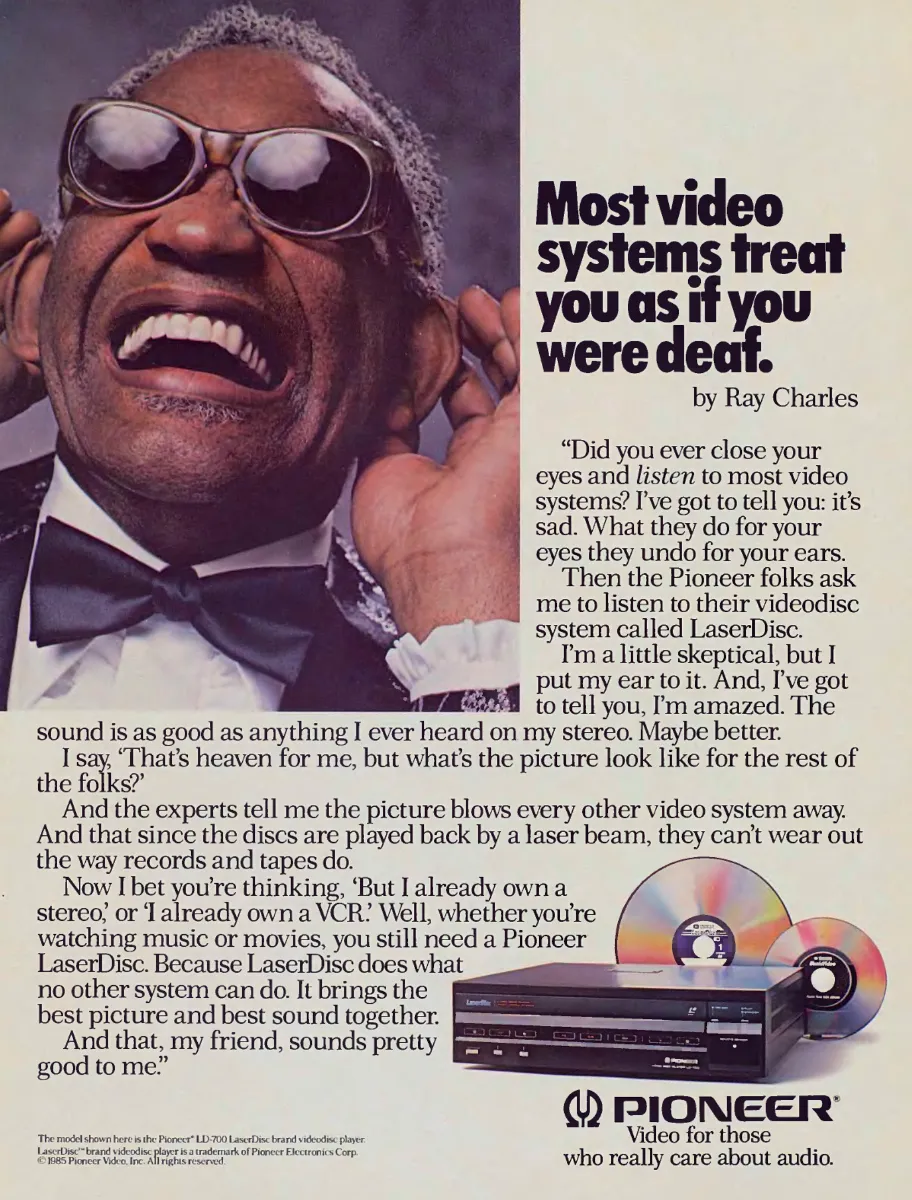
FROM THE PRINTED PAGEOriginal ad copy
OCR transcription from the archived page. Scanning and reading-order errors may remain.
Most video systems treat you as if you were deaf. by Ray Charles “Did you ever close your eyes and listen to most video systems? I’ve got to tell you: it’s sad. What they do for your eyes they undo for your ears. Then the Pioneer folks ask me to listen to their videodisc system called LaserDisc. I’m a little skeptical, but I put my ear to it. And, I’ve got to tell you, I’m amazed. The sound is as good as anything I ever heard on my stereo. Maybe better. I say, ‘That’s heaven for me, but what’s the picture look like for the rest of the folks?’ And the experts tell me the picture blows every other video system away. And that since the discs are played back by a laser beam, they can’t wear out the way records and tapes do. Now I bet you’re thinking, ‘But I already own a stereo,’ or ‘I already own a VCR.’ Well, whether you’re watching music or movies, you still need a Pioneer LaserDisc. Because LaserDisc does what no other system can do. It brings the best picture and best sound together. And that, my friend, sounds pretty good to me.” The model shown here is the Pioneer® LD-700 LaserDisc brand videodisc player. LaserDisc™ brand videodisc player is a trademark of Pioneer Electronics Corp. © 1985 Pioneer Video, Inc. All rights reserved. PIONEER® Video for those who really care about audio.
Commentary
I noticed the hands before the player. Ray Charles holds them beside his ears, smiling broadly, while the LaserDisc hardware occupies a much smaller patch at the bottom. The picture tells us where to direct attention. In an advertisement for video, listening has become the principal event.
The testimonial follows a conversion: dissatisfaction with other systems, an invitation from Pioneer, skepticism, then surprise. Charles’s musical authority makes the listening judgment relevant to the product rather than simply decorative celebrity. The copy also draws a boundary. He reports his own response to the sound, then attributes the assessment of the picture to “the experts.” The claim to visual superiority remains secondhand within the ad’s own telling.
That boundary is particularly revealing beside the headline’s use of deafness as a metaphor for neglect. The execution builds its argument around unequal treatment of the senses; its wording also makes disability the vehicle for a rebuke. A contemporary reader can examine both choices without assuming that either proves how audiences responded in 1985. The page supplies a persuasive construction, not reception data.
The anticipated objection is ownership: the reader already has a stereo or a VCR. Pioneer therefore has to justify another machine and another disc format. It does so by combining two pleasures the buyer is presumed to keep apart. The photographed player, reflective discs and familiar stereo reference make the promise tangible; they also show how much physical equipment could stand between wanting entertainment and experiencing it.
For beginning copywriters, study “What they do for your eyes they undo for your ears.” The parallel structure makes the comparison memorable, and the small change from “do” to “undo” supplies the accusation. Later, “Maybe better” interrupts a longer sentence with conversational emphasis. The closing “sounds pretty good” keeps the listening idea alive to the end. A testimonial gains coherence when its voice, argument and final phrase all serve the same benefit.
Pioneer’s history dates its founding to 1938 and its US home LaserDisc player to 1980. Its current account emphasizes mobility products and services. The company announced the end of LaserDisc player manufacturing in 2009, giving this once-new system a definite place in its past.
The demand that pictures deserve good sound survives the format. The sweeping superiority and wear claims should remain historical advertising claims, not present buying advice. What is still instructive is the choice of an endorser whose particular expertise gives the overlooked product benefit a persuasive voice.