Electronics 1981
TDK
When I listen to a cassette I take it apart.
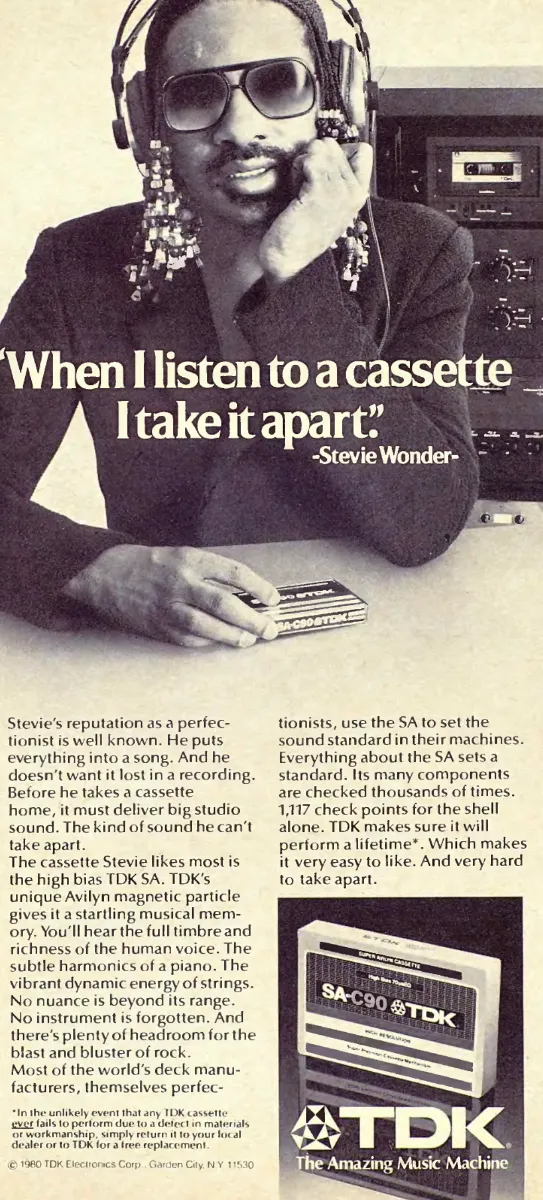
FROM THE PRINTED PAGEOriginal ad copy
OCR transcription from the archived page. Scanning and reading-order errors may remain.
“When I listen to a cassette I take it apart.” -Stevie Wonder- Stevie's reputation as a perfectionist is well known. He puts everything into a song. And he doesn't want it lost in a recording. Before he takes a cassette home, it must deliver big studio sound. The kind of sound he can't take apart. The cassette Stevie likes most is the high bias TDK SA. TDK's unique Avilyn magnetic particle gives it a startling musical memory. You'll hear the full timbre and richness of the human voice. The subtle harmonics of a piano. The vibrant dynamic energy of strings. No nuance is beyond its range. No instrument is forgotten. And there's plenty of headroom for the blast and bluster of rock. Most of the world's deck manufacturers, themselves perfectionists, use the SA to set the sound standard in their machines. Everything about the SA sets a standard. Its many components are checked thousands of times. 1,117 check points for the shell alone. TDK makes sure it will perform a lifetime*. Which makes it very easy to like. And very hard to take apart. *In the unlikely event that any TDK cassette ever fails to perform due to a defect in materials or workmanship, simply return it to your local dealer or to TDK for a free replacement. © 1980 TDK Electronics Corp., Garden City, N.Y. 11530 SUPER AVILYN CASSETTE SA-C90 TDK HIGH RESOLUTION SUPER PRECISION CASSETTE MECHANISM TDK® The Amazing Music Machine
Commentary
I looked at Stevie Wonder’s hands after reading the headline. He is not dismantling anything. One hand rests against his face, the other touches a cassette package; the headphones establish the activity as listening. “Take it apart” has to mean scrutiny. The joke invites the reader to imagine a recording subjected to an unusually exacting ear, then lets the intact product sit calmly through the examination.
TDK’s choice of witness makes the argument about preservation. The copy says Wonder puts everything into a song and wants none of it lost. That turns a blank cassette from a minor accessory into the place where somebody else’s detailed work might disappear. The Avilyn particle claim supplies a material explanation; voices, piano harmonics, strings and rock supply things the reader might actually miss. Invisible recording performance is translated into a series of possible audible losses.
I then followed the argument down to the shell. Its 1,117 checkpoints are an oddly memorable counterpart to the portrait: personal discrimination above, industrial inspection below. The claim about deck manufacturers using SA as a reference adds another class of demanding user. Neither assertion is independently demonstrated by the page, but each gives “perfectionist” a more specific job. The lifetime promise finally points to a replacement provision for defects, rather than an unqualified promise about every recording or every kind of damage.
The line about taking a cassette home exposes a small investment of attention. The buyer is choosing a physical recording medium as well as choosing music. With a digital file or stream, listeners can still care deeply about reproduction, but the shell, tape formulation and return to a local dealer disappear from that decision. Here, fidelity has packaging one can hold and a component one can worry about.
For young copywriters, the opening phrase changes meaning as it moves through the page. First it suggests critical listening; at the end, “very hard to take apart” also suggests physical integrity. “Musical memory” gives the tape a human-sounding capacity without requiring a technical lecture. The lesson is to choose a phrase that can bridge the emotional benefit and the product’s construction, then make both meanings visible in the supporting copy.
TDK was founded in 1935 to commercialize ferrite, and its history documents the later expansion into recording tape. Its present business segments include passive components, sensors, magnetic products and energy products.
Protecting the quality of an experience remains a useful reason to care about a component. The SA cassette, high-bias specification and dealer replacement offer belong to this historical sale. The endorsement’s lasting strength is the alignment between the person who might notice a loss and the product that promises to prevent it.