Electronics 1981
Sony
One of our biggest ideas. Ditto.
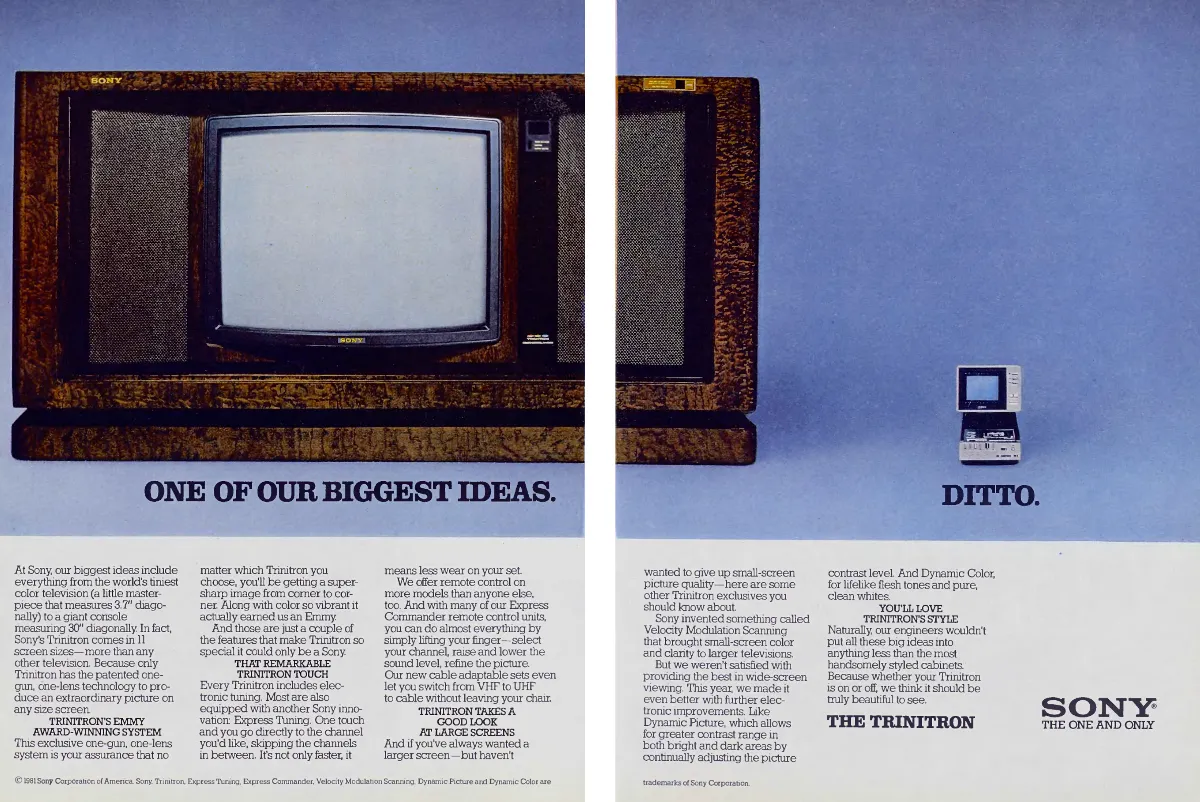
FROM THE PRINTED PAGEOriginal ad copy
OCR transcription from the archived page. Scanning and reading-order errors may remain.
ONE OF OUR BIGGEST IDEAS. DITTO. At Sony, our biggest ideas include everything from the world's tiniest color television (a little masterpiece that measures 3.7″ diagonally) to a giant console measuring 30″ diagonally. In fact, Sony's Trinitron comes in 11 screen sizes—more than any other television. Because only Trinitron has the patented one-gun, one-lens technology to produce an extraordinary picture on any size screen. TRINITRON'S EMMY AWARD-WINNING SYSTEM This exclusive one-gun, one-lens system is your assurance that no matter which Trinitron you choose, you'll be getting a super-sharp image from corner to corner. Along with color so vibrant it actually earned us an Emmy. And those are just a couple of the features that make Trinitron so special it could only be a Sony. THAT REMARKABLE TRINITRON TOUCH Every Trinitron includes electronic tuning. Most are also equipped with another Sony innovation: Express Tuning. One touch and you go directly to the channel you'd like, skipping the channels in between. It's not only faster, it means less wear on your set. We offer remote control on more models than anyone else, too. And with many of our Express Commander remote control units, you can do almost everything by simply lifting your finger—select your channel, raise and lower the sound level, refine the picture. Our new cable adaptable sets even let you switch from VHF to UHF to cable without leaving your chair. TRINITRON TAKES A GOOD LOOK AT LARGE SCREENS And if you've always wanted a larger screen—but haven't wanted to give up small-screen picture quality—here are some other Trinitron exclusives you should know about. Sony invented something called Velocity Modulation Scanning that brought small-screen color and clarity to larger televisions. But we weren't satisfied with providing the best in wide-screen viewing. This year, we made it even better with further electronic improvements. Like Dynamic Picture, which allows for greater contrast range in both bright and dark areas by continually adjusting the picture contrast level. And Dynamic Color, for lifelike flesh tones and pure, clean whites. YOU'LL LOVE TRINITRON'S STYLE Naturally, our engineers wouldn't put all these big ideas into anything less than the most handsomely styled cabinets. Because whether your Trinitron is on or off, we think it should be truly beautiful to see. THE TRINITRON SONY® THE ONE AND ONLY © 1981 Sony Corporation of America. Sony, Trinitron, Express Tuning, Express Commander, Velocity Modulation Scanning, Dynamic Picture and Dynamic Color are trademarks of Sony Corporation.
Commentary
I almost missed the second television. The wooden console takes up so much of the spread that the little portable initially looks like punctuation. Then “DITTO” makes the imbalance the point. Sony has created two different kinds of bigness: a physically imposing product and an idea supposedly capable of surviving miniaturization.
The blank screens matter. No beautiful programme is available to distract from the objects or smuggle picture quality into the demonstration. Instead, the enormous difference in scale makes the range visible, and the copy supplies the claim that one-gun, one-lens Trinitron technology connects it. Eleven screen sizes are presented as evidence of a coherent engineering family. Sony’s own history dates Trinitron’s introduction to 1968, giving that family a development history beyond this single spread.
I followed the lower columns expecting more miniature engineering and found a tour of domestic inconveniences. Channel selection, sound adjustment, picture refinement and switching between broadcast bands and cable all become things one need not leave a chair to do. Even tuning wear receives an answer. The final cabinet paragraph then resolves the other half of television ownership: the set must look acceptable when there is nothing on it.
That last concern is especially legible now. The console is furniture with a screen inside; the portable is a device one can put somewhere else. Contemporary screens can occupy walls and pockets, but the ad reminds us that selling television once included justifying a substantial permanent object in the room. Convenience meant both getting a picture and negotiating the space its machinery required.
For a young copywriter, “biggest” is doing two jobs, and “Ditto” lets the reader discover the second one. Repeating the full headline under the tiny set would flatten the joke. One short word makes the products equivalent in ambition while their sizes remain comically unequal. The lesson is to let layout complete a sentence: copy can be brief when placement supplies the missing argument.
Sony documents the Trinitron development story and its 1973 Emmy recognition. The company continues to sell televisions under BRAVIA; its current range includes OLED and LED-based displays rather than these cathode-ray-tube sets.
The portable and console no longer define the extremes of screen ownership, and the named circuitry belongs to its period. The lasting brand proposition is consistency across different sizes: a buyer choosing a smaller product should not feel that the manufacturer’s best thinking has been reserved for the largest one.