Telecommunications 1990
Siemens
Data instead of Cash
FROM THE PRINTED PAGEOriginal ad copy
OCR transcription from the archived page. Scanning and reading-order errors may remain.
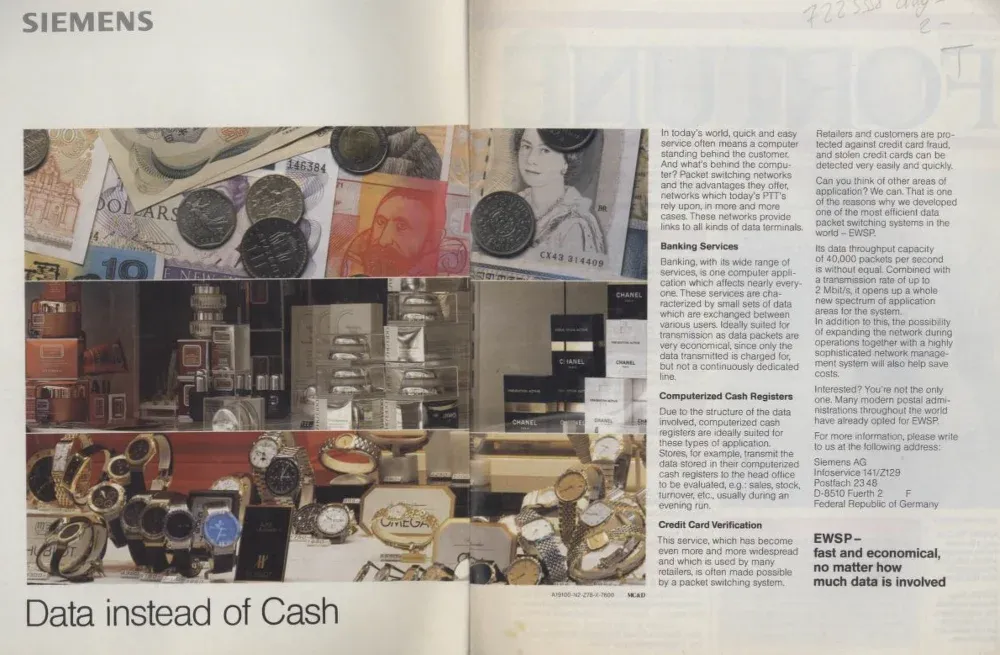
SIEMENS Data instead of Cash In today's world, quick and easy service often means a computer standing behind the customer. And what's behind the computer? Packet switching networks and the advantages they offer, networks which today's PTT's rely upon, in more and more cases. These networks provide links to all kinds of data terminals. Banking Services Banking, with its wide range of services, is one computer application which affects nearly every one. These services are characterized by small sets of data which are exchanged between various users. Ideally suited for transmission as data packets are very economical, since only the data transmitted is charged for, but not a continuously dedicated line. Computerized Cash Registers Due to the structure of the data involved, computerized cash registers are ideally suited for these types of application. Stores, for example, transmit the data stored in their computerized cash registers to the head office to be evaluated, e.g.: sales, stock, turnover, etc., usually during an evening run. Credit Card Verification This service, which has become even more and more widespread and which is used by many retailers, is often made possible by a packet switching system. Retailers and customers are protected against credit card fraud, and stolen credit cards can be detected very easily and quickly. Can you think of other areas of application? We can. That is one of the reasons why we developed one of the most efficient data networks in the world – EWSP. Its data throughput capacity of 40,000 packets per second is without equal. Combined with a transmission rate of up to 2 Mbit/s, it opens up a whole new spectrum of application areas for the system. In addition to this, the possibility of expanding the network during operations together with a highly sophisticated network management system will also help save costs. Interested? You're not the only one. Many modern postal administrations throughout the world have already opted for EWSP. For more information, please write to us at the following address: Siemens AG Infoservice 141/Z129 Postfach 23 48 D-8510 Fuerth 2 F Federal Republic of Germany EWSP – fast and economical, no matter how much data is involved
Commentary
At first the spread looks like a catalogue of things one might buy: notes and coins, perfume, watches, packaged goods. But Siemens has laid those objects in horizontal strips, as if they were being sorted into data. The title, “Data instead of Cash,” provides the hinge. The ad is about a packet-switching network, yet its opening visual belongs to a shop counter. I read that as an attempt to make the network’s invisible work visible at the point where money and merchandise meet.
The small columns on the right take a patient route from everyday service to telecommunications infrastructure. A bank exchanges small sets of data; a computerized cash register sends sales, stock and turnover information to head office, often in an evening run; credit-card checks help detect stolen cards. Only after these examples does Siemens name EWSP’s claimed capacity: 40,000 packets per second and up to 2 Mbit/s. “Only the data transmitted is charged for,” it says, contrasting packets with a dedicated line. These are the ad’s technical and economic claims, not independently verified performance figures.
The “evening run” is a small time capsule. Store information was imagined as something gathered at close of business and moved to head office in a batch. Today, many retail systems update inventory and payments continuously. The scan documents the earlier workflow; the shift toward real-time expectations is the comparison. What Siemens sells is not merely speed, but a different rhythm for commercial information.
For a new copywriter, notice how the title makes a compact substitution: one concrete noun, “Cash,” gives way to a less visible one, “Data.” The repeated service headings then keep the explanation in the buyer’s world before “EWSP” and its numbers appear. The practical lesson is to name the familiar transaction first, then introduce the mechanism that changes it. The tiny type makes close reading necessary, but the strips of goods give the reader a reason to enter those columns.
Siemens began as a telegraph workshop in 1847 and later built communications systems alongside its other industrial businesses. Its history timeline records that development; its current strategy centers on industry, infrastructure, transportation and software.
The durable promise is that better networks make routine transactions faster and easier to manage. The postal-administration audience, packet rate and letterbox address belong to the ad’s particular telecommunications market; its view of commerce as information moving through infrastructure still feels familiar.