Electronics 1994
RSA
Security Clearance
FROM THE PRINTED PAGEOriginal ad copy
OCR transcription from the archived page. Scanning and reading-order errors may remain.
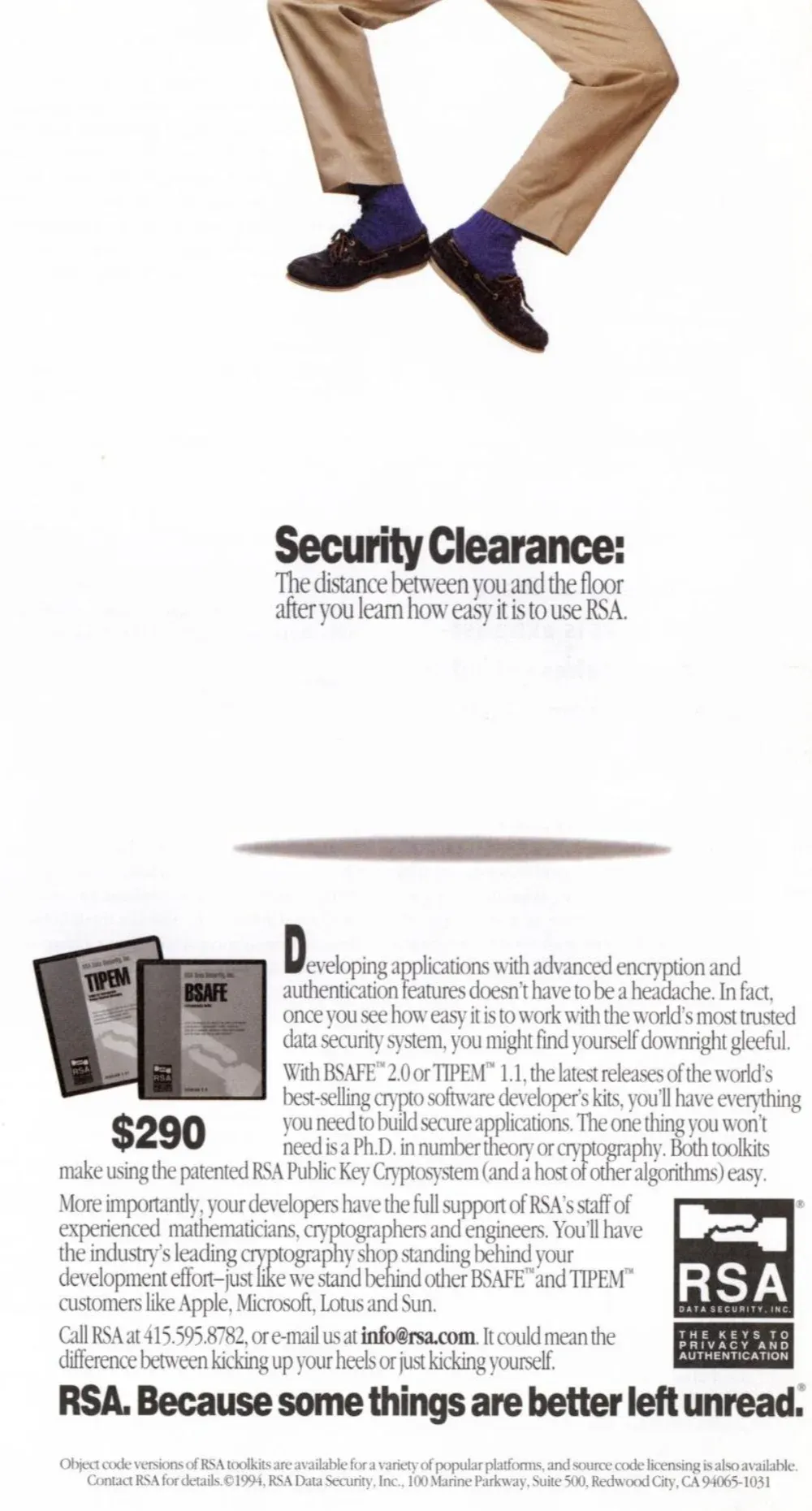
Security Clearance: The distance between you and the floor after you learn how easy it is to use RSA. TIPEM BSAFE $290 Developing applications with advanced encryption and authentication features doesn't have to be a headache. In fact, once you see how easy it is to work with the world's most trusted data security system, you might find yourself downright gleeful. With BSAFE™ 2.0 or TIPEM™ 1.1, the latest releases of the world's best-selling crypto software developer's kits, you'll have everything you need to build secure applications. The one thing you won't need is a Ph.D. in number theory or cryptography. Both toolkits make using the patented RSA Public Key Cryptosystem (and a host of other algorithms) easy. More importantly, your developers have the full support of RSA's staff of experienced mathematicians, cryptographers and engineers. You'll have the industry's leading cryptography shop standing behind your development effort—just like we stand behind other BSAFE™ and TIPEM™ customers like Apple, Microsoft, Lotus and Sun. Call RSA at 415.595.8782, or e-mail us at info@rsa.com. It could mean the difference between kicking up your heels or just kicking yourself. RSA DATA SECURITY, INC. THE KEYS TO PRIVACY AND AUTHENTICATION RSA. Because some things are better left unread. Object code versions of RSA toolkits are available for a variety of popular platforms, and source code licensing is also available. Contact RSA for details. ©1994, RSA Data Security, Inc., 100 Marine Parkway, Suite 500, Redwood City, CA 94065-1031
Commentary
The first clue is the shadow. It sits at the bottom of a large white gap, while a pair of trousered legs hovers far above it. RSA makes “security clearance” literal: the distance to the floor is also the emotional distance between a developer and a task that once seemed formidable. The image is almost comically sparse for an encryption ad. That sparseness matters. It turns an invisible technical problem into a physical sensation before the copy asks anyone to think about algorithms.
Then the products arrive in small boxes, beside a conspicuous $290. BSAFE 2.0 and TIPEM 1.1 are sold as developer’s kits, with encryption and authentication features that supposedly require no Ph.D. RSA backs the ease claim with a different kind of reassurance: its mathematicians and engineers, plus named customers Apple, Microsoft, Lotus and Sun. Those names are the ad’s evidence of adoption, not independent proof of its “world’s most trusted” or “best-selling” claims. The phone number, email address, object-code availability and source-code licensing place the ad in a practical purchasing conversation with software teams.
The contact choices also mark a change in how technical software is bought. A reader could call, email, or arrange source licensing directly with RSA. Today’s developer may first meet a product through documentation, a package registry, or an online trial. That comparison is an inference from the ad’s sales route, but it sharpens its central proposition: make specialist security feel reachable without removing the specialist support behind it.
For a new copywriter, “Security Clearance” is doing two jobs in two words. The formal phrase belongs to access control; the visual supplies the everyday meaning of clearance as empty space. “Kicking up your heels” then carries the elevated feet into the call to action, while “kicking yourself” gives inaction an opposite physical consequence. The lesson is to let one concrete image organize both headline and closing line, so the joke carries the product benefit rather than distracting from it.
RSA says it was founded in 1982 around the public-key algorithm developed by Ron Rivest, Adi Shamir and Leonard Adleman; it now focuses on identity security, including access and authentication products. Its company history describes the algorithm’s release into the public domain in 2000.
The enduring need is to make security usable for people building systems. The patented cryptosystem and boxed toolkit offer belong to this ad’s moment; RSA’s current identity products address a different layer of the same trust problem.