Electronics 1989
Pioneer
Quality Time.
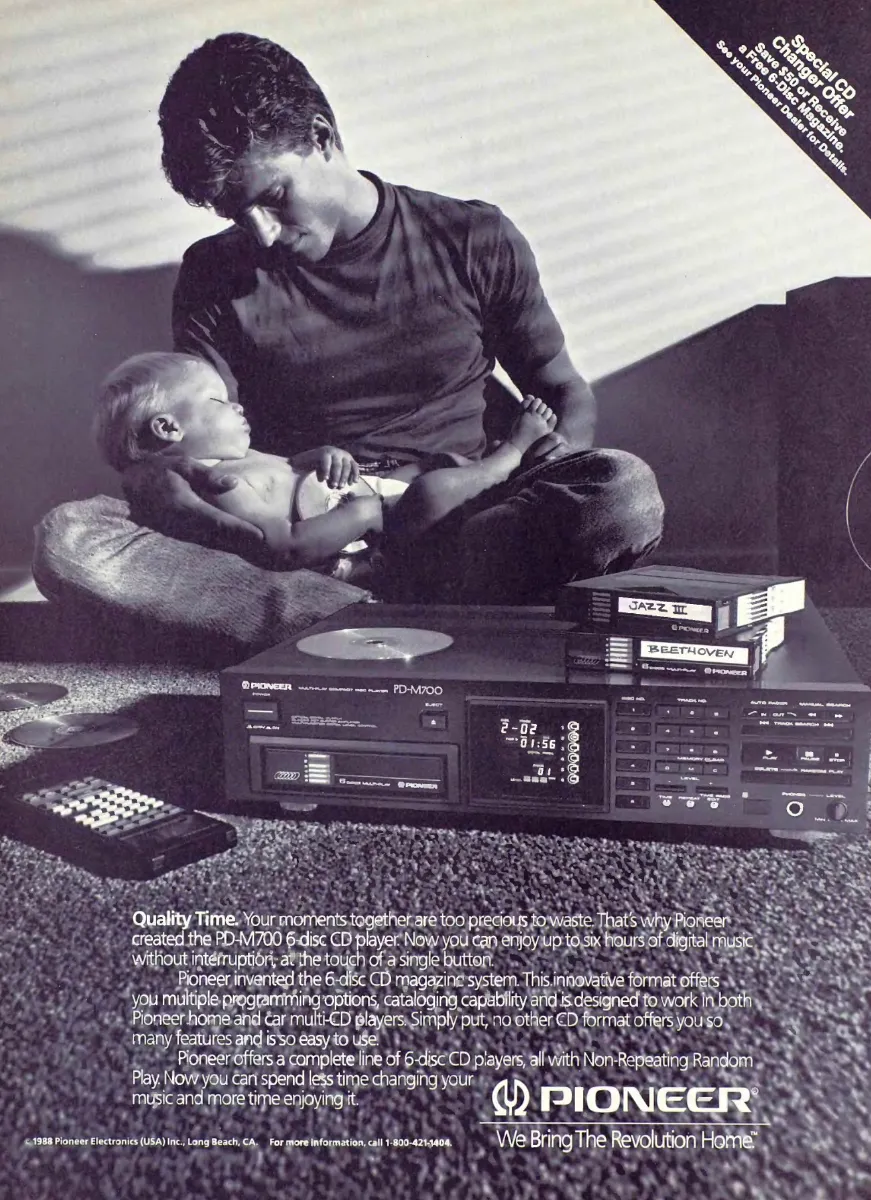
FROM THE PRINTED PAGEOriginal ad copy
OCR transcription from the archived page. Scanning and reading-order errors may remain.
Special CD Changer Offer Save $50 or Receive a Free 6-Disc Magazine. See Your Pioneer Dealer for Details. JAZZ III BEETHOVEN PIONEER MULTI-PLAY COMPACT DISC PLAYER PD-M700 6 DISC MULTI-PLAY [illegible smaller player and remote-control labels] Quality Time. Your moments together are too precious to waste. That's why Pioneer created the PD-M700 6-disc CD player. Now you can enjoy up to six hours of digital music without interruption, at the touch of a single button. Pioneer invented the 6-disc CD magazine system. This innovative format offers you multiple programming options, cataloging capability and is designed to work in both Pioneer home and car multi-CD players. Simply put, no other CD format offers you so many features and is so easy to use. Pioneer offers a complete line of 6-disc CD players, all with Non-Repeating Random Play. Now you can spend less time changing your music and more time enjoying it. PIONEER® We Bring The Revolution Home.™ ©1988 Pioneer Electronics (USA) Inc., Long Beach, CA. For more information, call 1-800-421-1404.
Commentary
The player occupies the foreground, but the father is looking somewhere else. He sits on the floor with a baby across his lap, giving the machine an unusually modest role in the household: it should keep working while his attention remains with the child. Pioneer makes uninterrupted music valuable by showing an interruption that nobody would want to resent.
I then noticed the labelled disc magazines. “JAZZ III” and “BEETHOVEN” make a collection visible as something already organized and ready to use. The remote lies within reach; a loose disc rests on the player. These objects explain the practical claim under the photograph: six discs, up to six hours and a single button. The ad also says the magazines work in Pioneer home and car players. Its claim to inventing the system is preserved as advertising copy, rather than independently certified by the image.
“Quality time” could have been an empty sentiment. Here it is attached to a particular domestic task that the product reduces: stopping to change discs. I read the composition as an attempt to give male caregiving the same visual importance as the substantial piece of audio equipment below it. That is an observation about this page, not a claim about how fathers generally spent their time in 1989.
The inconvenience has since changed shape. A modern listener can queue far more than six albums without loading physical media, but selecting, organizing and interrupting music still consume attention. The labelled magazines show a former version of that work. The human benefit in the photograph is not a larger catalogue; it is permission to look away from the system once the music begins.
For a new copywriter, “Quality Time” makes a technical improvement answer an emotional concern in just two words. “Less time changing” and “more time enjoying” then balance the closing sentence around the same noun. That parallel construction converts mechanism into consequence. Use it when the product removes a specific chore, and name that chore clearly enough for the reader to recognize it.
Pioneer began as a high-fidelity speaker manufacturer in 1938. Its present corporate account emphasizes car entertainment and mobility technology and records joining the CarUX Group in December 2025, a different business setting from this home CD changer.
The magazine system and six-hour capacity are historical answers to physical-media handling. The more persistent promise is dependable technology that asks less of its owner. The photograph explains that promise more effectively than an isolated list of playback functions could.