Consumer Goods 1989
Jack Daniel's
October in Tennessee is when the hills grow darker and the stories taller.
FROM THE PRINTED PAGEOriginal ad copy
OCR transcription from the archived page. Scanning and reading-order errors may remain.
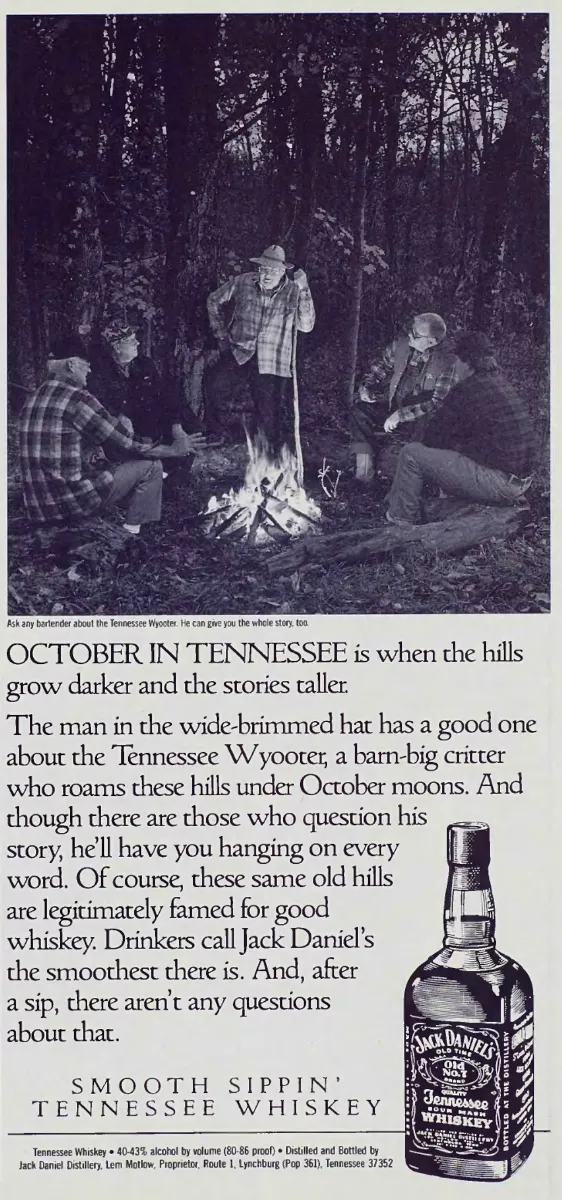
Ask any bartender about the Tennessee Wyooter. He can give you the whole story, too. OCTOBER IN TENNESSEE is when the hills grow darker and the stories taller. The man in the wide-brimmed hat has a good one about the Tennessee Wyooter, a barn-big critter who roams these hills under October moons. And though there are those who question his story, he'll have you hanging on every word. Of course, these same old hills are legitimately famed for good whiskey. Drinkers call Jack Daniel's the smoothest there is. And, after a sip, there aren't any questions about that. SMOOTH SIPPIN' TENNESSEE WHISKEY JACK DANIEL'S OLD TIME Old No. 7 BRAND Tennessee SOUR MASH WHISKEY [illegible remaining bottle-label text] Tennessee Whiskey · 40-43% alcohol by volume (80-86 proof) · Distilled and Bottled by Jack Daniel Distillery, Lem Motlow, Proprietor, Route 1, Lynchburg (Pop 361), Tennessee 37352
Commentary
I found the bottle only after the campfire had done its work. The photograph gives most of the page to dark trees and a group listening to a man in a broad-brimmed hat. A flame lights the centre of the gathering. It is an image of attention being held, which turns out to be the quality the prose wants from its own reader.
The story concerns a Tennessee Wyooter, described as a “barn-big critter.” The ad invites doubt about the creature and then sharply limits that doubt: the whiskey, it says, is legitimately good. I read the tall tale as a controlled transfer of authority. An entertaining local storyteller establishes the place’s character; the word “legitimately” tries to move the product outside the fiction while retaining the atmosphere the fiction created.
The drawn bottle matters to that transition. It sits against the copy rather than appearing as something the people around the fire are visibly consuming. The product belongs to the account of Tennessee, while the scene remains a social occasion. Small particulars—the old hills, October moons, the town’s printed population—make the brand’s setting feel close enough to visit. They provide specificity without offering a production explanation or a measurable basis for “smoothest.” That superlative is the advertiser’s claim.
The caption above the headline directs the reader to a bartender for the rest of the story. This makes oral retelling part of the sales route. Today a brand might distribute a short film or a social post; here it imagines a person carrying the anecdote from the printed page into a conversation. The continuity is the wish to have a memorable piece of local culture travel farther than a product specification would.
For young copywriters, the opening balances “darker” against “taller,” turning a seasonal change into a change in the scale of stories. “Barn-big” gives the imaginary creature a unit of measurement that belongs to the setting. Then “Of course” and “legitimately” manage the turn toward the whiskey. Notice how small transition words can separate a playful story from the proposition a brand wants taken seriously.
Jack Daniel’s remains a Brown-Forman whiskey brand. Its company background records Brown-Forman’s purchase of the distillery in 1956 and describes the Lynchburg production site and its whiskey range.
Place and sociability still give a drink brand material beyond the liquid itself. The bartender-led continuation and this particular invented creature belong to the page’s approach. Its enduring device is to let a story establish a world, then place the product carefully within that world.