Electronics 1973
Panasonic
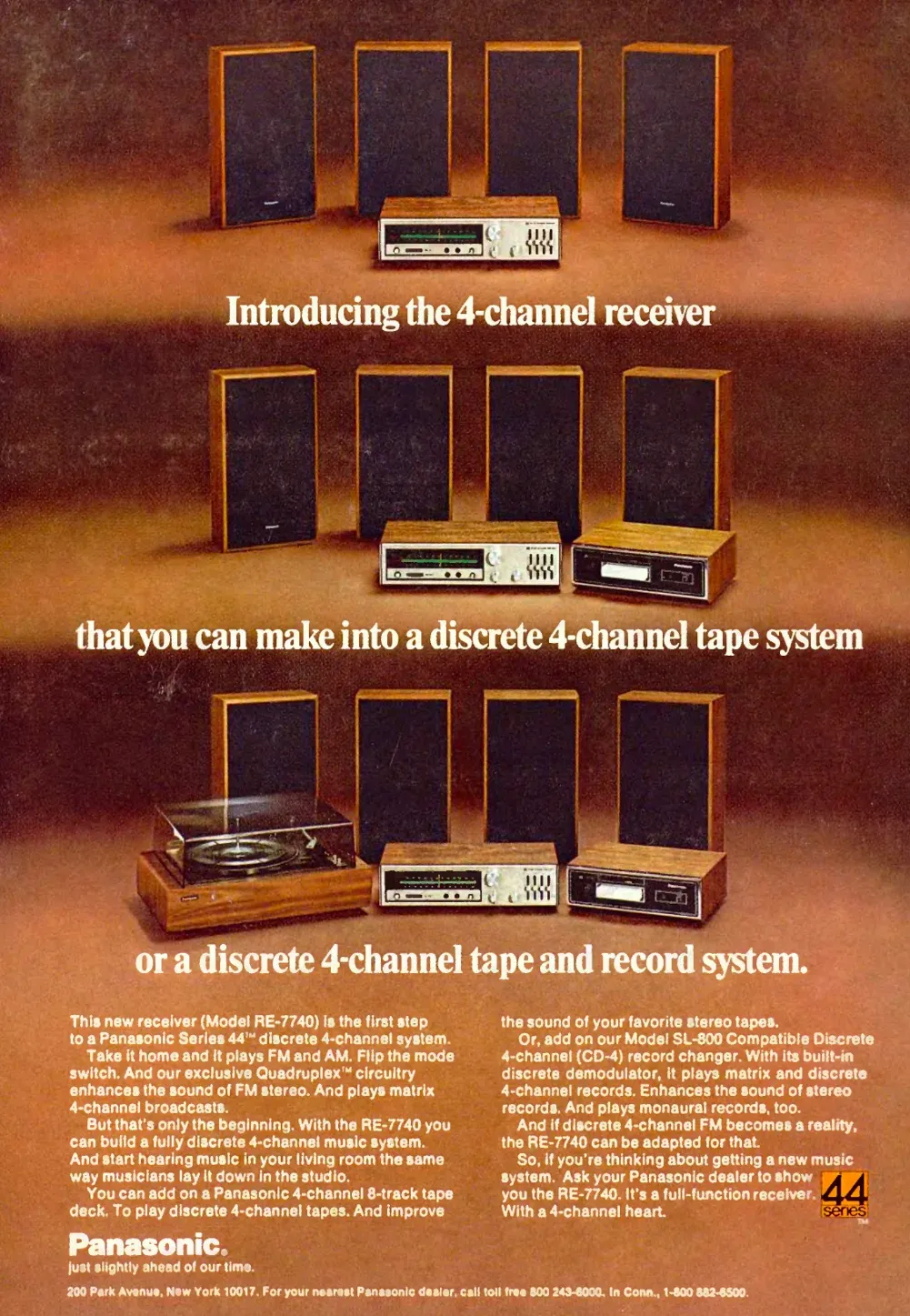
Introducing the 4-channel receiver
FROM THE PRINTED PAGEOriginal ad copy
OCR transcription from the archived page. Scanning and reading-order errors may remain.
Introducing the 4-channel receiver that you can make into a discrete 4-channel tape system or a discrete 4-channel tape and record system. This new receiver (Model RE-7740) is the first step to a Panasonic Series 44™ discrete 4-channel system. Take it home and it plays FM and AM. Flip the mode switch. And our exclusive Quadruplex™ circuitry enhances the sound of FM stereo. And plays matrix 4-channel broadcasts. But that's only the beginning. With the RE-7740 you can build a fully discrete 4-channel music system. And start hearing music in your living room the same way musicians lay it down in the studio. You can add on a Panasonic 4-channel 8-track tape deck. To play discrete 4-channel tapes. And improve the sound of your favorite stereo tapes. Or, add on our Model SL-800 Compatible Discrete 4-channel (CD-4) record changer. With its built-in discrete demodulator, it plays matrix and discrete 4-channel records. Enhances the sound of stereo records. And plays monaural records, too. And if discrete 4-channel FM becomes a reality, the RE-7740 can be adapted for that. So, if you're thinking about getting a new music system. Ask your Panasonic dealer to show you the RE-7740. It's a full-function receiver. With a 4-channel heart. Panasonic. just slightly ahead of our time. 200 Park Avenue, New York 10017. For your nearest Panasonic dealer, call toll free 800 243-6000. In Conn., 1-800 882-8500.
Commentary
At first I thought I was looking at the same hi-fi system three times. Then the additions became visible. Four speakers and a receiver occupy the first scene; an 8-track deck joins them in the second; a turntable arrives in the third. The three photographs are a buying sequence, and the headline is deliberately spread across them. It can only be finished by following the equipment down the page.
That structure solves a complicated sales problem. Panasonic wants the reader to commit to an RE-7740 receiver now, while imagining a larger four-channel system later. The copy begins with everyday FM and AM, then moves through enhanced stereo, matrix broadcasts, discrete tapes and CD-4 records. It even allows for a future in which discrete four-channel FM “becomes a reality.” Each capability comes with a different level of certainty. The ad’s own future tense is a useful reminder that “ahead of our time” is partly an aspiration; it does not prove that every proposed format became standard.
The composition gives a technical category a domestic shape. The four speakers remain in place while the source components accumulate below them. Wood-grain cabinets and a warm brown background make the system look like furniture as well as electronics. The small print does the work of a salesperson, naming the deck and SL-800 changer, while the dealer phone numbers at the bottom tell the reader how to turn curiosity into an in-person demonstration.
For a young copywriter, the repeated phrase “you can make into” is the key. It makes a receiver sound like a beginning, not an incomplete purchase. The headline’s three clauses are placed between the three photographs, so the sentence itself grows with the system. Short fragments in the body—“Flip the mode switch,” “Or, add on”—make a dense format explanation feel like manageable steps. When selling something expandable, let the language reveal one useful stage at a time.
Panasonic’s history traces the business to Konosuke Matsushita in 1918. It remains an electronics group; the current Panasonic Corporation includes consumer electronics and audio-video products among its businesses.
The underlying promise, a system that can grow with its owner, still makes sense. The 8-track deck, CD-4 records and uncertain four-channel broadcast future locate this precise path in 1973. The ad’s transferable idea is its patient staging of an upgrade, with each visible addition giving the next claim a place to land.