Automotive 1976
Kawasaki
Only $995?
FROM THE PRINTED PAGEOriginal ad copy
OCR transcription from the archived page. Scanning and reading-order errors may remain.
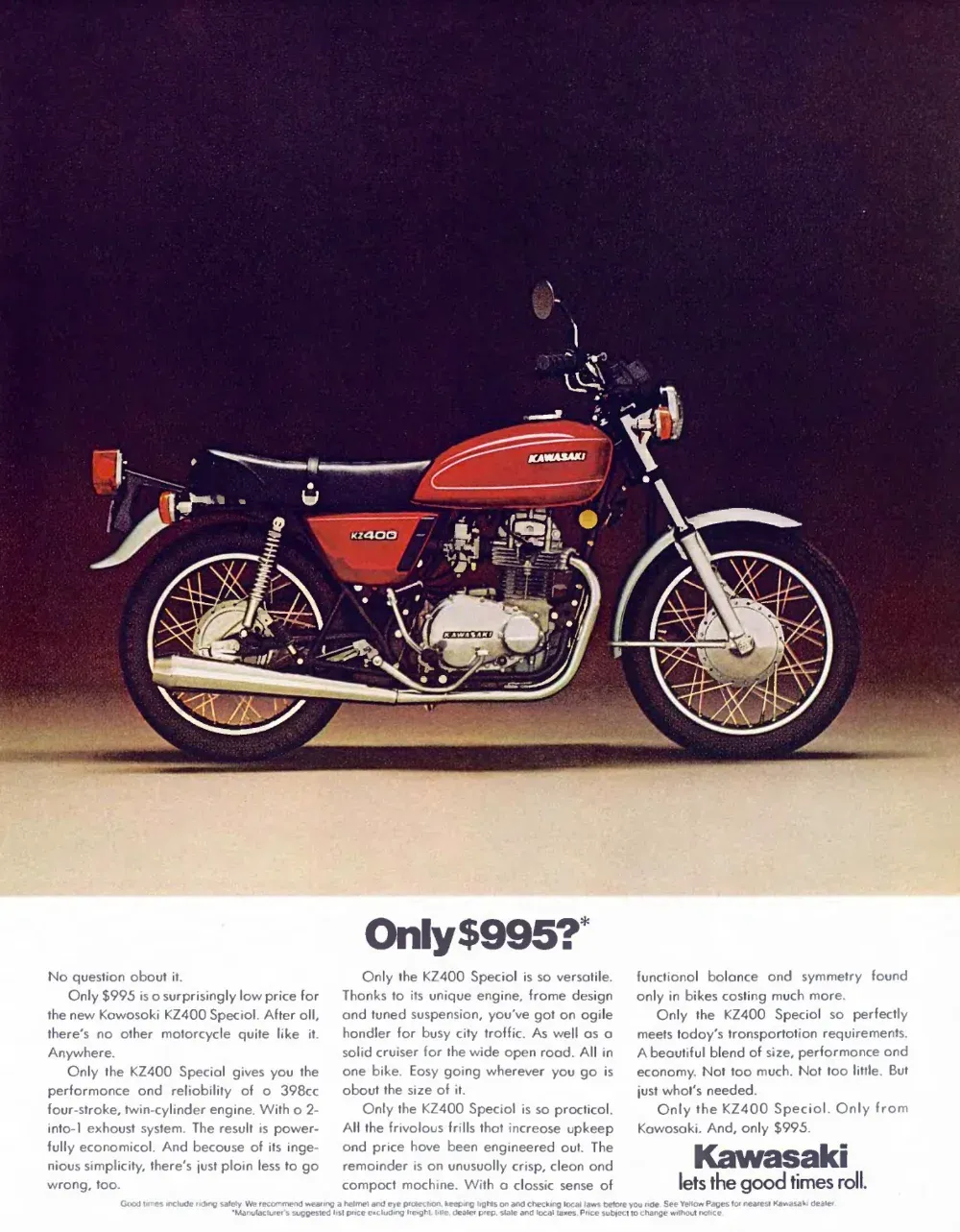
Only $995?* No question about it. Only $995 is a surprisingly low price for the new Kawasaki KZ400 Special. After all, there's no other motorcycle quite like it. Anywhere. Only the KZ400 Special gives you the performance and reliability of a 398cc four-stroke, twin-cylinder engine. With a 2-into-1 exhaust system. The result is powerfully economical. And because of its ingenious simplicity, there's just plain less to go wrong, too. Only the KZ400 Special is so versatile. Thanks to its unique engine, frame design and tuned suspension, you've got an agile handler for busy city traffic. As well as a solid cruiser for the wide open road. All in one bike. Easy going wherever you go is about the size of it. Only the KZ400 Special is so practical. All the frivolous frills that increase upkeep and price have been engineered out. The remainder is an unusually crisp, clean and compact machine. With a classic sense of functional balance and symmetry found only in bikes costing much more. Only the KZ400 Special so perfectly meets today's transportation requirements. A beautiful blend of size, performance and economy. Not too much. Not too little. But just what's needed. Only the KZ400 Special. Only from Kawasaki. And, only $995. Kawasaki lets the good times roll. Good times include riding safely. We recommend wearing a helmet and eye protection, keeping lights on and checking local laws before you ride. See Yellow Pages for nearest Kawasaki dealer. *Manufacturer's suggested list price excluding freight, title, dealer prep, state and local taxes. Price subject to change without notice.
Commentary
The first thing I notice is how much empty darkness Kawasaki gives the motorcycle. The red KZ400 Special sits in exact profile, its tank, engine, wheels and long exhaust legible as separate pieces. There is no rider and no promised destination. The photograph asks the buyer to consider the machine itself, then the headline turns that inspection into a question: “Only $995?” The asterisk quietly warns that the number has conditions attached.
Below the photograph, the copy answers with a chain of practical reasons. A 398cc four-stroke twin and 2-into-1 exhaust are offered as sources of performance and reliability. City agility and open-road cruising are assigned to the same bike. The argument then narrows from what it has to what it lacks: “frivolous frills” have supposedly been engineered out to lower upkeep and price. I read that as a way to make restraint feel designed, rather than merely inexpensive. The safety line and the suggested-price exclusions at the very bottom place limits on the carefree mood of “lets the good times roll.”
The page also exposes a particular purchasing route. The nearest dealer is found in the Yellow Pages; the ad supplies no address or photograph of a showroom. The buyer is meant to carry the remembered model and price into a local search. Today product comparisons and dealer inventories are usually available immediately online, but the need behind the pitch remains recognizable: a bike that can handle routine travel without feeling like a compromise.
For a beginning copywriter, count the “Only”s. The first suggests disbelief at the price; later uses claim that this model alone combines the advertised qualities. Short fragments—“All in one bike,” “Not too much. Not too little”—give the dense technical copy a speaking rhythm. Repetition works here because each return adds a new reason for the same word. It would be weaker if it merely restated the price.
Kawasaki’s U.S. history traces its American motorcycle business to 1966; the company’s own timeline records U.S. KZ-series production beginning in 1975. Kawasaki Motors still sells motorcycles and other powersports vehicles.
The durable position is useful performance at an attainable price. This ad’s exact $995 offer, its excluded charges and its Yellow Pages instruction belong to a particular sales moment; the careful balance of economy, capability and mechanical simplicity remains the idea worth studying.