Electronics 1992
Motorola
Recent Studies Reveal 25 MHz Is Now Faster Than 50 MHz.
FROM THE PRINTED PAGEOriginal ad copy
OCR transcription from the archived page. Scanning and reading-order errors may remain.
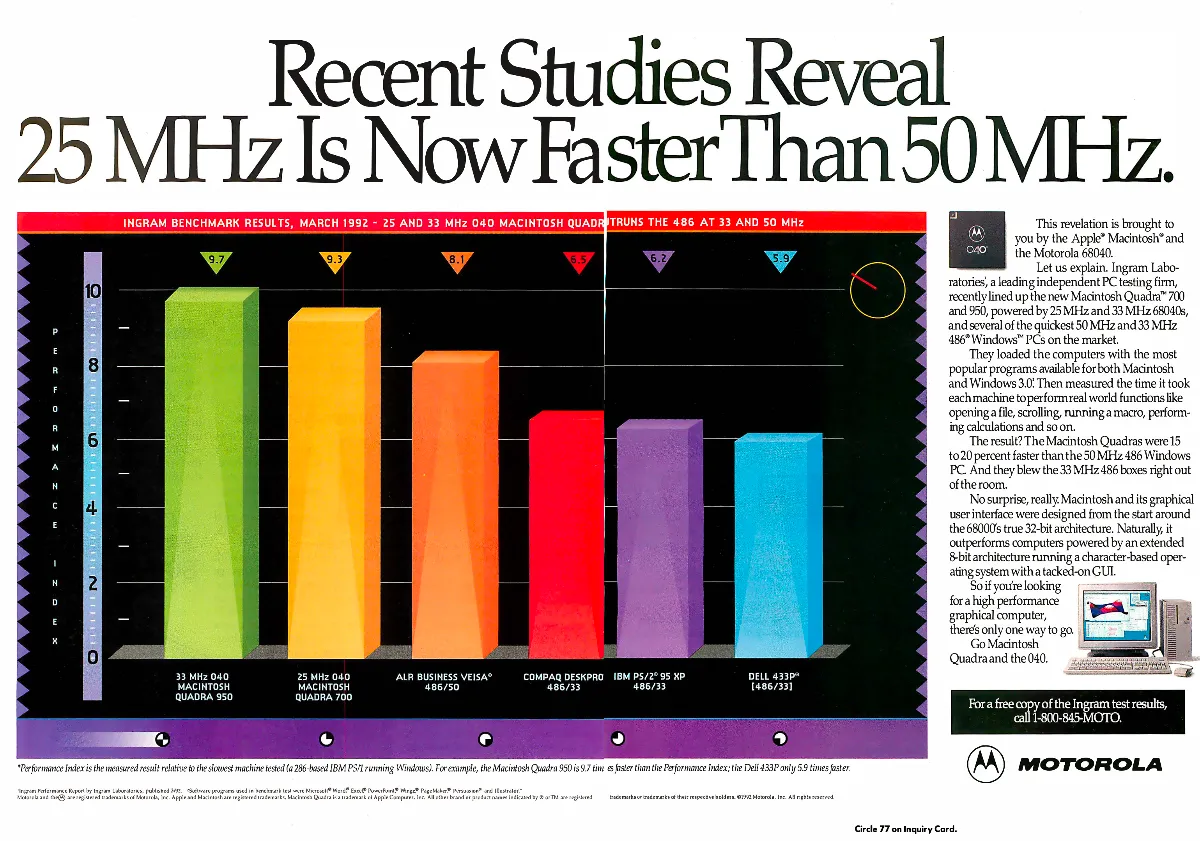
Recent Studies Reveal 25 MHz Is Now Faster Than 50 MHz. INGRAM BENCHMARK RESULTS, MARCH 1992 — 25 AND 33 MHz 040 MACINTOSH QUADRA OUTRUNS THE 486 AT 33 AND 50 MHz PERFORMANCE INDEX* 33 MHz 040 MACINTOSH QUADRA 950: 9.7 25 MHz 040 MACINTOSH QUADRA 700: 9.3 ALR BUSINESS VEISA® 486/50: 8.1 COMPAQ DESKPRO 486/33: 6.5 IBM PS/2® 95 XP 486/33: 6.2 DELL 433P® [486/33]: 5.9 This revelation is brought to you by the Apple® Macintosh® and the Motorola 68040. Let us explain. Ingram Laboratories,¹ a leading independent PC testing firm, recently lined up the new Macintosh Quadra™ 700 and 950, powered by 25 MHz and 33 MHz 68040s, and several of the quickest 50 MHz and 33 MHz 486® Windows™ PCs on the market. They loaded the computers with the most popular programs available for both Macintosh and Windows 3.0.² Then measured the time it took each machine to perform real world functions like opening a file, scrolling, running a macro, performing calculations and so on. The result? The Macintosh Quadras were 15 to 20 percent faster than the 50 MHz 486 Windows PC. And they blew the 33 MHz 486 boxes right out of the room. No surprise, really. Macintosh and its graphical user interface were designed from the start around the 68000's true 32-bit architecture. Naturally, it outperforms computers powered by an extended 8-bit architecture running a character-based operating system with a tacked-on GUI. So if you're looking for a high performance graphical computer, there's only one way to go. Go Macintosh Quadra and the 040. For a free copy of the Ingram test results, call 1-800-845-MOTO. MOTOROLA *Performance Index is the measured result relative to the slowest machine tested (a 286-based IBM PS/1 running Windows). For example, the Macintosh Quadra 950 is 9.7 times faster than the Performance Index; the Dell 433P only 5.9 times faster. ¹Ingram Performance Report by Ingram Laboratories, published 3/92. ²Software programs used in benchmark test were Microsoft® Excel, Claris® [illegible], PageMaker® [illegible] and Illustrator.® [illegible trademark fine print] Circle 77 on Inquiry Card.
Commentary
I read the headline twice because its arithmetic is designed to look wrong. Motorola asks a reader accustomed to shopping by megahertz to accept that 25 can beat 50. Below, six colored towers turn that provocation into a ranking. The component advertiser is borrowing the whole Macintosh Quadra as its demonstration vehicle; Apple receives the product recommendation, Motorola receives credit for what is inside.
The important clue is the chart’s label: performance index. Its numbers are relative to a slower reference machine, not clock frequencies. The copy describes opening files, scrolling, macros and calculations, and dates the Ingram results to March 1992. That scope matters. This is a claim about particular machines, applications and tests, not a proof that every 25 MHz computer beats every 50 MHz computer. Even the small footnote is part of the persuasion: it supplies a denominator for the spectacular colored bars.
Then the argument changes register. The measured comparison becomes a story about a “true” architecture and a “tacked-on GUI.” I take those words as Motorola’s competitive characterization, not a neutral technical history. They invite the reader to see Macintosh performance as the natural result of coherent design. The chart attracts the specification shopper; the prose offers that shopper a more flattering way to choose.
The free test report required a telephone call. That detail makes the magazine page a starting point for investigation rather than a complete evidence pack. A present-day buyer might expect a benchmark link and downloadable methods immediately beside the claim. Here the gap between seeing the graph and obtaining its supporting report is part of the sales process.
For a new copywriter, “Recent Studies Reveal” lends an institutional voice to an aggressively simple numerical reversal. “Let us explain” acknowledges the confusion the headline deliberately creates. The practical lesson is to resolve your provocation with specific evidence. Notice also how “blew … out of the room” shifts from laboratory tone to competitive swagger; it dramatizes a result without adding another number.
Motorola’s semiconductor operation later became Freescale in 2004; NXP’s corporate timeline traces that lineage and its 2015 merger with Freescale. NXP now makes semiconductors for automotive, industrial and connected-device applications.
The enduring idea is to judge useful work rather than one specification. These Quadras and 486 PCs belong to a particular test in 1992, while the tension between a convenient shopping number and actual experience remains useful territory for component advertising.