Electronics 1992
Intel
Look what’s at the heart of all the best notebooks.
FROM THE PRINTED PAGEOriginal ad copy
OCR transcription from the archived page. Scanning and reading-order errors may remain.
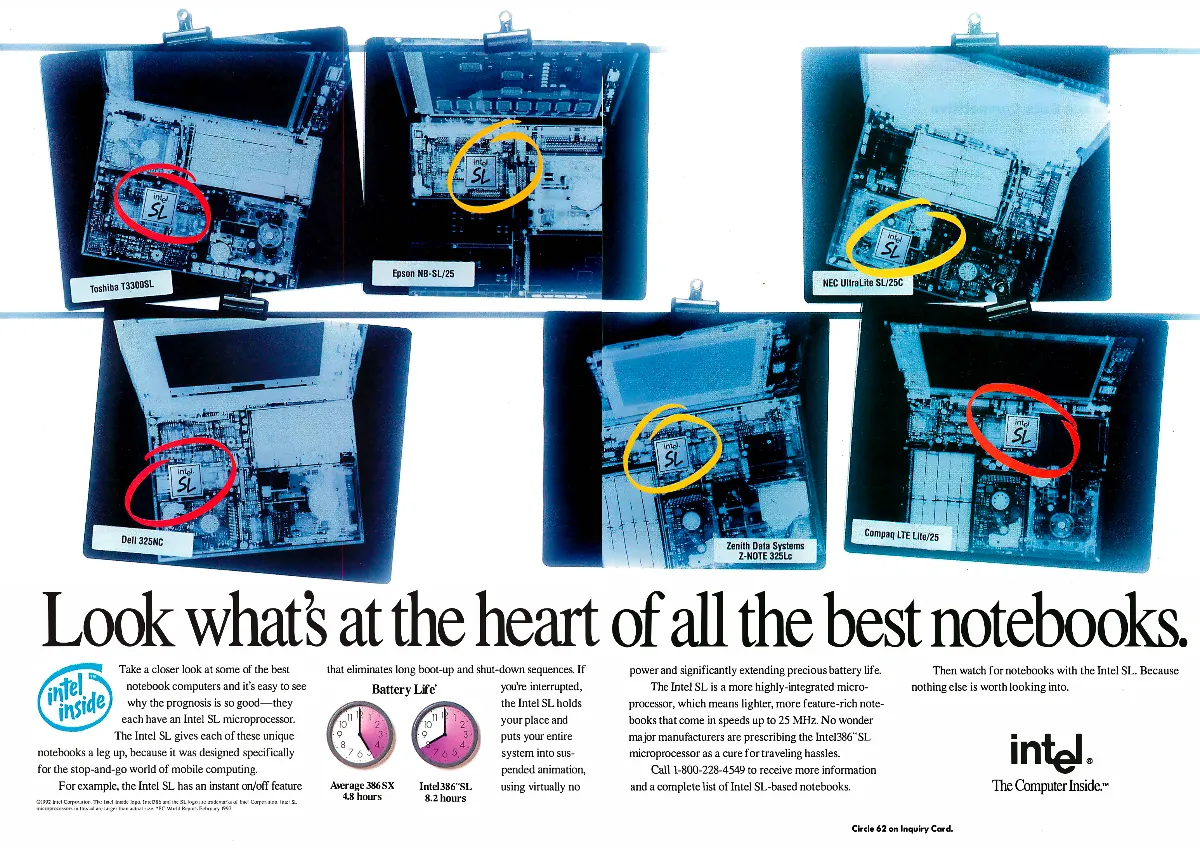
Look what's at the heart of all the best notebooks. Toshiba T3300SL Epson NB-SL/25 NEC UltraLite SL/25C Dell 325NC Zenith Data Systems Z-NOTE 325Lc Compaq LTE Lite/25 intel SL intel inside Take a closer look at some of the best notebook computers and it's easy to see why the prognosis is so good—they each have an Intel SL microprocessor. The Intel SL gives each of these unique notebooks a leg up, because it was designed specifically for the stop-and-go world of mobile computing. For example, the Intel SL has an instant on/off feature that eliminates long boot-up and shut-down sequences. If you're interrupted, the Intel SL holds your place and puts your entire system into suspended animation, using virtually no power and significantly extending precious battery life. Battery Life† Average 386 SX: 4.8 hours Intel386™SL: 8.2 hours The Intel SL is a more highly-integrated microprocessor, which means lighter, more feature-rich notebooks that come in speeds up to 25 MHz. No wonder major manufacturers are prescribing the Intel386™SL microprocessor as a cure for traveling hassles. Call 1-800-228-4549 to receive more information and a complete list of Intel SL-based notebooks. Then watch for notebooks with the Intel SL. Because nothing else is worth looking into. intel® The Computer Inside.™ ©1992 Intel Corporation. The Intel Inside logo, Intel386 and the SL logo are trademarks of Intel Corporation. [illegible battery-test footnote and remaining fine print] Circle 62 on Inquiry Card.
Commentary
I found myself following the colored circles as if someone had marked up a set of medical films. Six notebooks hang from clips, their blue interiors exposed. Toshiba, Epson, NEC, Dell, Zenith and Compaq remain identifiable, but each case has become a frame around the same Intel component. The advertiser makes the invisible part legible before asking the reader to remember its name.
The medical language is sustained unusually far. “Heart” leads to “prognosis,” then manufacturers are “prescribing” the processor as a “cure.” Inside that conceit sits a practical account of travel: interruptions, long start-up sequences, the need to keep one’s place. Two small clocks translate the engineering into 4.8 and 8.2 hours. Those figures are the ad’s battery-life comparison; the scan’s tiny test qualification is not fully readable, so they should not be detached from the historical claim and treated as a universal specification.
What interested me most was “stop-and-go.” The mobile worker imagined here does not simply need a smaller computer. They need work to survive repeated pauses. Sleep and resume now feel like routine expectations, which makes the explicit explanation of suspended animation revealing. The ad sells continuity of attention as much as time away from a socket. Its many manufacturers also give the reader permission to retain a preferred brand while adopting Intel’s proposed buying rule.
For a young copywriter, this is a useful example of keeping a metaphor productive. “Heart” alone would be a familiar cliché; the X-rays and later medical verbs give it a working system. The closing “worth looking into” returns to the act of seeing inside. Build supporting language from the same image, but keep attaching it to a benefit: here the metaphor repeatedly returns to portable computing and battery endurance.
Intel began in 1968 and developed from a memory-chip business into a microprocessor supplier; its historical annual report describes that transition. Its current processor range includes Core and Core Ultra for personal computers and Xeon for servers and workstations.
Making a component matter to the person choosing the finished machine remains relevant. The 25 MHz ceiling and these six notebooks are historical particulars. The more durable proposition is that what happens inside the case determines whether the owner can keep working outside the office.