Electronics 1981
Maxell
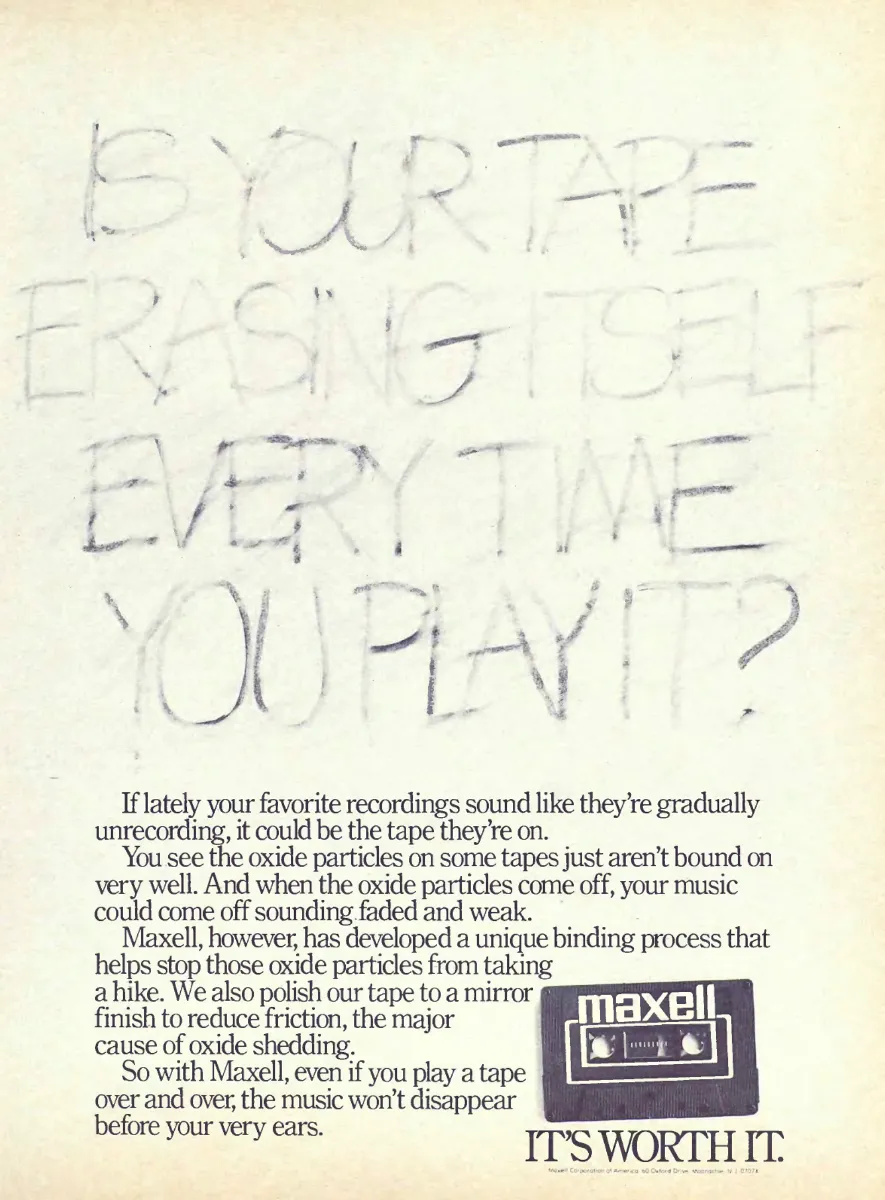
Is your tape erasing itself every time you play it?
FROM THE PRINTED PAGEOriginal ad copy
OCR transcription from the archived page. Scanning and reading-order errors may remain.
IS YOUR TAPE ERASING ITSELF EVERY TIME YOU PLAY IT? If lately your favorite recordings sound like they're gradually unrecording, it could be the tape they're on. You see the oxide particles on some tapes just aren't bound on very well. And when the oxide particles come off, your music could come off sounding faded and weak. Maxell, however, has developed a unique binding process that helps stop those oxide particles from taking a hike. We also polish our tape to a mirror finish to reduce friction, the major cause of oxide shedding. So with Maxell, even if you play a tape over and over, the music won't disappear before your very ears. maxell IT'S WORTH IT. Maxell Corporation of America [illegible] Oxford Drive, Moonachie, N.J. 07074
Commentary
I had to work to read the headline, which is precisely its argument. The lettering looks rubbed away, leaving fragments that the eye must reconstruct. Before Maxell names oxide shedding, the page has staged a small experience of losing information. The question becomes both copy and demonstration, though the demonstration is a graphic analogy rather than a test of any particular tape.
The body starts with a cautious diagnosis: if favourite recordings seem to be “unrecording,” the tape could be responsible. “Could” matters. Maxell does not establish that every deterioration has the same cause. It then offers a simple chain of explanation—particles loosen, music sounds weak, better binding and reduced friction are the proposed remedies. The composition keeps the technical argument below the visual symptom, so the reader has a reason to care before being asked to understand the process.
I noticed that the pictured cassette carries no elaborate model comparison. The large Maxell mark and “IT’S WORTH IT” close an argument about the cost of losing something already valued. The recording, rather than the blank tape’s ticket price, is the asset at risk. That is a sharper justification for paying attention to a consumable than announcing that its materials are impressive in isolation. The binding and polishing claims remain the advertiser’s explanation, not measurements supplied by this page.
Repeated play is assumed to be both normal and potentially wearing. A digital copy does not shed oxide through playback, although access and preservation bring other vulnerabilities. This comparison makes the old anxiety specific: enjoyment itself might damage the thing being enjoyed. Maxell makes continued listening the reason to buy a medium that promises to endure it.
For beginning copywriters, “unrecording” invents a compact reversal of the task the product is supposed to perform. “Taking a hike” makes departing particles conversational, while “before your very ears” alters an expression associated with seeing a disappearance. Each phrase translates the same technical failure into something easy to picture. The lesson is consistency: the headline, explanation and final turn of phrase should develop one idea rather than compete with it.
Maxell’s corporate history traces its dry-battery and magnetic-tape origins and records its cassette products in the 1960s. Its current U.S. site includes batteries and audio products, and still lists cassette tapes among its physical media.
The historical process claims should stay attached to the tape sold here. The wider proposition survives: reliability becomes meaningful when the advertiser identifies what the customer would lose. This unusually faint headline makes preservation feel worth buying before the product makes its case in ordinary, readable ink.