Consumer Goods 1967
Jim Beam
Thumbprints.
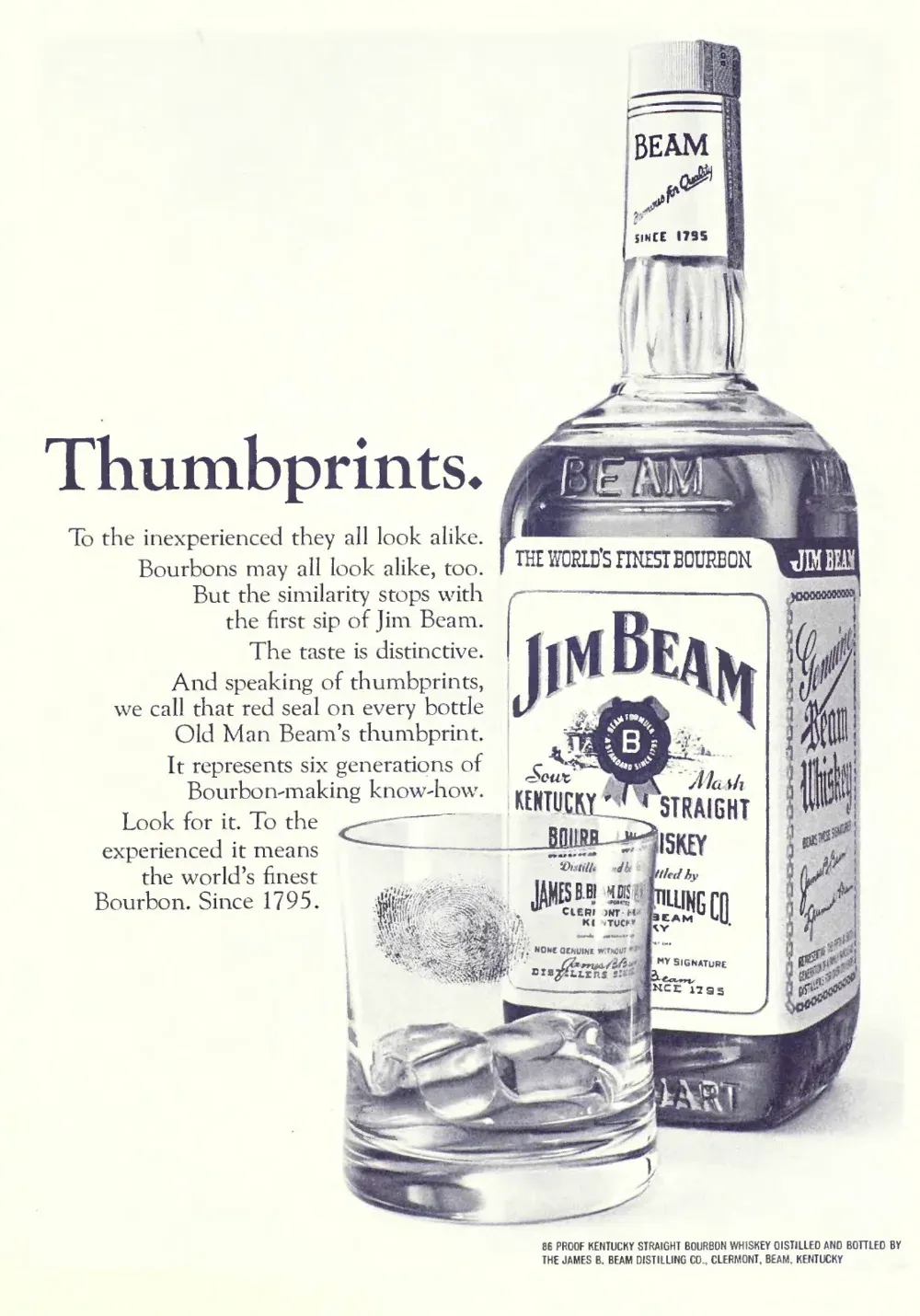
FROM THE PRINTED PAGEOriginal ad copy
OCR transcription from the archived page. Scanning and reading-order errors may remain.
Thumbprints. To the inexperienced they all look alike. Bourbons may all look alike, too. But the similarity stops with the first sip of Jim Beam. The taste is distinctive. And speaking of thumbprints, we call that red seal on every bottle Old Man Beam's thumbprint. It represents six generations of Bourbon-making know-how. Look for it. To the experienced it means the world's finest Bourbon. Since 1795. BEAM Famous for Quality SINCE 1795 THE WORLD'S FINEST BOURBON JIM BEAM Sour Mash KENTUCKY STRAIGHT BOURBON WHISKEY JAMES B. BEAM DISTILLING CO. CLERMONT, BEAM, KENTUCKY [illegible] 86 PROOF KENTUCKY STRAIGHT BOURBON WHISKEY DISTILLED AND BOTTLED BY THE JAMES B. BEAM DISTILLING CO., CLERMONT, BEAM, KENTUCKY
Commentary
The fingerprint catches my eye after the bottle does. It sits on the tumbler in front, a literal mark left by a hand, while the bottle rises behind it like evidence placed on a table. The headline offers only one word: “Thumbprints.” Nothing in the picture asks me to imagine a particular party or drinker. The white field, the ice, the glass, and the oversized label leave room for one question: what makes this bourbon identifiable?
The copy starts with a concession. To an inexperienced eye, fingerprints look alike; so might bourbons. It moves the test from sight to taste, then gives the bottle’s red seal a second role as “Old Man Beam’s thumbprint.” In the monochrome scan I can see a seal but cannot verify its advertised color. The printed claim of “six generations” and “Since 1795” turns that small graphic into a family credential. The ad asks the reader to believe that difference has been passed down, marked, and can be found again on the shelf. The seal is a navigation device as well as a symbol.
There is a useful tension in that argument. “The taste is distinctive” is a sensory claim that the page itself cannot demonstrate. The giant bottle can, however, make its name, shape, and label unmistakable. It offers recognition before consumption and promises recognition afterward. Present-day shoppers can compare tasting notes and reviews in seconds, but this ad puts the burden on a single first sip and an inherited mark. That makes the pack itself the bridge between assertion and experience.
For a new copywriter, notice how “look alike” is repeated before the sentence turns to “the first sip.” The copy sets up an easy visual objection, then changes the sense used to judge the product. “Thumbprints” works because the word appears in the headline, on the glass, and again in the explanation of the seal. Repetition here does more than decorate a page: it gives the reader a way to remember what to look for when the ad is gone.
Suntory Global Spirits’ history traces the bourbon to Jacob Beam’s first whiskey in 1795. Jim Beam remains in its current spirits portfolio, which now describes seven generations of family craft; the six in this 1967 scan is a record of what the advertiser said then.
The appeal of a recognizable bottle and a repeatable taste still carries through. The old ad’s proof rests almost entirely on lineage and the buyer’s palate; today the same claim meets a far wider field of published product information and competing reviews.