Automotive 1967
Ducati
Ride the thoroughbred
FROM THE PRINTED PAGEOriginal ad copy
OCR transcription from the archived page. Scanning and reading-order errors may remain.
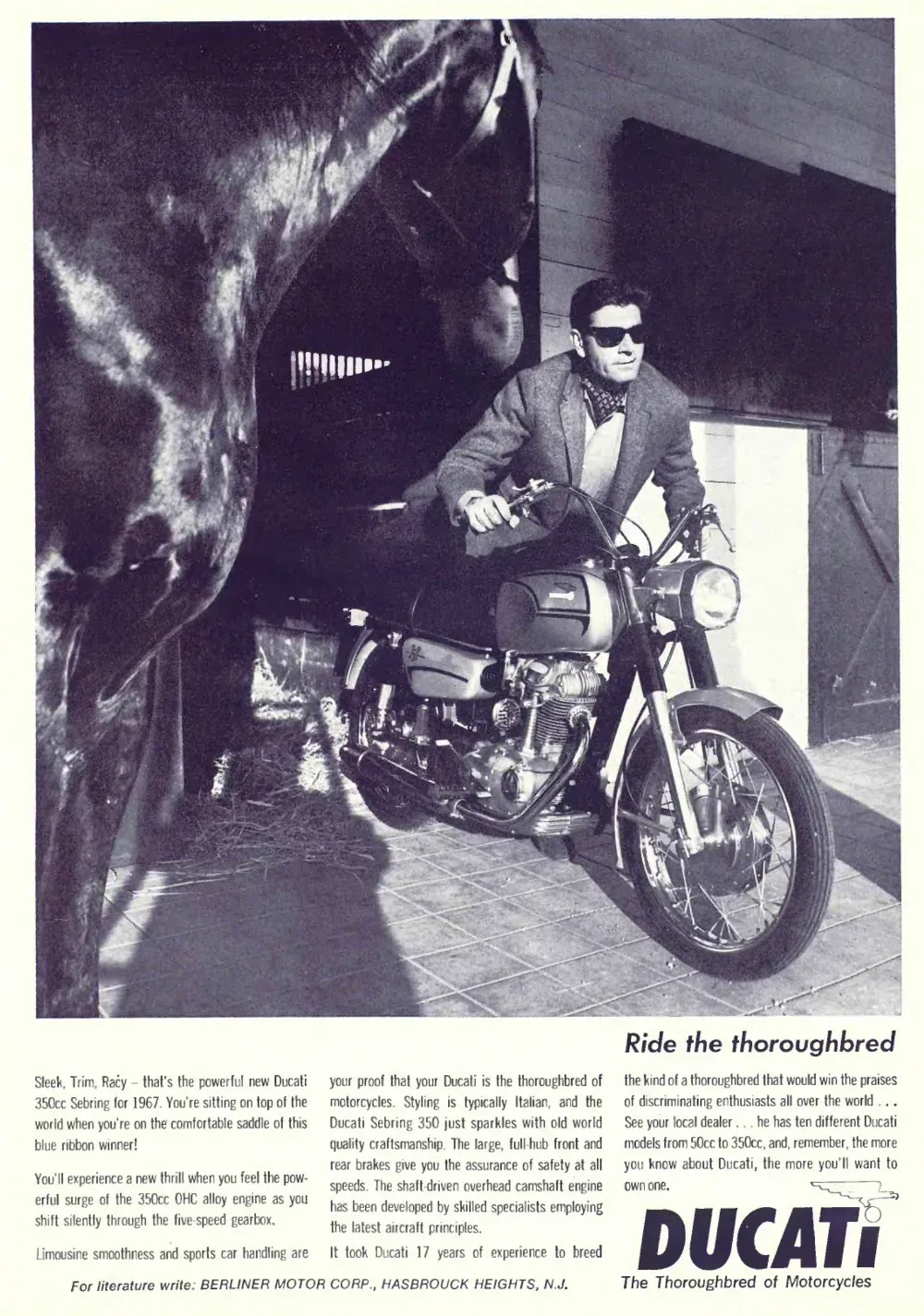
Ride the thoroughbred Sleek, Trim, Racy – that's the powerful new Ducati 350cc Sebring for 1967. You're sitting on top of the world when you're on the comfortable saddle of this blue ribbon winner! You'll experience a new thrill when you feel the powerful surge of the 350cc OHC alloy engine as you shift silently through the five-speed gearbox. Limousine smoothness and sports car handling are your proof that your Ducati is the thoroughbred of motorcycles. Styling is typically Italian, and the Ducati Sebring 350 just sparkles with old world quality craftsmanship. The large, full-hub front and rear brakes give you the assurance of safety at all speeds. The shaft-driven overhead camshaft engine has been developed by skilled specialists employing the latest aircraft principles. It took Ducati 17 years of experience to breed the kind of a thoroughbred that would win the praises of discriminating enthusiasts all over the world . . . See your local dealer . . . he has ten different Ducati models from 50cc to 350cc, and, remember, the more you know about Ducati, the more you'll want to own one. DUCATI The Thoroughbred of Motorcycles For literature write: BERLINER MOTOR CORP., HASBROUCK HEIGHTS, N.J.
Commentary
I first look at the horse. Its dark body takes up nearly half the photograph, leaving the rider and his Ducati to emerge from the stable beside it. The motorcycle’s front wheel points out toward the reader; the rider, in sunglasses and a scarf, appears ready to follow. The picture makes “thoroughbred” a visible comparison before the headline states it. A small horse drawing above the Ducati wordmark repeats the point after the photograph has done the heavy lifting.
The copy then asks the motorcycle to deserve the metaphor. Its opening three adjectives—“Sleek, Trim, Racy”—belong equally to horse and machine. Below them come the mechanical details: a 350cc OHC alloy engine, five-speed gearbox, full-hub brakes, and shaft-driven overhead camshaft. The pitch borrows from other kinds of travel too, promising “limousine smoothness” and “sports car handling.” I read that combination as an attempt to make the Sebring seem both exciting and civilized. The claims are the advertiser’s; the scan does not verify how the motorcycle rode.
The ad also shows how the sale was meant to continue. “See your local dealer” offers ten Ducati models, and the small line at the bottom sends anyone wanting literature to Berliner Motor Corp. in New Jersey. The photograph supplies desire, the specifications supply reasons, and the dealer or mailed literature supplies the next encounter. Today a buyer could investigate the same question through specifications, owner reports, and riding videos before reaching a showroom. The old page gives the reader a horse and a promise, then points outward for more evidence.
For a beginning copywriter, the lesson is to make the governing image carry several words at once. “Thoroughbred,” “blue ribbon winner,” and “breed” keep the horse in the language without explaining the photograph. The three short opening adjectives quicken the pace; the longer engineering sentences slow it down and try to make the excitement credible. A metaphor works hardest when the factual copy can return the reader to the product.
Ducati’s company history dates its founding to 1926 and describes its present motorcycle business in Bologna, where design and engineering remain central to the brand. Its heritage archive traces the marque’s long progression through motorcycles and racing.
The 1967 ad’s link between performance, Italian styling, and engineering still sounds like Ducati. What has changed is the sales route and the proof available to a prospective rider: a postal address and a dealer’s literature no longer have to carry the whole burden of explanation.