Consumer Goods 1981
Jack Daniel's
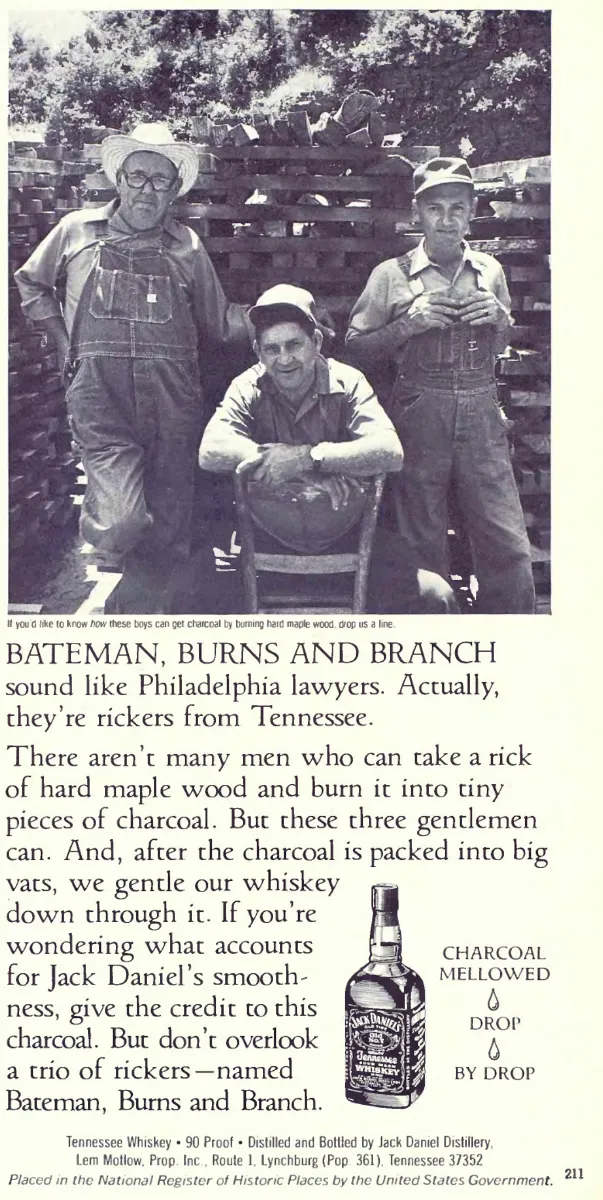
Bateman, Burns and Branch sound like Philadelphia lawyers. Actually, they’re rickers from Tennessee.
FROM THE PRINTED PAGEOriginal ad copy
OCR transcription from the archived page. Scanning and reading-order errors may remain.
If you'd like to know how these boys can get charcoal by burning hard maple wood, drop us a line. BATEMAN, BURNS AND BRANCH sound like Philadelphia lawyers. Actually, they're rickers from Tennessee. There aren't many men who can take a rick of hard maple wood and burn it into tiny pieces of charcoal. But these three gentlemen can. And, after the charcoal is packed into big vats, we gentle our whiskey down through it. If you're wondering what accounts for Jack Daniel's smoothness, give the credit to this charcoal. But don't overlook a trio of rickers—named Bateman, Burns and Branch. JACK DANIEL'S OLD No. 7 BRAND TENNESSEE SOUR MASH WHISKEY [illegible] CHARCOAL MELLOWED DROP BY DROP Tennessee Whiskey • 90 Proof • Distilled and Bottled by Jack Daniel Distillery, Lem Motlow, Prop. Inc., Route 1, Lynchburg (Pop. 361), Tennessee 37352 Placed in the National Register of Historic Places by the United States Government. 211
Commentary
I read the names before learning the occupation. Bateman, Burns and Branch has the rhythm of a professional partnership, and the headline briefly invites a picture of lawyers before the photograph supplies three men in overalls. The joke is affectionate, but it also distributes prestige: the workers are called “gentlemen,” and a difficult piece of practical knowledge takes the place of a legal qualification.
The stack behind them is the first piece of product evidence. Hard maple is made into charcoal, charcoal fills vats, whiskey passes through it, and the resulting smoothness is the advertised benefit. That sequence gives the portrait a job beyond local colour. The men stand at the beginning of a process whose final result cannot be photographed. The small bottle has to inherit the authority of the work shown above it.
I was struck by the instruction about giving credit. The copy first directs it toward the charcoal, then corrects any temptation to stop there: do not overlook the rickers. That second movement makes labour the differentiator. There are no tasting scores or comparative measurements on the page. Instead, named people and a concrete account of making something are offered as reasons to trust an otherwise abstract description of smoothness.
The little invitation to “drop us a line” reveals another pace of brand contact. Curiosity about charcoal could become a posted inquiry to a distillery in a town whose population is printed beneath the bottle. Today such process stories are available on demand: the company’s distillery background still lists the rickyard and charcoal-mellowing vats among its tour highlights. The subject has continuity even though obtaining the explanation no longer requires a letter.
For beginning copywriters, notice the turn on “Actually.” The opening creates a plausible category, then replaces it with a more interesting one. Later, “gentle” turns a description of texture into an action performed on the whiskey, while the narrow “DROP / BY DROP” arrangement makes the process sound patient. The lesson is to let a surprising human detail lead into the product mechanism, so the anecdote earns its place in the sale.
Jack Daniel’s remains a Tennessee whiskey brand associated with Lynchburg. Its official historical account describes charcoal mellowing through hard sugar maple and says the tradition continues at the distillery; its current product account lists Black Label at 80 proof, distinct from the 90-proof offer printed here.
The named workers, population figure and strength belong to this advertisement. The enduring idea is that a process becomes easier to understand when someone is visibly responsible for it. The page sells a bottle by asking the reader to remember the people who made one of its ingredients.