Fashion & Accessories 1981
De Beers
Isn’t that an expensive engagement ring for a guy on your salary?
FROM THE PRINTED PAGEOriginal ad copy
OCR transcription from the archived page. Scanning and reading-order errors may remain.
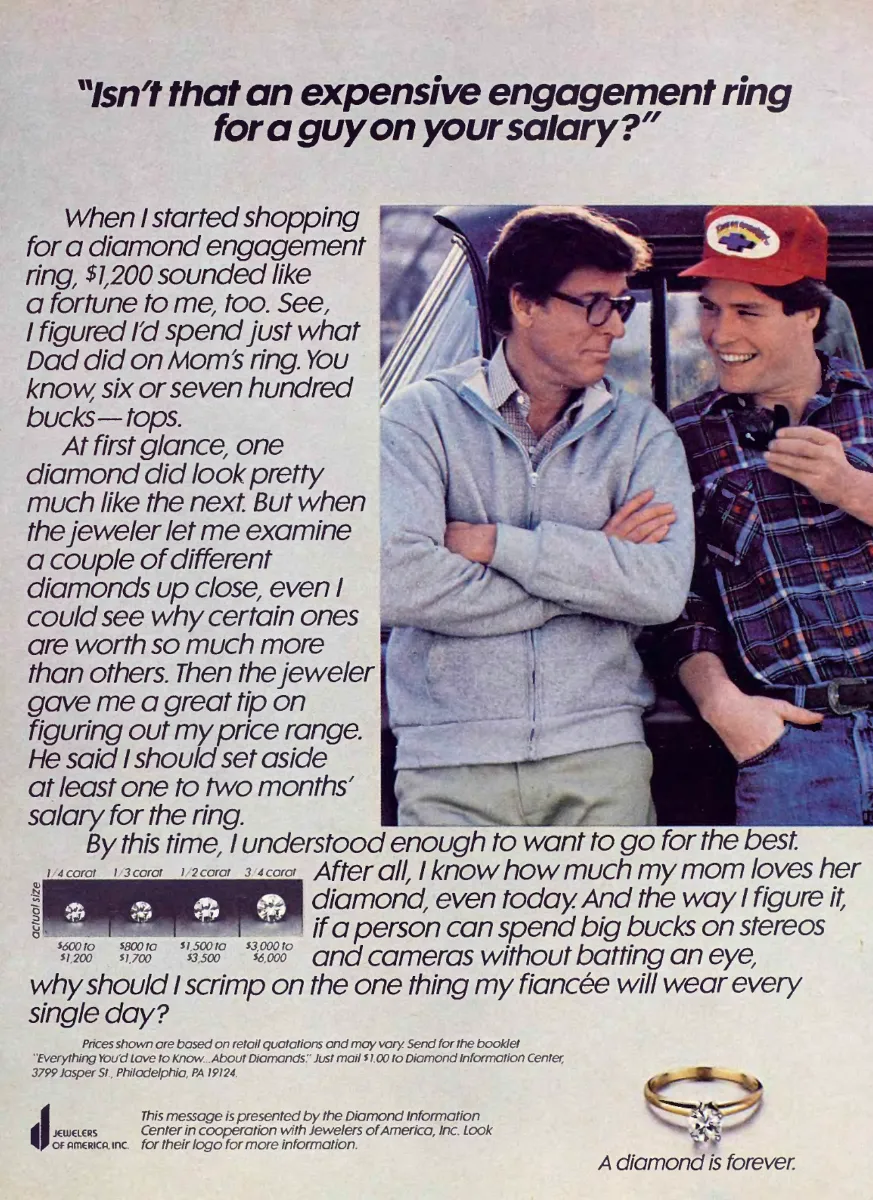
“Isn't that an expensive engagement ring for a guy on your salary?” When I started shopping for a diamond engagement ring, $1,200 sounded like a fortune to me, too. See, I figured I'd spend just what Dad did on Mom's ring. You know, six or seven hundred bucks—tops. At first glance, one diamond did look pretty much like the next. But when the jeweler let me examine a couple of different diamonds up close, even I could see why certain ones are worth so much more than others. Then the jeweler gave me a great tip on figuring out my price range. He said I should set aside at least one to two months' salary for the ring. By this time, I understood enough to want to go for the best. After all, I know how much my mom loves her diamond, even today. And the way I figure it, if a person can spend big bucks on stereos and cameras without batting an eye, why should I scrimp on the one thing my fiancée will wear every single day? actual size 1/4 carat: $600 to $1,200 1/3 carat: $800 to $1,700 1/2 carat: $1,500 to $3,500 3/4 carat: $3,000 to $6,000 Prices shown are based on retail quotations and may vary. Send for the booklet “Everything You'd Love to Know... About Diamonds.” Just mail $1.00 to Diamond Information Center, 3799 Jasper St., Philadelphia, PA 19124. JEWELERS OF AMERICA, INC. This message is presented by the Diamond Information Center in cooperation with Jewelers of America, Inc. Look for their logo for more information. A diamond is forever.
Commentary
I started with the raised hand. The man in the cap is showing a ring; his companion keeps his arms folded. Between them, the photograph makes a spending objection look like an ordinary conversation beside a vehicle. The headline provides the skeptical voice, while the long first-person answer turns the purchase into a story of having one’s mind changed.
The amounts do careful work. Six or seven hundred dollars is the inherited expectation, $1,200 the initially alarming alternative, and one to two months’ salary the jeweller’s proposed way of thinking. The salary formula replaces a fixed ceiling with a personal income measure. I read that as persuasion about the size of the purchase, not impartial budgeting guidance. The page identifies the presenter as the Diamond Information Center, cooperating with Jewelers of America; it is selling confidence in the category, rather than a ring available from one named shop.
The size chart looks educational, but its ranges are wide. A half-carat diamond runs from $1,500 to $3,500, leaving room for the story’s claim that close inspection reveals differences. The jeweller serves as guide to those differences and as the source of the spending recommendation. The buyer’s mother then supplies evidence of emotional longevity. Technical discrimination and family memory converge on the same conclusion: spend more willingly.
The comparison with stereos and cameras caught my attention. The reader is presumed to understand spending seriously on equipment; the copy redirects that permission toward a fiancée’s daily jewellery. Today the same rhetoric invites scrutiny of whose wants establish the budget. Even within this page, the woman who will wear the ring is absent from the conversation. That is a specific assumption of the scene, rather than proof of how every couple made the decision.
For young copywriters, “me, too” lowers resistance by letting the speaker admit the objection before answering it. “Bucks—tops” sounds like an informal spending limit; “scrimp” later makes restraint sound less admirable. The closing question changes the standard from affordability to generosity. The useful lesson is to trace how diction can move a reader’s judgment, and to recognize when advice is also advancing the seller’s interests.
De Beers was established in 1888, and its history dates “A diamond is forever” to 1947. The group remains involved in diamond recovery, trading, technology and jewellery. The visible sender here is the Diamond Information Center and its trade partner, rather than a De Beers retail store.
The connection between a lasting object and a lasting commitment remains central to the promise. The price ranges, mail-order booklet and gendered spending script belong to this historical execution. Its strongest lesson is how a commercial recommendation can acquire the reassuring voice of a friend recounting what he has learned.