Electronics 1969
Hitachi
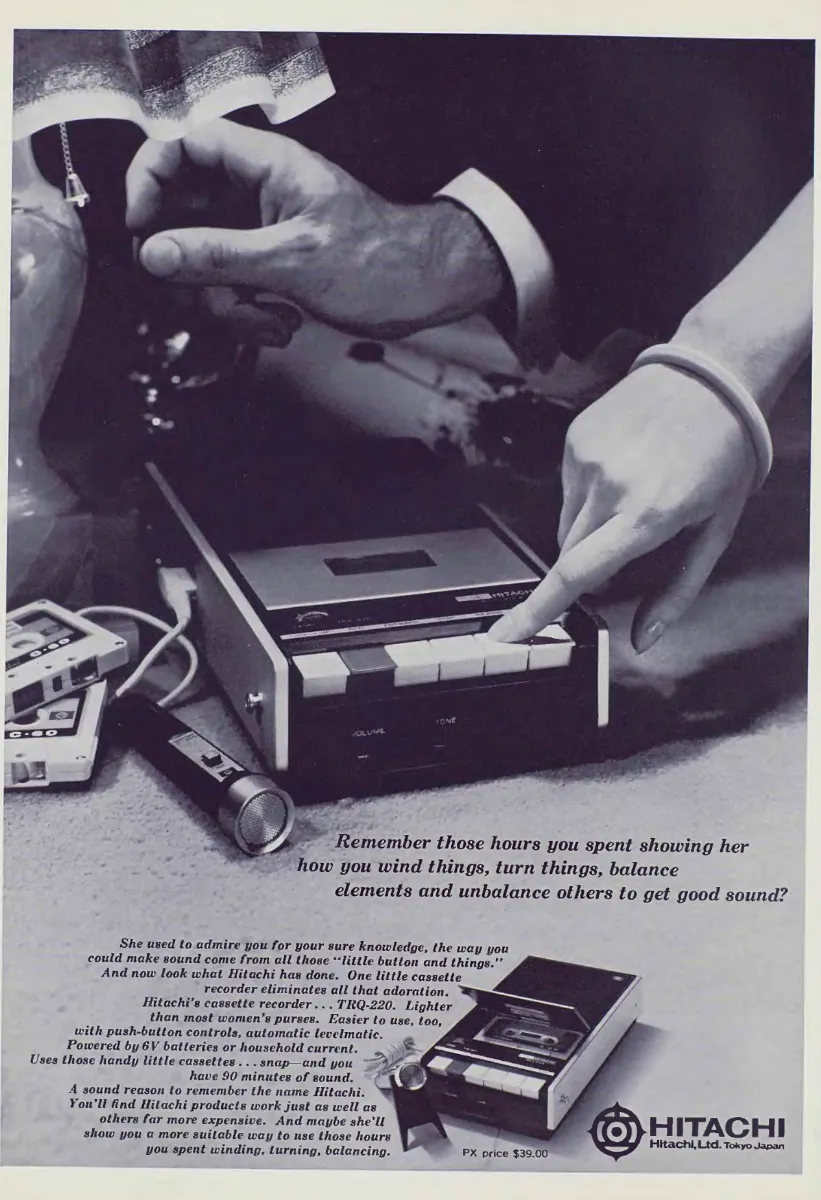
Remember those hours you spent showing her how you wind things, turn things, balance elements and unbalance others to get good sound?
FROM THE PRINTED PAGEOriginal ad copy
OCR transcription from the archived page. Scanning and reading-order errors may remain.
HITACHI VOLUME TONE C.60 Remember those hours you spent showing her how you wind things, turn things, balance elements and unbalance others to get good sound? She used to admire you for your sure knowledge, the way you could make sound come from all those “little button and things.” And now look what Hitachi has done. One little cassette recorder eliminates all that adoration. Hitachi's cassette recorder... TRQ-220. Lighter than most women's purses. Easier to use, too, with push-button controls, automatic levelmatic. Powered by 6V batteries or household current. Uses those handy little cassettes... snap—and you have 90 minutes of sound. A sound reason to remember the name Hitachi. You'll find Hitachi products work just as well as others far more expensive. And maybe she'll show you a more suitable way to use those hours you spent winding, turning, balancing. PX price $39.00 HITACHI Hitachi, Ltd. Tokyo Japan
Commentary
The decisive gesture is a fingertip on a large white key. Nearby lie a microphone and cassette cases; above them, a man’s hand reaches toward the lamp. I read the arrangement as an argument about effort. The recorder takes only a press, leaving the people in the photograph free to attend to each other.
The copy starts somewhere less flattering to the presumed male buyer: his equipment knowledge used to secure admiration. Hitachi jokingly apologizes for making him unnecessary. “One little cassette recorder” can undo hours of demonstrating how to wind, turn and balance things. The alleged loss is the benefit. A machine that removes the need for an instructor is being sold to the instructor by offering him a different use for his time.
The practical evidence follows the social joke. Push-button controls and “automatic levelmatic” support the ease claim; batteries or household current support portability. The product inset shows the cassette compartment open, explaining where the small recording medium goes. At $39, explicitly labelled a PX price, the ad also makes a value claim. I would keep that qualification attached to the figure rather than present it as an unrestricted retail price.
What feels most dated is not the cassette but the imagined distribution of competence. He understands equipment; she admires him until the equipment becomes simple enough for her. That is the script this ad chooses, not evidence about women’s technical ability. The broader design question remains useful: what happens to a hobby’s social prestige when its procedures become easier? Here, simplification is sold as permission to stop performing expertise.
For beginning copywriters, the verb sequence is the engine. “Wind,” “turn,” “balance” and “unbalance” make operation sound fussy and faintly absurd. “Snap” replaces that labor with one syllable, while “a sound reason” briefly ties the argument back to audio. The closing return to “winding, turning, balancing” makes the saved time feel recovered. Repetition works because the same activities acquire a different meaning by the end.
Hitachi’s history begins in 1910 with a mining repair operation and electrical machinery. Today’s products and solutions span digital services, energy, mobility and industrial infrastructure, a much broader business identity than this domestic recorder suggests.
Ease of operation and value remain intelligible product promises. The TRQ-220’s cassette handling is specific to its medium, and the gendered lesson is no longer a sound default for explaining simplicity. The durable creative move is to show the chore disappearing and give the buyer a compelling reason to welcome that disappearance.