Electronics 2000
Creative
This is Not Your Daddy's Jukebox
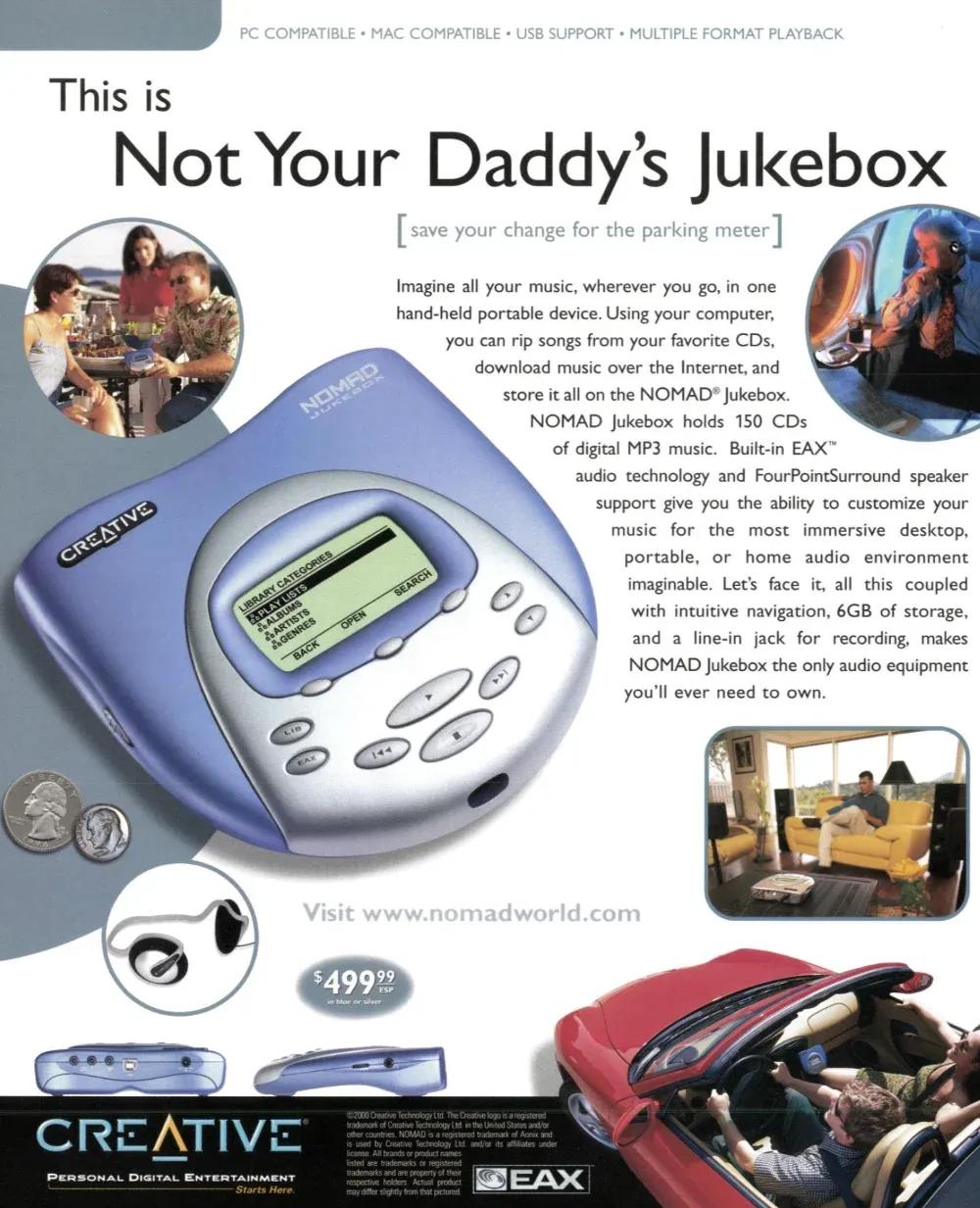
FROM THE PRINTED PAGEOriginal ad copy
OCR transcription from the archived page. Scanning and reading-order errors may remain.
PC COMPATIBLE • MAC COMPATIBLE • USB SUPPORT • MULTIPLE FORMAT PLAYBACK This is Not Your Daddy's Jukebox [save your change for the parking meter] Imagine all your music, wherever you go, in one hand-held portable device. Using your computer, you can rip songs from your favorite CDs, download music over the Internet, and store it all on the NOMAD® Jukebox. NOMAD Jukebox holds 150 CDs of digital MP3 music. Built-in EAX™ audio technology and FourPointSurround speaker support give you the ability to customize your music for the most immersive desktop, portable, or home audio environment imaginable. Let's face it, all this coupled with intuitive navigation, 6GB of storage, and a line-in jack for recording, makes NOMAD Jukebox the only audio equipment you'll ever need to own. CREATIVE NOMAD JUKEBOX [Player screen: LIBRARY, PLAYLISTS, ALBUMS, ARTISTS, GENRES, SEARCH, OPEN, BACK.] Visit www.nomadworld.com $499.99 ESP in blue or silver CREATIVE PERSONAL DIGITAL ENTERTAINMENT Starts Here. EAX [Small trademark and product-variation notice is partly illegible.]
Commentary
The title borrows an old machine to make a new one intelligible. A jukebox was a place you visited; this purple and silver object is presented as a music collection you can carry away. The ad makes that inversion visible by giving the player nearly half the page, then placing it near coins for scale. Smaller circular photographs show music in company, in transit, and at home. The line under the headline, “[save your change for the parking meter],” turns the old coin-operated association into a joke about portability.
The specifications do unusually heavy work. “150 CDs,” “6GB of storage,” a line-in recording jack, PC and Mac compatibility, and USB support all answer questions a buyer might ask before trusting the headline. The body copy describes ripping songs from CDs and downloading music over the internet, which means the advertised freedom still starts at a computer. At $499.99, the device is presented as a substantial purchase. Its promise that it is the “only audio equipment you’ll ever need to own” is an advertiser’s claim, not a conclusion the scan can verify.
The ad catches a change in what ownership meant for music. A physical collection could become files on a portable drive, while the user still handled the transfer, storage, and playback. Today’s listening can involve streaming catalogs and recurring access instead of locally stored albums. The scan makes the earlier sense of possession concrete through the capacity comparison: an entire wall of discs imagined inside one object.
For a young copywriter, “Not Your Daddy’s Jukebox” works because the familiar noun supplies a picture before “not” revises it. The parking-meter aside keeps the joke moving, and the large numerals “150” and “6GB” give the new definition substance. A headline can change a category quickly when the supporting copy tells the reader exactly what has changed.
Creative’s company timeline records the 6GB NOMAD Jukebox announcement in 2000, and its September launch release confirms the 150-CD and $499.99 claims. Creative continues to sell audio products, including speakers and headphones.
Portable access to a personal music collection remains the appealing idea. The CD-ripping workflow, hard-drive capacity as the central boast, and claim that one player could replace every other audio device belong to the ad’s particular moment.