Telecommunications 1990
AT&T
We fit the world's most reliable communications network into a very small space.
FROM THE PRINTED PAGEOriginal ad copy
OCR transcription from the archived page. Scanning and reading-order errors may remain.
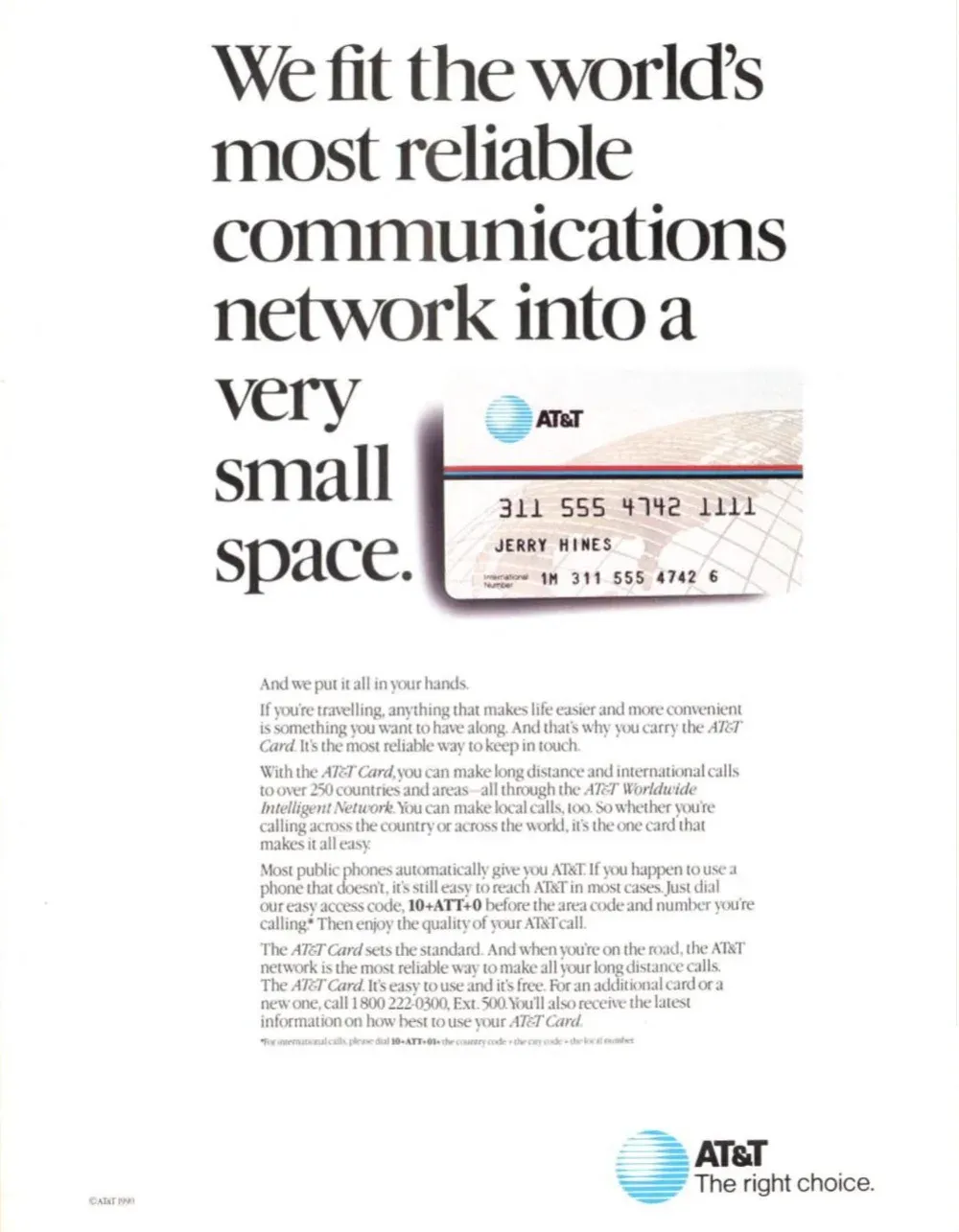
We fit the world's most reliable communications network into a very small space. AT&T 311 555 4742 1111 JERRY HINES [Small numbers on card are partly illegible.] And we put it all in your hands. If you're travelling, anything that makes life easier and more convenient is something you want to have along. And that's why you carry the AT&T Card. It's the most reliable way to keep in touch. With the AT&T Card, you can make long distance and international calls to over 250 countries and areas—all through the AT&T Worldwide Intelligent Network. You can make local calls, too. So whether you're calling across the country or across the world, it's the one card that makes it all easy. Most public phones automatically give you AT&T. If you happen to use a phone that doesn't, it's still easy to reach AT&T in most cases. Just dial our easy access code, 10+ATT+0 before the area code and number you're calling.* Then enjoy the quality of your AT&T call. The AT&T Card sets the standard. And when you're on the road, the AT&T network is the most reliable way to make all your long distance calls. The AT&T Card. It's easy to use and it's free. For an additional card or a new one, call 1 800 222-0300, Ext. 500. You'll also receive the latest information on how best to use your AT&T Card. * For international calls, please dial 10+ATT+01, the country code, the city code, the local number. AT&T The right choice. © AT&T 1990
Commentary
I follow the headline down the page until its last three words become a narrow column: “very / small / space.” An AT&T card occupies that space, as though the type itself has made room for the product. The layout turns a vast, invisible network into a pocket-sized object without trying to draw cables, switches, or a map. The card carries a named holder, Jerry Hines, which makes the promise look issued to someone rather than imagined for everyone.
The copy beneath it does the work the image cannot. It says the card can be used for long-distance and international calls to more than 250 countries and areas, as well as local calls. It explains what to do when a public phone does not automatically connect through AT&T: dial
10+ATT+0before the number. These are the advertiser’s stated capabilities, not independent evidence of coverage or reliability. The phrase “most reliable” appears twice, while the free-card offer and telephone number address the practical objection of how to get one.The ad assumes a traveler will meet an unfamiliar public phone and need a way to reach a familiar network. Its convenience is therefore conditional: the customer still locates a phone, remembers an access code, and places a call. A mobile phone now moves the connection into the traveler’s own device. That change makes the pictured card a useful record of how portability once meant carrying credentials rather than carrying the whole communications terminal.
For a new copywriter, the important device is scale. “World’s most reliable communications network” expands the idea; “very small space” contracts it, and the line breaks physically perform the contraction. The short bridge, “And we put it all in your hands,” turns that visual trick into a customer benefit. The lesson is to make typography carry an argument that the following copy can specify.
AT&T’s history traces its long-distance network to 1885 and notes the later corporate changes behind today’s AT&T. The company now describes its core connectivity work in wireless and fiber networks.
The need to stay reachable while traveling remains. The dedicated calling card, public-phone instructions, and dialed access code no longer describe the usual way a person carries that connection.