Electronics 1985
Commodore
If you own an Apple IIc, you’d have to add three more Apple IIc’s...
FROM THE PRINTED PAGEOriginal ad copy
OCR transcription from the archived page. Scanning and reading-order errors may remain.
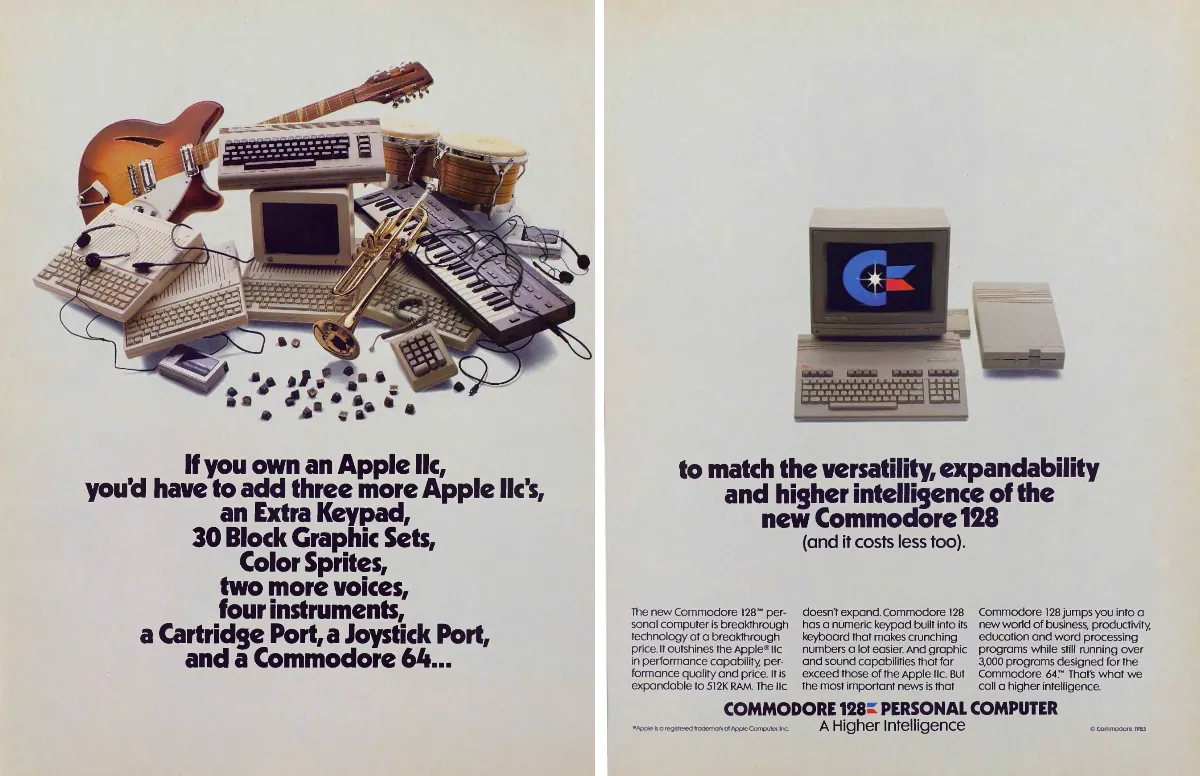
If you own an Apple IIc, you'd have to add three more Apple IIc's, an Extra Keypad, 30 Block Graphic Sets, Color Sprites, two more voices, four instruments, a Cartridge Port, a Joystick Port, and a Commodore 64... to match the versatility, expandability and higher intelligence of the new Commodore 128 (and it costs less too). The new Commodore 128™ personal computer is breakthrough technology at a breakthrough price. It outshines the Apple® IIc in performance capability, performance quality and price. It is expandable to 512K RAM. The IIc doesn't expand. Commodore 128 has a numeric keypad built into its keyboard that makes crunching numbers a lot easier. And graphic and sound capabilities that far exceed those of the Apple IIc. But the most important news is that Commodore 128 jumps you into a new world of business, productivity, education and word processing programs while still running over 3,000 programs designed for the Commodore 64.™ That's what we call a higher intelligence. COMMODORE 128 PERSONAL COMPUTER A Higher Intelligence ®Apple is a registered trademark of Apple Computer, Inc. © commodore 1985
Commentary
My eye counts keyboards before it reads specifications. On the left, computers mingle with a guitar, percussion, a trumpet and a scattered assortment of objects. On the right, the Commodore system has room to breathe. The comparison has already been decided by the photographer’s arrangement: one purchase appears to rescue the buyer from a heap.
Reading the headline reveals the joke’s accounting system. “Voices” and “instruments,” terms that can describe electronic sound capabilities, become things one might physically collect. The stack of Apple machines makes a numerical comparison visible without asking the reader to study a table. It is a theatrical inventory, not a practical instruction for combining computers. That distinction matters when studying the ad: the image dramatizes the advertiser’s selected advantages rather than proving that every activity has an equivalent on both sides.
The small print changes register. Expansion to 512K, a built-in numeric keypad and compatibility with over 3,000 Commodore 64 programs address different anxieties: future capacity, routine work and software already available. I read that last promise as an attempt to make an upgrade feel less like abandonment. The Computer History Museum’s 1985 C128 record places the machine in the period; the scan supplies the claims being made for it.
The spread also preserves a purchasing burden that is easy to underestimate now. A computer’s ports, sound facilities and software library could require separate explanation before a household knew what it was buying. Compatibility remains consequential, but here the advertiser can count the inherited programs and present the total as reassurance. The elaborate pile is a picture of decisions the buyer would rather not have to make.
For new copywriters, study how the sentence crosses the gutter. “You’d have to add” sets up an accumulating burden; the right-hand continuation delivers relief. Then the parenthesis about cost lowers its voice, making another major claim sound almost incidental. A list works when its order builds pressure and its conclusion releases it. Here layout performs the same argument as syntax.
Commodore’s home-computer history included the C64 and C128. The current brand’s official FAQ reports a 2025 acquisition of Commodore Corporation and describes a revival centered initially on the Commodore 64 Ultimate range and licensed community products.
The old promise was more capability for the money in a current computer purchase. Today’s revival adds nostalgia and continuity with an established community. The need to preserve useful software still resonates, but this direct contest with Apple’s IIc belongs to the particular hardware and purchasing choices of 1985.