Consumer Goods 1978
Agfa
What makes European color so beautiful?
FROM THE PRINTED PAGEOriginal ad copy
OCR transcription from the archived page. Scanning and reading-order errors may remain.
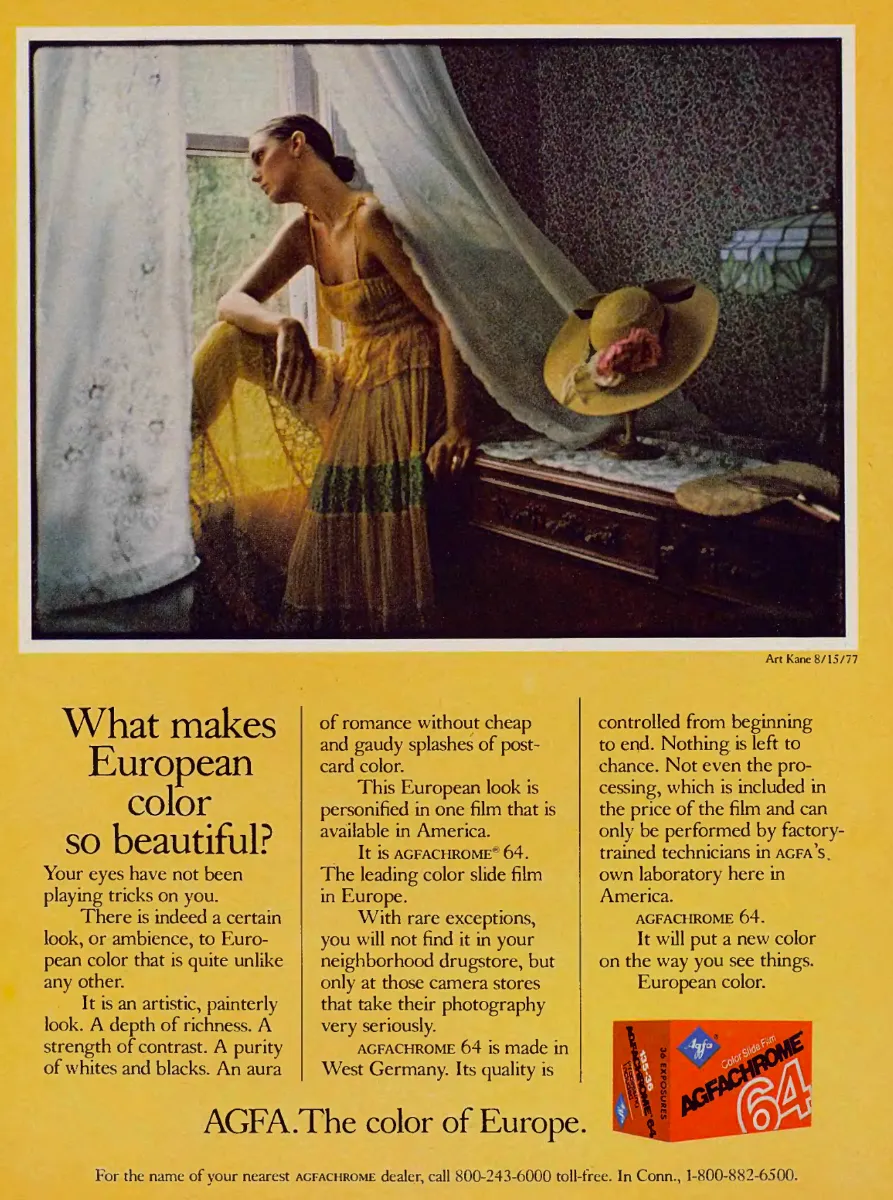
Art Kane 8/15/77 What makes European color so beautiful? Your eyes have not been playing tricks on you. There is indeed a certain look, or ambience, to European color that is quite unlike any other. It is an artistic, painterly look. A depth of richness. A strength of contrast. A purity of whites and blacks. An aura of romance without cheap and gaudy splashes of post-card color. This European look is personified in one film that is available in America. It is AGFACHROME® 64. The leading color slide film in Europe. With rare exceptions, you will not find it in your neighborhood drugstore, but only at those camera stores that take their photography very seriously. AGFACHROME 64 is made in West Germany. Its quality is controlled from beginning to end. Nothing is left to chance. Not even the processing, which is included in the price of the film and can only be performed by factory-trained technicians in AGFA’s own laboratory here in America. AGFACHROME 64. It will put a new color on the way you see things. European color. AGFA. The color of Europe. Agfa Color Slide Film AGFACHROME 64 36 EXPOSURES Process included For the name of your nearest AGFACHROME dealer, call 800-243-6000 toll-free. In Conn., 1-800-882-6500.
Commentary
I began with the yellow border, then noticed how differently yellow behaves inside the photograph. A dress and a broad-brimmed hat catch the window light, while curtains and dark wallpaper keep the scene muted and private. The page is brilliantly colored; its example of good color is restrained. That contrast makes the body’s complaint about gaudy postcard color more interesting than an ordinary claim of vividness.
Agfa calls the desired effect “European,” then translates geography into taste: painterliness, contrast, pure whites and blacks, romance. The photograph carries a visible Art Kane credit dated 8/15/77. That is evidence about the credited image, not a reason to replace the supplied 1978 advertisement date. Nor does the setting alone establish a European location. The persuasive geography is supplied by the words and by the statement that the film is made in West Germany.
The distribution argument is almost as revealing as the picture. Agfachrome 64 is said to be found mainly in serious camera stores rather than neighborhood drugstores. Scarcity becomes selection; the place of purchase certifies the purchaser’s intentions. Processing is included and restricted to factory-trained technicians in Agfa’s American laboratory. The promise of a look is therefore supported by control over the whole route from purchase to finished slide.
That route contrasts with adjusting color after capture on a screen. The page sells an aesthetic decision made before exposure, embodied in a particular film and processing arrangement. It is a reminder that “the look” could be an advance commitment involving retail advice and laboratory work, rather than an immediately reversible choice.
For new copywriters, study the fragments: “A depth of richness. A strength of contrast.” Repeated articles give an abstract judgment the rhythm of an inventory. “Your eyes have not been playing tricks on you” flatters the reader’s perception before naming the product. The lesson is to make the buyer feel able to recognize the difference, then explain what purchasing decision supposedly produces it. Here the national label is positioning, not an objective definition of an entire continent’s color.
Agfa’s historical consumer-film business later separated from the group in 2004, documented in its divestiture announcement. Agfa-Gevaert now describes printing, radiology, film, and chemicals activities in its 2025 results and 2026 business update.
The desire for a recognizable photographic character persists. This particular emulsion, laboratory arrangement, retail hierarchy, and West German provenance belong to the historical offer. Its enduring strategy is to sell controlled results as an expression of taste, with the distribution model helping substantiate the claim.