Electronics 1981
Acoustic Research
In 27 years, most of the world’s hi-fi manufacturers have copied our woofers, our tweeters, and just about everything else in our speakers. Except the sound.
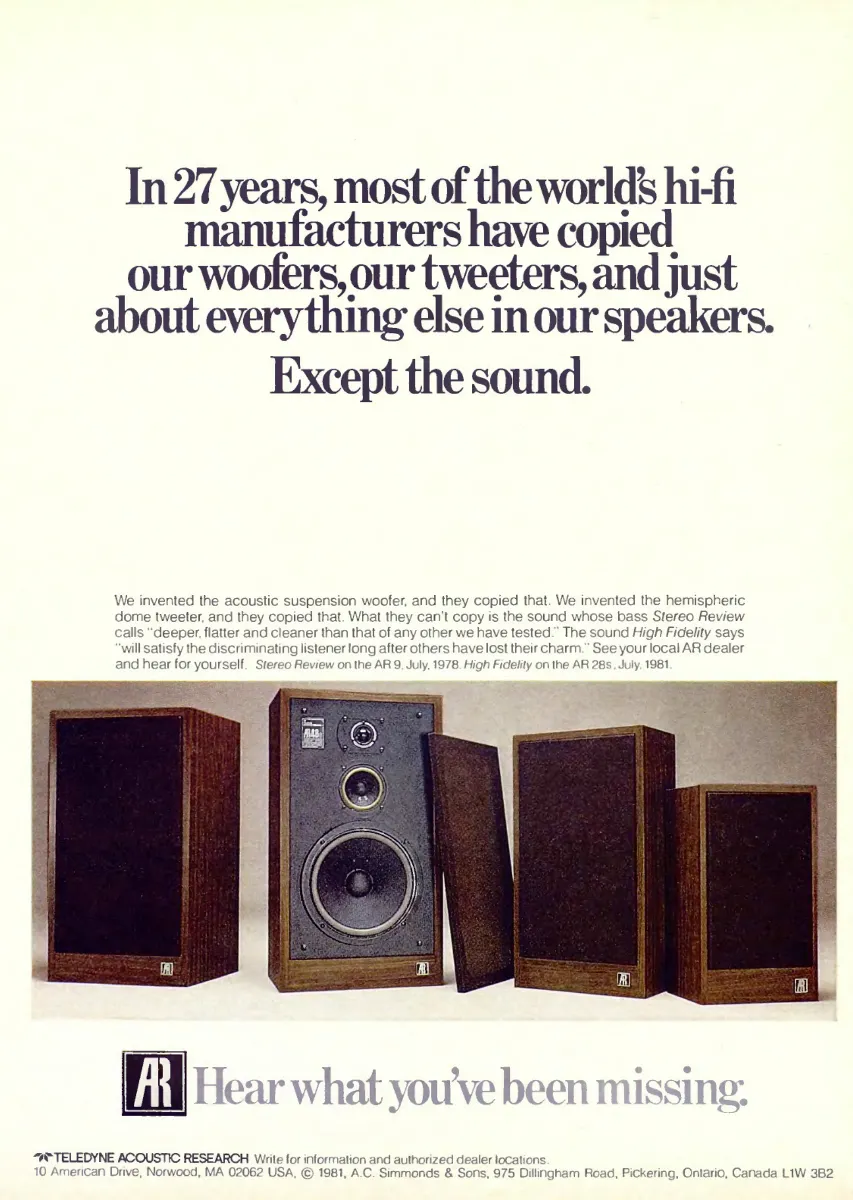
FROM THE PRINTED PAGEOriginal ad copy
OCR transcription from the archived page. Scanning and reading-order errors may remain.
In 27 years, most of the world’s hi-fi manufacturers have copied our woofers, our tweeters, and just about everything else in our speakers. Except the sound. We invented the acoustic suspension woofer, and they copied that. We invented the hemispheric dome tweeter, and they copied that. What they can’t copy is the sound whose bass Stereo Review calls “deeper, flatter and cleaner than that of any other we have tested.” The sound High Fidelity says “will satisfy the discriminating listener long after others have lost their charm.” See your local AR dealer and hear for yourself. Stereo Review on the AR 9, July, 1978. High Fidelity on the AR 28s, July, 1981. AR Hear what you’ve been missing. TELEDYNE ACOUSTIC RESEARCH Write for information and authorized dealer locations. 10 American Drive, Norwood, MA 02062 USA. © 1981, A.C. Simmonds & Sons, 975 Dillingham Road, Pickering, Ontario, Canada L1W 3B2
Commentary
I counted the drivers in the one cabinet with its grille removed, then went back to the headline. Acoustic Research invites that inspection only to declare it insufficient. Competitors, the ad says, have copied the woofer, the tweeter, and practically everything else. The decisive property remains unavailable to the eye: the sound. The enormous white space between headline and product makes the boast feel almost leisurely. A company claiming twenty-seven years of being imitated can afford, at least on the page, to pause.
That pause conceals a practical advertising problem. Loudspeakers are boxes whose most important behavior cannot be printed. AR gives us a family of walnut cabinets, one exposed baffle, two named inventions, and testimony from listeners with editorial authority. The review quotations need to be read with their labels attached: Stereo Review’s July 1978 passage concerns the AR 9; High Fidelity’s July 1981 passage concerns the AR 28s. The layout gathers them into a case for the brand, but they are not two tests of the same speaker. Nor does the page independently prove its sweeping account of competitors’ copying.
“Hear for yourself” is therefore more than a routine close. It moves the final proof out of the magazine and into a dealer’s room. Writing for dealer locations adds another stage to that journey. Today specifications and listening discussions can be found immediately online, but a recording played through someone else’s equipment still cannot settle exactly how a speaker will sound in one’s own room. The gap between description and experience remains commercially useful.
For a new copywriter, the short sentence “Except the sound” depends on the much longer sentence before it. The inventory builds apparent surrender; the exception turns imitation into tribute. “We invented … and they copied that” repeats the contrast until originality seems to belong to AR by grammatical habit. The lesson is to control the order of disclosure: a concession can strengthen a distinction when the promised difference matters more than the conceded similarities.
AR’s acoustic-suspension history has a contemporary technical record in Edgar Villchur’s 1954 account of the AR-1. The later brand appears in VOXX’s current support directory, rather than establishing continuity of the Teledyne-era speaker range shown here.
The lasting position is that engineering experience must resolve into an audible difference. The old cabinet range, review extracts, and dealer-search arrangements belong to this advertisement. Its continuing challenge to marketers is sharper: explain why similar-looking parts need not make interchangeable products, then offer a credible way to experience the difference.