Automotive 1983
Volkswagen
Ten reasons not to buy a Rabbit GTI.
FROM THE PRINTED PAGEOriginal ad copy
OCR transcription from the archived page. Scanning and reading-order errors may remain.
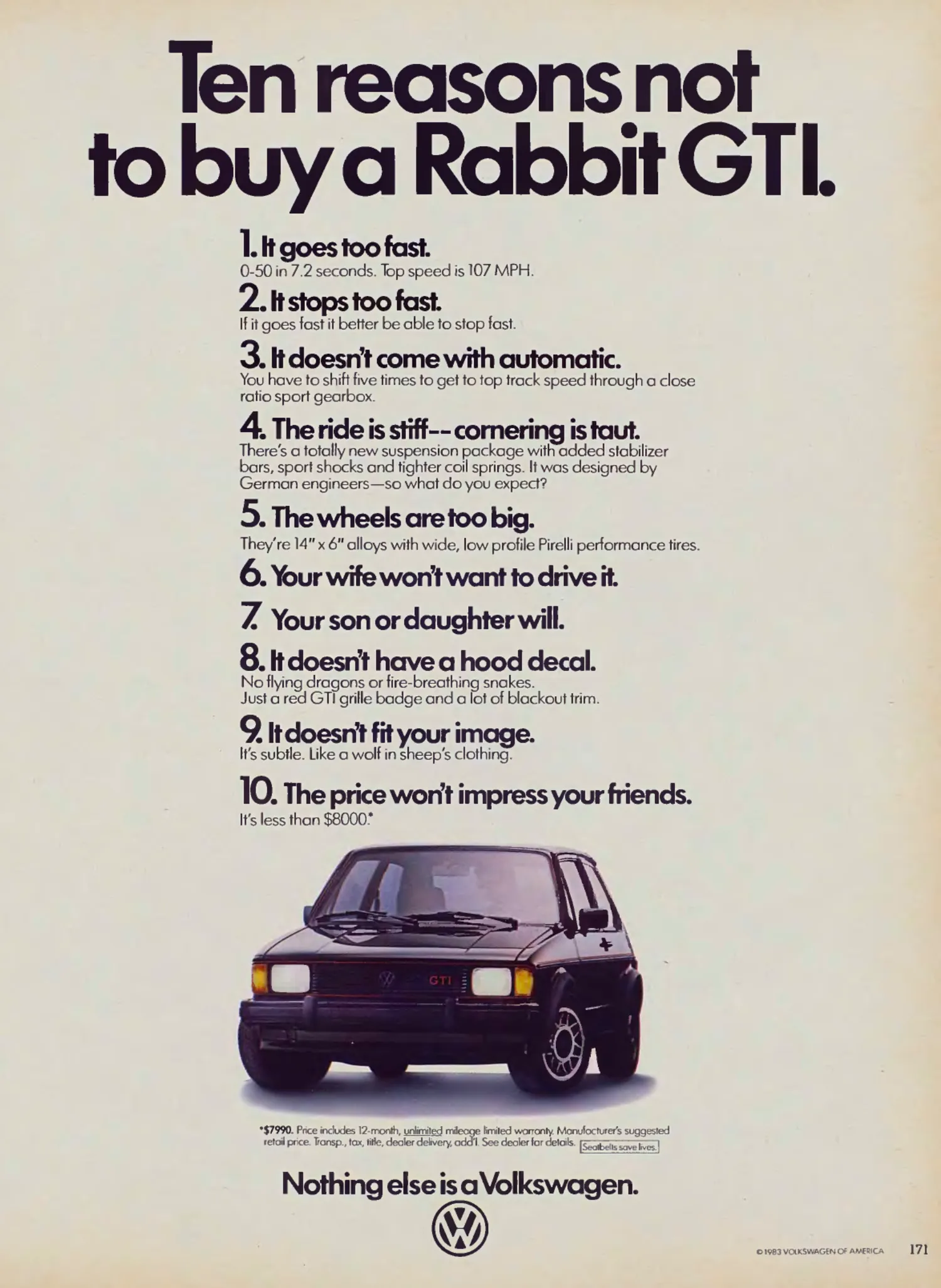
Ten reasons not to buy a Rabbit GTI. 1. It goes too fast. 0-50 in 7.2 seconds. Top speed is 107 MPH. 2. It stops too fast. If it goes fast it better be able to stop fast. 3. It doesn’t come with automatic. You have to shift five times to get to top track speed through a close ratio sport gearbox. 4. The ride is stiff--cornering is taut. There’s a totally new suspension package with added stabilizer bars, sport shocks and tighter coil springs. It was designed by German engineers—so what do you expect? 5. The wheels are too big. They’re 14″ x 6″ alloys with wide, low profile Pirelli performance tires. 6. Your wife won’t want to drive it. 7. Your son or daughter will. 8. It doesn’t have a hood decal. No flying dragons or fire-breathing snakes. Just a red GTI grille badge and a lot of blackout trim. 9. It doesn’t fit your image. It’s subtle. Like a wolf in sheep’s clothing. 10. The price won’t impress your friends. It’s less than $8000.* *$7990. Price includes 12-month, unlimited mileage limited warranty. Manufacturer’s suggested retail price. Transp., tax, title, dealer delivery, add’l. See dealer for details. Seatbelts save lives. Nothing else is a Volkswagen. ©1983 VOLKSWAGEN OF AMERICA 171
Commentary
A buying guide becomes an invitation to disagree. Volkswagen presents ten apparent objections, then expects the intended driver to read most of them as advantages. Speed, strong brakes, a manual gearbox and firm suspension become reasons to want the Rabbit GTI precisely because the headline calls them reasons to avoid it. The reader participates by reversing each proposition.
The numbered structure makes a substantial amount of product information easy to scan. Bold objections establish the rhythm; smaller explanations introduce acceleration, wheel dimensions, tire specification and suspension hardware. This lets the page alternate between a joke and evidence without needing a separate technical panel. Some objections describe real compromises, especially the absence of an automatic and the stiff ride. The ad makes those compromises part of belonging to its intended audience.
The black car waits below the list as a visual answer to the promises of subtlety. Its restrained appearance supports the rejection of decorative hood graphics and the wolf-in-sheep’s-clothing comparison. Price supplies the final reversal: a figure too low to impress friends becomes evidence that the purchase serves driving pleasure more than display. The detailed price qualification remains in small print beneath the photograph.
The two family remarks reveal a narrower assumption about that audience. Treating a wife’s supposed lack of interest as a selling point casts the buyer as male and makes enthusiasm for driving a gendered distinction. Preserving the wording helps explain how the joke operates, while also exposing a limitation in its appeal.
Volkswagen’s GTI story began with the Golf GTI in 1976. The manufacturer continues the line today and marks its fiftieth anniversary in 2026, as documented in its GTI anniversary account. This Rabbit advertisement presents that sporting idea through a compact American-market product.
Turning a genuine product compromise into a signal of fit remains useful positioning. The particular speed, price and equipment claims belong to this 1983 offer. Its family stereotype is less transferable than its central proposition: an understated everyday car can appeal to someone who cares strongly about how it drives.