Automotive 1978
Volkswagen
The least remarkable thing about the new Rabbit Diesel is 53 mpg h’way. 40 mpg city.
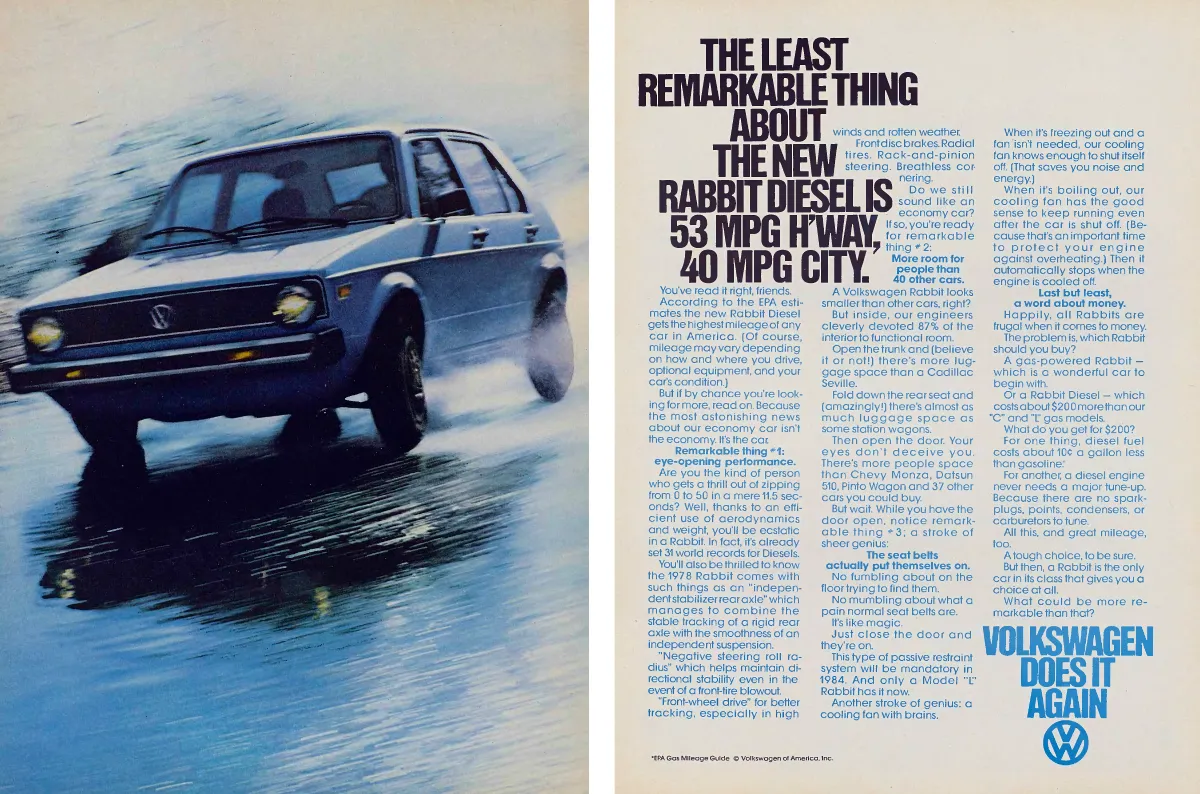
FROM THE PRINTED PAGEOriginal ad copy
OCR transcription from the archived page. Scanning and reading-order errors may remain.
THE LEAST REMARKABLE THING ABOUT THE NEW RABBIT DIESEL IS 53 MPG H’WAY. 40 MPG CITY.* You’ve read it right, friends. According to the EPA estimates the new Rabbit Diesel gets the highest mileage of any car in America. (Of course, mileage may vary depending on how and where you drive, optional equipment, and your car’s condition.) But if by chance you’re looking for more, read on. Because the most astonishing news about our economy car isn’t the economy. It’s the car. Remarkable thing #1: eye-opening performance. Are you the kind of person who gets a thrill out of zipping from 0 to 50 in a mere 11.5 seconds? Well, thanks to an efficient use of aerodynamics and weight, you’ll be ecstatic in a Rabbit. In fact, it’s already set 31 world records for Diesels. You’ll also be thrilled to know the 1978 Rabbit comes with such things as an “independent stabilizer rear axle” which manages to combine the stable tracking of a rigid rear axle with the smoothness of an independent suspension. “Negative steering roll radius” which helps maintain directional stability even in the event of a front-tire blowout. “Front-wheel drive” for better tracking, especially in high winds and rotten weather. Front disc brakes. Radial tires. Rack-and-pinion steering. Breathless cornering. Do we still sound like an economy car? If so, you’re ready for remarkable thing #2: More room for people than 40 other cars. A Volkswagen Rabbit looks smaller than other cars, right? But inside, our engineers cleverly devoted 87% of the interior to functional room. Open the trunk and (believe it or not!) there’s more luggage space than a Cadillac Seville. Fold down the rear seat and (amazingly!) there’s almost as much luggage space as some station wagons. Then open the door. Your eyes don’t deceive you. There’s more people space than Chevy Monza, Datsun 510, Pinto Wagon and 37 other cars you could buy. But wait. While you have the door open, notice remarkable thing #3; a stroke of sheer genius: The seat belts actually put themselves on. No fumbling about on the floor trying to find them. No mumbling about what a pain normal seat belts are. It’s like magic. Just close the door and they’re on. This type of passive restraint system will be mandatory in 1984. And only a Model “L” Rabbit has it now. Another stroke of genius: a cooling fan with brains. When it’s freezing out and a fan isn’t needed, our cooling fan knows enough to shut itself off. (That saves you noise and energy.) When it’s boiling out, our cooling fan has the good sense to keep running even after the car is shut off. (Because that’s an important time to protect your engine against overheating.) Then it automatically stops when the engine is cooled off. Last but least, a word about money. Happily, all Rabbits are frugal when it comes to money. The problem is, which Rabbit should you buy? A gas-powered Rabbit — which is a wonderful car to begin with. Or a Rabbit Diesel — which costs about $200 more than our “C” and “L” gas models. What do you get for $200? For one thing, diesel fuel costs about 10¢ a gallon less than gasoline. For another, a diesel engine never needs a major tune-up. Because there are no sparkplugs, points, condensers, or carburetors to tune. All this, and great mileage, too. A tough choice, to be sure. But then, a Rabbit is the only car in its class that gives you a choice at all. What could be more remarkable than that? VOLKSWAGEN DOES IT AGAIN *EPA Gas Mileage Guide © Volkswagen of America, Inc.
Commentary
I began with the spray behind the rear wheel. Volkswagen gives half the spread to a Rabbit moving through wet weather, then fills the other half with enough blue copy to resemble a small instruction manual. The photograph supplies the sensation; the text supplies permission to enjoy it. This is an economy car determined to avoid the social fate of being merely economical.
The headline demotes the very numbers that make the diesel interesting: 53 highway mpg and 40 city mpg become its “least remarkable” attribute. Three numbered discoveries follow—performance, room, and automatic seat belts—before the writer remembers the money. I read that sequence as an attempt to answer the objection beneath a rational purchase: will saving fuel mean accepting less car? The Cadillac Seville luggage comparison and the list of forty smaller passenger compartments make thrift feel unexpectedly expansive. These remain the advertiser’s period comparisons, with its own mileage qualification, rather than independently established results.
The $200 diesel premium and claimed ten-cent fuel saving reconstruct a buying calculation whose inputs cannot travel unchanged into the present. More revealing is the cooling fan that keeps working after the driver switches off. The copy patiently teaches readers why an apparently disobedient machine is being helpful. Automation still needs that kind of explanation when its sensible behavior looks like a fault.
For a new copywriter, watch the little reversal “Last but least.” It resumes the headline’s demotion of economy and turns a price discussion into a running joke. “No fumbling” and “No mumbling” give the belt explanation an audible rhythm; “a cooling fan with brains” translates a control mechanism into familiar behavior. The lesson is to keep each verbal flourish attached to something the buyer can picture doing.
Volkswagen identifies the Rabbit within its American progression from Beetle and Bus to later passenger cars and SUVs in its company history. It remains a vehicle manufacturer; that history also helps locate this ad in the brand’s move beyond its familiar rear-engined cars.
The durable promise is useful engineering without a joyless ownership experience. The specific diesel economics, passive-restraint forecast, rival measurements, and maintenance assumptions belong to this page’s 1978 sales argument. A marketer can borrow the hierarchy of benefits; the historical claims need to stay with the historical car.