Automotive 1996
Volkswagen
Remember when you were young and idealistic?
FROM THE PRINTED PAGEOriginal ad copy
OCR transcription from the archived page. Scanning and reading-order errors may remain.
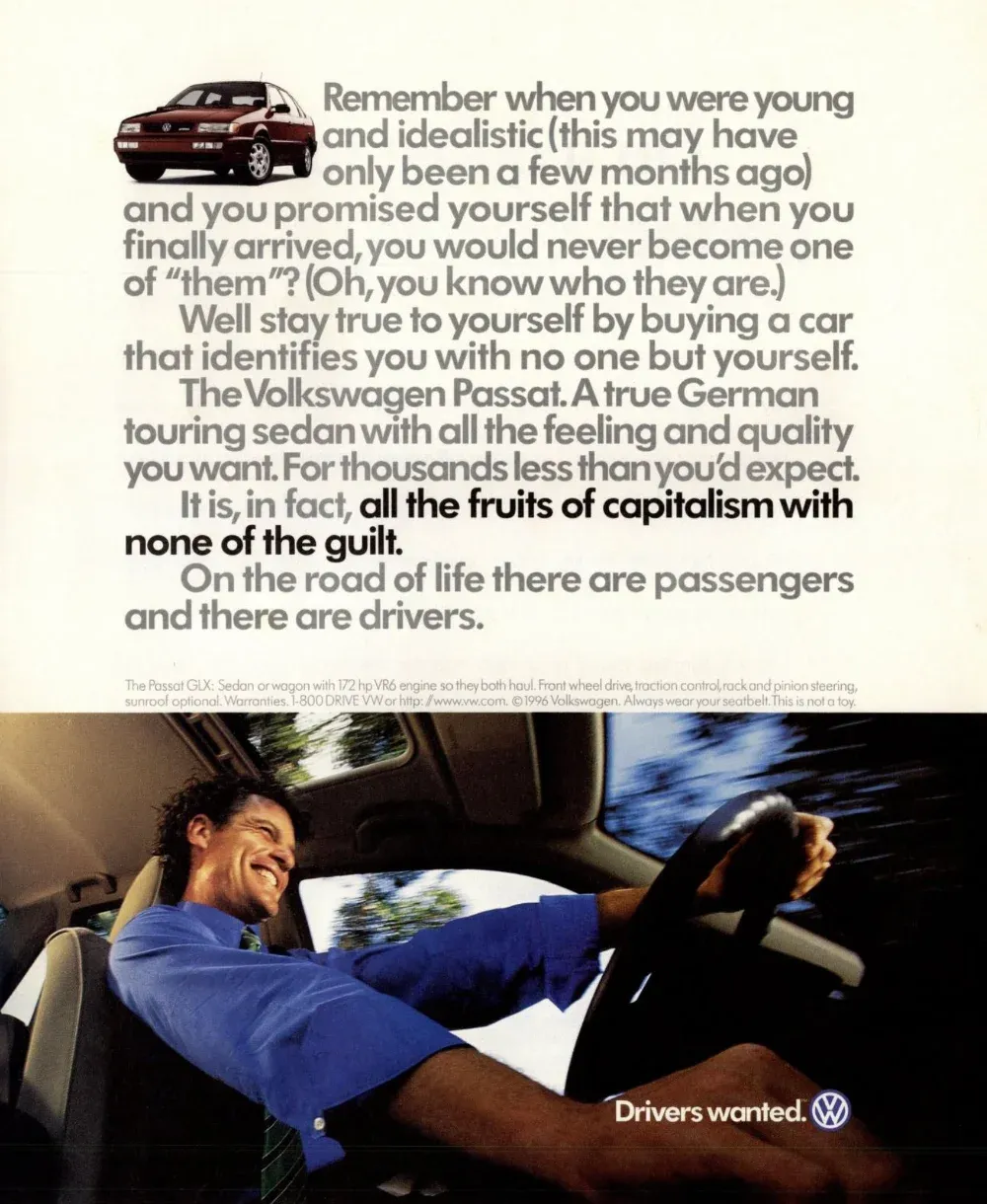
Remember when you were young and idealistic (this may have only been a few months ago) and you promised yourself that when you finally arrived, you would never become one of “them”? (Oh, you know who they are.) Well, stay true to yourself by buying a car that identifies you with no one but yourself. The Volkswagen Passat. A true German touring sedan with all the feeling and quality you want. For thousands less than you'd expect. It is, in fact, all the fruits of capitalism with none of the guilt. On the road of life there are passengers and there are drivers. The Passat GLX: Sedan or wagon with 172 hp VR6 engine so they both haul. Front wheel drive, traction control, rack and pinion steering, sunroof optional. Warranties. 1-800-DRIVE-VW or http://www.vw.com. © 1996 Volkswagen. Always wear your seatbelt. This is not a toy. Drivers wanted.
Commentary
The copy opens by asking the reader to remember being young and idealistic, then adds the parenthetical that this may have been only “a few months ago.” That aside keeps the address from becoming a lecture. The ad imagines a buyer who has begun to “arrive” in life but is wary of turning into an unnamed, conforming “them.” Its proposed answer is not rebellion by withdrawal: buy a German touring sedan, enjoy the “fruits of capitalism,” and feel no guilt about it.
The Passat itself is small beside the argument. Above the text, the sedan sits like a footnote; below it, a driver grins at the wheel, with the road rendered as motion across the window. The product is framed as a way to stay self-directed while enjoying comfort, quality and value. “For thousands less than you’d expect” supplies a price rationale, while the small specification line names the GLX’s 172 hp VR6, traction control and optional sunroof. The image does not supply an actual price, so the savings claim remains comparative rather than quantified.
There is a revealing negotiation here between individualism and status. The ad tells the reader to identify with “no one but yourself,” but makes the car the instrument of that independence. Its tone knows the contradiction and treats the wink as part of the appeal. For a reader now, the confident driver image and the long sermon about arriving in life feel more explicit than today’s screen-led automotive advertising; that is a reading of this particular page, not a claim about every car ad.
For a young copywriter, the parenthetical “(this may have only been a few months ago)” is doing precise work: it lets the brand tease the reader’s compromise while sounding like an ally. The line “all the fruits of capitalism with none of the guilt” then compresses the car’s value and identity pitch into a paradox. A practical lesson is to acknowledge the buyer’s tension in their own language, then make the product a plausible way through it.
The Passat’s B5 generation debuted in 1996 with a focus on understated design and quality. Volkswagen still sells the Passat in Europe, where the current generation is offered as an estate and includes mild-hybrid and plug-in hybrid versions. Volkswagen’s B5 history and current Passat information document the model’s evolution.
The ad’s attempt to make an attainable car feel both considered and self-expressive still resonates. The 172 hp specification, manual “drivers wanted” appeal, and U.S. sedan-or-wagon offer are tied to this 1996 model and market; the present European Passat centers on a spacious estate, digital cockpit and electrified powertrains.