Automotive 1969
Volkswagen
Can you spot the Volkswagen?
FROM THE PRINTED PAGEOriginal ad copy
OCR transcription from the archived page. Scanning and reading-order errors may remain.
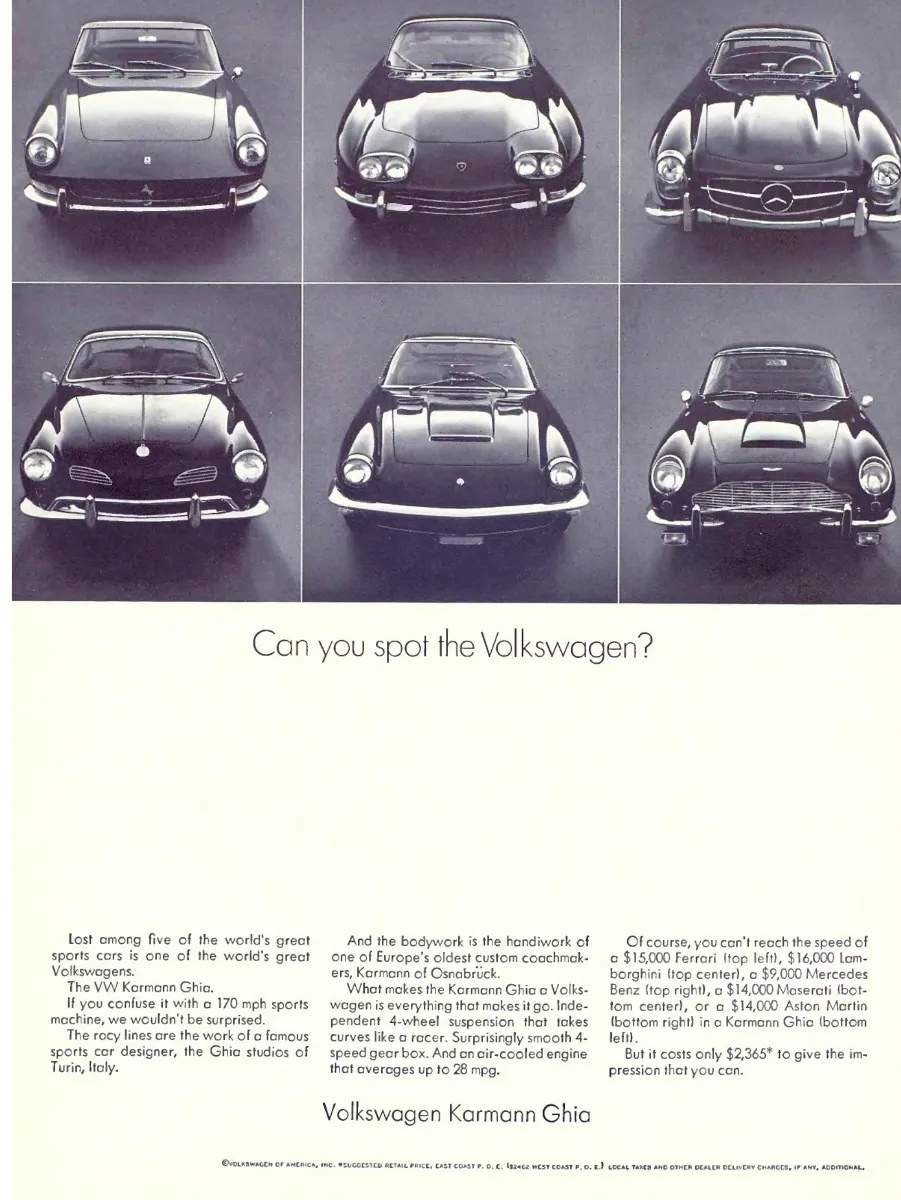
Can you spot the Volkswagen? Lost among five of the world's great sports cars is one of the world's great Volkswagens. The VW Karmann Ghia. If you confuse it with a 170 mph sports machine, we wouldn't be surprised. The racy lines are the work of a famous sports car designer, the Ghia studios of Turin, Italy. And the bodywork is the handiwork of one of Europe's oldest custom coachmakers, Karmann of Osnabrück. What makes the Karmann Ghia a Volkswagen is everything that makes it go. Independent 4-wheel suspension that takes curves like a racer. Surprisingly smooth 4-speed gear box. And an air-cooled engine that averages up to 28 mpg. Of course, you can't reach the speed of a $15,000 Ferrari (top left), $16,000 Lamborghini (top center), a $9,000 Mercedes Benz (top right), a $14,000 Maserati (bottom center), or a $14,000 Aston Martin (bottom right) in a Karmann Ghia (bottom left). But it costs only $2,365* to give the impression that you can. Volkswagen Karmann Ghia © VOLKSWAGEN OF AMERICA, INC. *SUGGESTED RETAIL PRICE, EAST COAST P.O.E. ($2462 WEST COAST P.O.E.) LOCAL TAXES AND OTHER DEALER DELIVERY CHARGES, IF ANY, ADDITIONAL.
Commentary
At first I look for badges. Six dark cars face the camera in a strict grid, and the headline asks me to find the Volkswagen. The answer is withheld until the final copy column: bottom left. This is a comparison staged as a visual quiz. The generous white area between the grid and the paragraphs slows the reveal, leaving the reader to notice family resemblances among cars with very different prices.
The text is careful about where the likeness ends. It credits Ghia’s Turin studio for the lines and Karmann of Osnabrück for the bodywork, then gives the Volkswagen machinery its own evidence: independent four-wheel suspension, a four-speed gearbox and a claimed average of up to 28 mpg. It openly concedes the Karmann Ghia cannot match the named rivals’ speed. That concession makes the final price joke credible: $2,365 buys “the impression” of a more expensive sports car. The footnote adds a higher West Coast suggested price and possible taxes and dealer charges. These figures belong to the ad, not a verified price comparison across dealers.
I notice how much work the reader has to do. The puzzle makes the Ghia’s appearance a finding rather than a boast, and the body copy supplies the explanation only after the visual has made its case. Today an online comparison could place specifications and prices side by side in seconds. This printed arrangement offers a different kind of interaction: six photographs, an unanswered question, and a payoff earned by reading to the bottom.
For a new copywriter, “Can you spot” is a useful example of an imperative that invites inspection instead of demanding belief. “Of course” then admits the performance limit before the economical punch line. The words “give the impression” are precise: they promise a look, not Ferrari speed. A comparison can be more persuasive when the copy names its boundary as plainly as its advantage.
Volkswagen’s Karmann Ghia history records the collaboration among Volkswagen, Ghia and Karmann and the coupé’s 1955 introduction. Volkswagen continues to make passenger cars; this model has been out of production for decades.
The enduring idea is that distinctive design can make an accessible car feel special. The six named 1969 prices, air-cooled engine and claim of sports-car resemblance are bound to the choices and market shown in this scan.