Automotive 1969
Volkswagen
The sports car that's just as reliable as a Volkswagen.
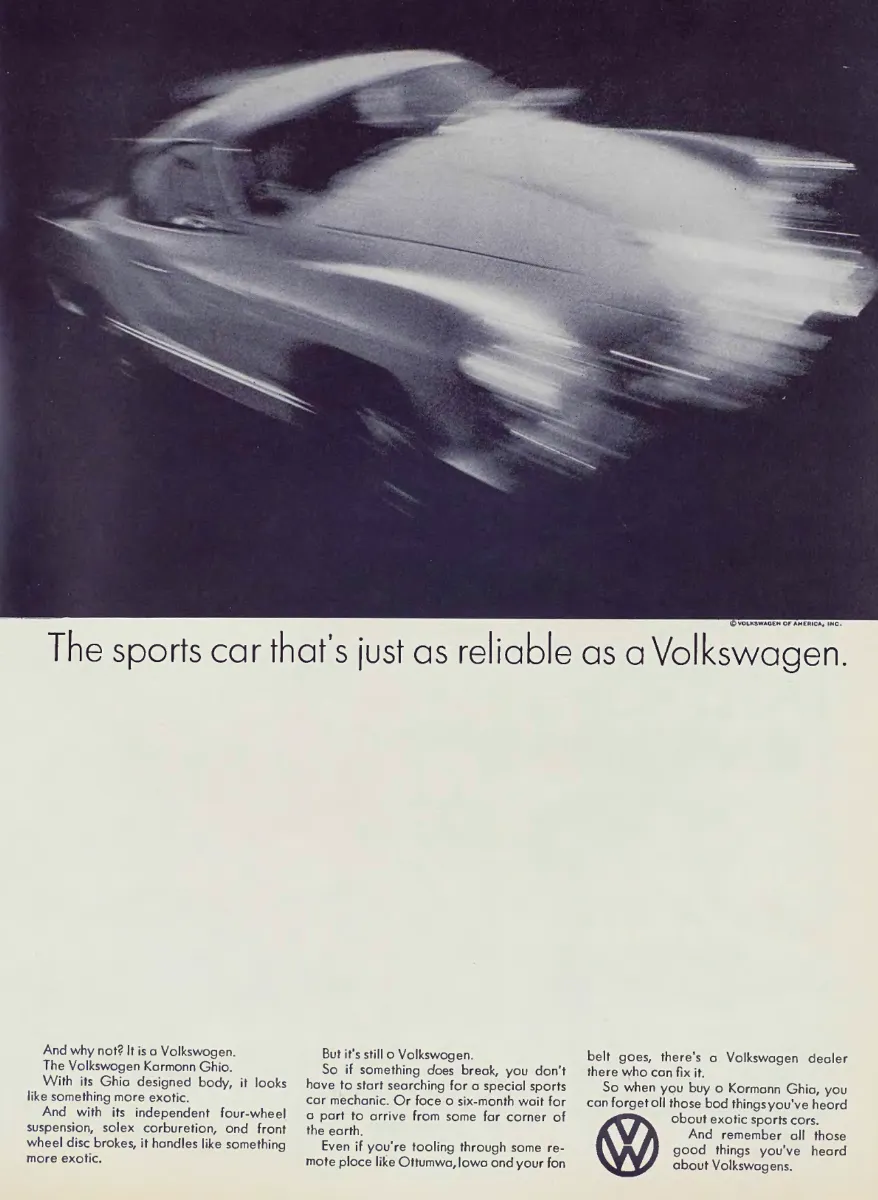
FROM THE PRINTED PAGEOriginal ad copy
OCR transcription from the archived page. Scanning and reading-order errors may remain.
The sports car that's just as reliable as a Volkswagen. And why not? It is a Volkswagen. The Volkswagen Karmann Ghia. With its Ghia designed body, it looks like something more exotic. And with its independent four-wheel suspension, solex carburetion, and front wheel disc brakes, it handles like something more exotic. But it's still a Volkswagen. So if something does break, you don't have to start searching for a special sports car mechanic. Or face a six-month wait for a part to arrive from some far corner of the earth. Even if you're tooling through some remote place like Ottumwa, Iowa and your fan belt goes, there's a Volkswagen dealer there who can fix it. So when you buy a Karmann Ghia, you can forget all those bad things you've heard about exotic sports cars. And remember all those good things you've heard about Volkswagens. © VOLKSWAGEN OF AMERICA, INC.
Commentary
The car is blurred almost beyond recognition. I can make out the Karmann Ghia’s low roof and motion, but the photograph withholds the tidy showroom view one might expect. Underneath it, a large white field leaves the headline exposed: “The sports car that’s just as reliable as a Volkswagen.” The sentence seems to compare two different things until the body copy replies, “And why not? It is a Volkswagen.” The ad’s small joke clears room for a serious buyer objection.
The copy lets the Ghia-designed body and mechanical details carry the appeal of an exotic car. Independent suspension, Solex carburetion, and front disc brakes are offered as reasons it handles differently from an ordinary sedan. Then the argument turns to failure. If the fan belt breaks in Ottumwa, Iowa, the reader is told, a Volkswagen dealer can fix it. The place name matters: it pulls the sports car out of a coastal fantasy and onto an American road where parts, mechanics, and waiting time become real. The image sells motion; the paragraphs sell the ability to keep moving.
The scan does not establish any reliability rate, dealer coverage, or repair time. Its evidence is rhetorical: familiar Volkswagen ownership is made to underwrite a more glamorous shape. That trade between beauty and practical reassurance still structures car marketing, even though a present-day owner would likely locate a repairer and check parts availability through a phone before setting out.
For a beginning copywriter, watch the order of “sports car” and “Volkswagen.” The headline first grants the desirable category, then immediately supplies a reliability promise. The short reply, “It is a Volkswagen,” delivers the turn without a technical lecture. The repeated “exotic” later names both the attraction and the fear, showing how one word can carry the objection as well as the aspiration.
Volkswagen’s history of the Karmann Ghia traces the design to Ghia and Karmann, with the coupé arriving in 1955. Volkswagen still makes cars; the Karmann Ghia itself has long since left production.
What survives is the appeal of a distinctive car that feels manageable to own. The named carburetion, fan belt, and 1969 dealer-network reassurance locate the argument in its particular mechanical and distribution world.