Electronics 1979
Sony
Sony Tape. Full Color Sound.
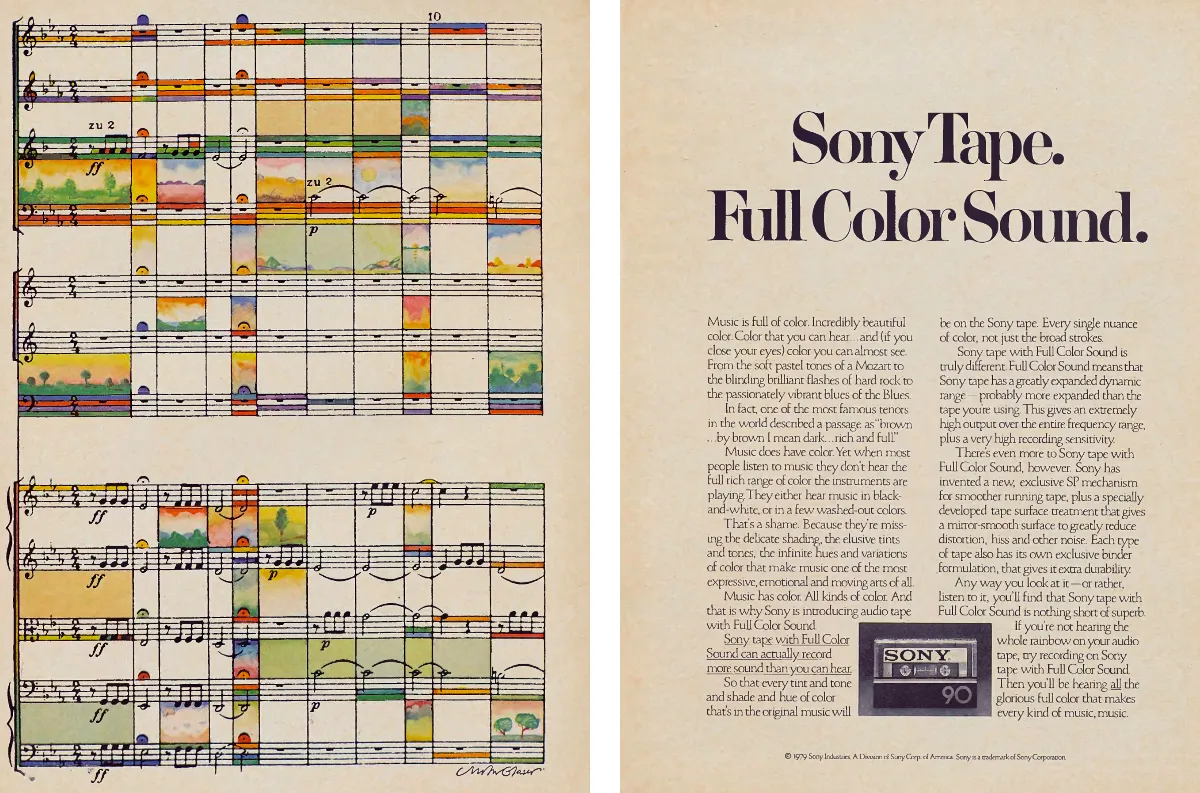
FROM THE PRINTED PAGEOriginal ad copy
OCR transcription from the archived page. Scanning and reading-order errors may remain.
Sony Tape. Full Color Sound. Music is full of color. Incredibly beautiful color. Color that you can hear...and (if you close your eyes) color you can almost see. From the soft pastel tones of a Mozart to the blinding brilliant flashes of hard rock to the passionately vibrant blues of the Blues. In fact, one of the most famous tenors in the world described a passage as “brown...by brown I mean dark...rich and full.” Music does have color. Yet when most people listen to music they don't hear the full rich range of color the instruments are playing. They either hear music in black-and-white, or in a few washed-out colors. That's a shame. Because they're missing the delicate shading, the elusive tints and tones, the infinite hues and variations of color that make music one of the most expressive, emotional and moving arts of all. Music has color. All kinds of color. And that is why Sony is introducing audio tape with Full Color Sound. Sony tape with Full Color Sound can actually record more sound than you can hear. So that every tint and tone and shade and hue of color that's in the original music will be on the Sony tape. Every single nuance of color, not just the broad strokes. Sony tape with Full Color Sound is truly different. Full Color Sound means that Sony tape has a greatly expanded dynamic range—probably more expanded than the tape you're using. This gives an extremely high output over the entire frequency range, plus a very high recording sensitivity. There's even more to Sony tape with Full Color Sound, however. Sony has invented a new, exclusive SP mechanism for smoother running tape, plus a specially developed tape surface treatment that gives a mirror-smooth surface to greatly reduce distortion, hiss and other noise. Each type of tape also has its own exclusive binder formulation, that gives it extra durability. Any way you look at it—or rather, listen to it, you'll find that Sony tape with Full Color Sound is nothing short of superb. If you're not hearing the whole rainbow on your audio tape, try recording on Sony tape with Full Color Sound. Then you'll be hearing all the glorious full color that makes every kind of music, music. SONY 90 © 1979 Sony Industries, A Division of Sony Corp. of America. Sony is a trademark of Sony Corporation.
Commentary
The left page made me stop before I reached the sales argument. It looks like a printed orchestral score, but patches of landscape sit inside the staves: little sunsets, hills, and clouds held between black rules. The right page asks for “Full Color Sound.” Together they make an impossible demonstration. Sound cannot be printed here, so Sony gives the eye a substitute for what the ear is meant to notice. Even the little cassette is kept near the bottom, long after the score has established the sensation.
The copy keeps returning to the color metaphor, then gradually converts it into a technical proposition. It moves from Mozart’s “soft pastel tones” to hard rock’s “brilliant flashes” and the Blues’ “vibrant blues.” Only after that does it name dynamic range, frequency output, recording sensitivity, smoother tape travel, a treated surface, and binder durability. These are advertiser claims; the scan gives no measurements or comparison method. The metaphor does the preliminary work of making those specifications feel like an audible loss a listener might already have suffered. “Black-and-white” playback is a clever accusation, because no one wants to believe a favorite recording has been flattened.
The score also asks for a kind of careful, repeatable listening. To get its promised color, the reader has to choose a blank cassette and record music onto it. That step is largely absent from today’s streamed listening, where the recording medium is hidden from the consumer. What persists is the desire to hear detail in familiar music. The ad makes that desire visible without ever providing a sound sample.
For a new copywriter, notice how the short sentence “Music has color” becomes a hinge. Its repeated nouns—“tint,” “tone,” “shade,” “hue”—prepare the reader for “dynamic range” more gently than a specification table would. The page break and the large serif headline then turn the metaphor into a product name. When borrowing language from another sense, carry the image through both the copy and the design, and make the technical claim that follows specific.
Sony began in 1946 as Tokyo Telecommunications Engineering and now spans electronics and entertainment, including music. Its history makes the ad’s concern with both recording hardware and musical experience especially apt.
The wish to preserve every nuance of music still fits Sony’s audio identity. Blank cassette chemistry, binder formulas, and the invitation to make a home recording belong to a different delivery system. The design lesson remains: give an invisible performance quality a concrete visual form, then tell the reader which product properties are supposed to produce it.