Electronics 2000
Sony
Sony CLIÉ: a leisurely bike ride
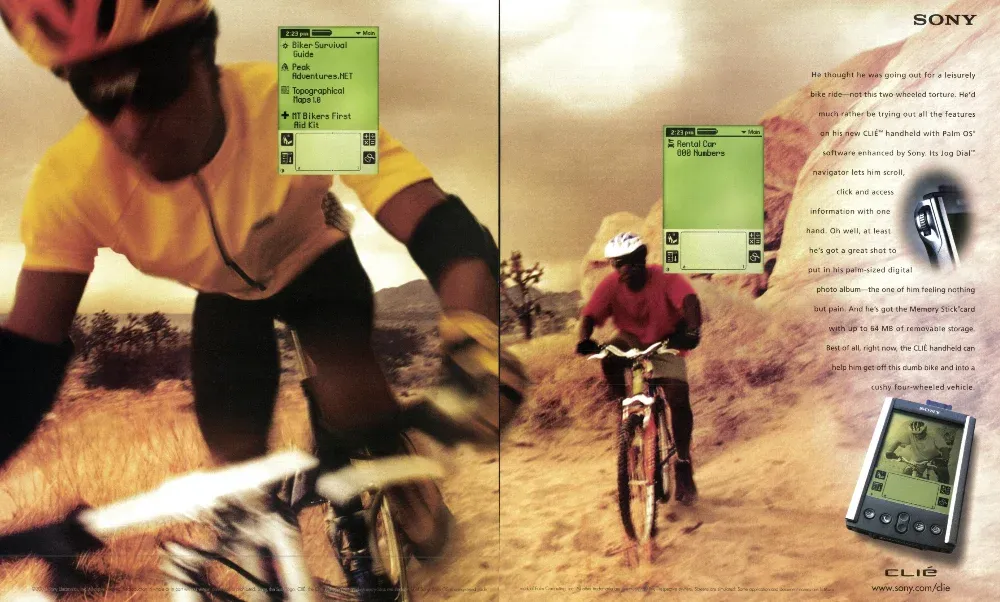
FROM THE PRINTED PAGEOriginal ad copy
OCR transcription from the archived page. Scanning and reading-order errors may remain.
SONY 2:23 pm Biker Survival Guide [illegible] Adventures.NET Topographical Maps [version illegible] MT Bikers First Aid Kit 2:23 pm Rental Car 800 Numbers He thought he was going out for a leisurely bike ride—not this two wheeled torture. He'd much rather be trying out all the features on his new CLIÉ™ handheld with Palm OS® software enhanced by Sony. Its Jog Dial™ navigator lets him scroll, click and access information with one hand. Oh well, at least he's got a great shot to put in his palm-sized digital photo album—the one of him feeling nothing but pain. And he's got the Memory Stick® card with up to 64 MB of removable storage. Best of all, right now, the CLIÉ handheld can help him get off this dumb bike and into a cushy four-wheeled vehicle. CLIÉ www.sony.com/clie [Fine print along the bottom edge is illegible.]
Commentary
The first page looks like an outdoor sports advertisement: a helmeted rider rushes toward us, so close that the handlebars almost scrape the frame. The second page pulls back to show a smaller rider on a dusty trail. Only then does the copy reveal the joke. He expected “a leisurely bike ride” and got “two wheeled torture.” The trail is an inconvenience from which the advertised handheld might rescue him. Sony borrows the visual excitement of an adventure, then lets its protagonist quietly wish for a rental car.
Two green organizer screens hover over the landscape. One offers a Biker Survival Guide, maps, and a first aid kit; the other offers rental car numbers. They organize the page as a story with a change of plan. The device itself waits at the lower right, after the rider’s predicament and the imagined solution are already clear. The body copy adds the evidence: Palm OS software, a Jog Dial for one-handed navigation, a digital photo album, and a Memory Stick card with up to 64 MB of removable storage. The scan advertises these uses, though it cannot prove that the pictured rider had any of this information available on the trail.
What has changed is the labor of finding help away from a desk. The rental car numbers appear as a stored list, and maps are named as software on a separate handheld. A modern phone can commonly search for a car, show a map, and hold photographs through connected services. That comparison is an inference about everyday use, not a claim that the CLIÉ offered live booking. In this ad, portability means bringing selected information with you before you need it.
For a young copywriter, the comedy depends on a small reversal. “Leisurely” sets an expectation, “torture” punctures it, and “cushy four-wheeled vehicle” gives the rider a very unheroic goal. Between those phrases, “scroll, click and access” supplies a brisk sequence of actions that makes the Jog Dial’s benefit tangible. The practical lesson is to put a feature inside a believable predicament; a reader remembers why one-handed navigation matters when the other hand is occupied.
Sony began in 1946 and reported the CLIÉ as a Palm OS handheld. The company now spans games, music, pictures, electronics, and imaging technology.
The enduring need is access to useful information while plans change. The separate organizer, removable card, and prepared list of phone numbers locate that need in a world before one connected pocket device could routinely do all three jobs.