Electronics 1990
Samsung
Technology that works for all of us
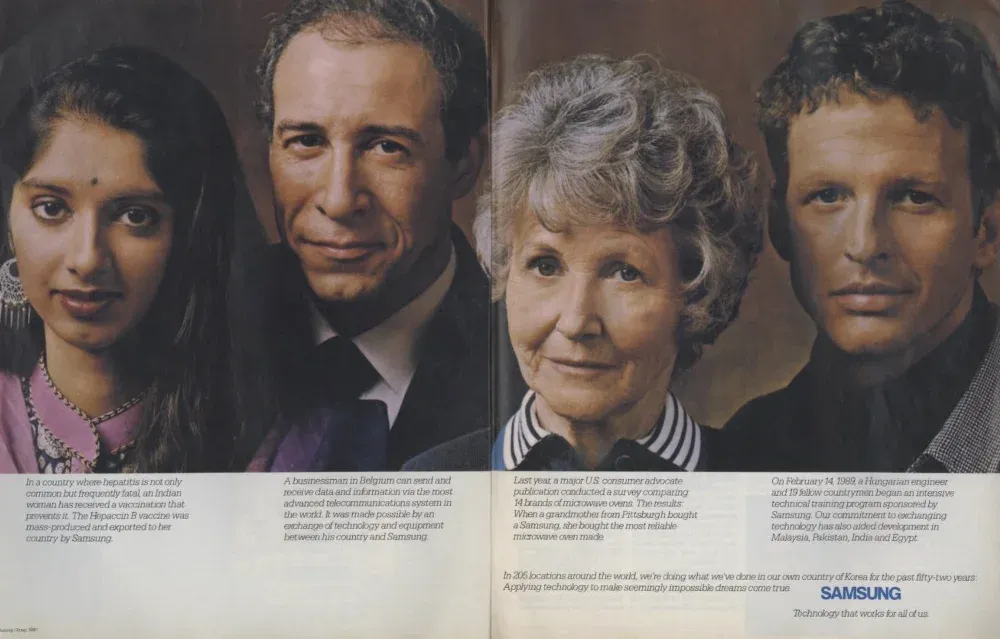
FROM THE PRINTED PAGEOriginal ad copy
OCR transcription from the archived page. Scanning and reading-order errors may remain.
In a country where hepatitis is not only common but frequently fatal, an Indian woman has received a vaccination that prevents it. The Hepaccin B vaccine was mass-produced and exported to her country by Samsung. A businessman in Belgium can send and receive data and information via the most advanced telecommunications system in the world. It was made possible by an exchange of technology and equipment between his country and Samsung. Last year, a major US consumer advocate publication conducted a survey comparing 14 brands of microwave ovens. The results: When a grandmother from Pittsburgh bought a Samsung, she bought the most reliable microwave oven made. On February 14, 1989, a Hungarian engineer and 19 fellow countrymen began an intensive technical training program sponsored by Samsung. Our commitment to exchanging technology has also aided development in Malaysia, Pakistan, India and Egypt. In 205 locations around the world, we're doing what we've done in our own country of Korea for the past fifty-two years: Applying technology to make seemingly impossible dreams come true. SAMSUNG Technology that works for all of us. [Small bottom-edge line is illegible.]
Commentary
I count four faces before I read the first product claim. None is holding a branded device. Their portraits fill most of the spread, while the stories sit in a fine strip beneath them. Samsung asks a reader to move from a person to an outcome: vaccination in India, data exchange in Belgium, a microwave purchase in Pittsburgh, and technical training in Hungary. The geographic spread does what a product lineup would normally do. It presents the name Samsung as a connecting thread across different kinds of work.
The copy makes unusually large claims for such small type. It says Samsung mass-produced and exported the named vaccine, helped enable a telecommunications system, made the most reliable microwave in a survey, and sponsored training for engineers. Those are the ad’s assertions; the scan does not provide the survey citation or enough information to verify each outcome. The date “February 14, 1989” and the count of 19 trainees lend one story documentary precision. In the closing line, “205 locations” and “fifty-two years” turn the four portraits into evidence for a worldwide corporate identity.
This is an ad about a company’s reach, yet its structure is intimate. Each paragraph starts from an individual or small group, then widens to technology exchange across borders. In the present, global technology advertising often makes similarly broad social claims, but the pictured faces and place names invite a sharper question: who specifically benefits, and by what mechanism? The ad answers that question with four anecdotes, not with a complete account of the systems behind them.
For a beginning copywriter, notice how the repeated story pattern disciplines the grand closing line. “An Indian woman,” “A businessman in Belgium,” “a grandmother from Pittsburgh,” and “a Hungarian engineer” give the reader four human entry points before “all of us” appears. The lesson is that a universal promise becomes easier to follow when the copy first identifies particular people and actions. It also makes unsupported superlatives easier to spot.
Samsung’s own history timeline dates the wider company’s founding to 1938; Samsung Electronics was established in 1969. Its current product and company account focuses on electronics and related technologies, while this ad speaks for the broader Samsung name.
The durable idea is to explain technology through consequences for people. The ad’s mixture of a vaccine, a household appliance, a telecom system, and international training is particular to the broad corporate story Samsung chose to tell in 1990; its factual claims should remain attributed to that advertisement.