Electronics 1981
Pioneer
High Fidelity for Humans: It even finds your favorite stations when you can’t.
FROM THE PRINTED PAGEOriginal ad copy
OCR transcription from the archived page. Scanning and reading-order errors may remain.
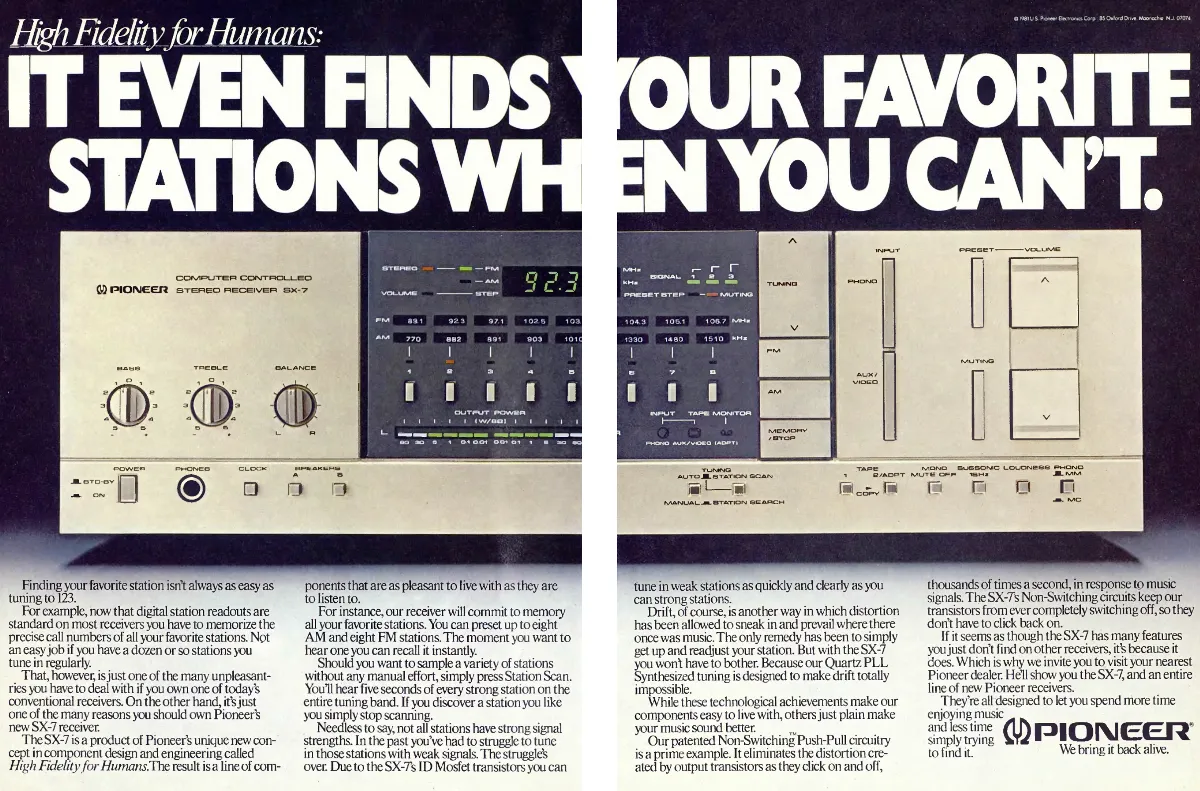
High Fidelity for Humans: IT EVEN FINDS YOUR FAVORITE STATIONS WHEN YOU CAN’T. Finding your favorite station isn’t always as easy as tuning to 123. For example, now that digital station readouts are standard on most receivers you have to memorize the precise call numbers of all your favorite stations. Not an easy job if you have a dozen or so stations you tune in regularly. That, however, is just one of the many unpleasantries you have to deal with if you own one of today’s conventional receivers. On the other hand, it’s just one of the many reasons you should own Pioneer’s new SX-7 receiver. The SX-7 is a product of Pioneer’s unique new concept in component design and engineering called High Fidelity for Humans. The result is a line of components that are as pleasant to live with as they are to listen to. For instance, our receiver will commit to memory all your favorite stations. You can preset up to eight AM and eight FM stations. The moment you want to hear one you can recall it instantly. Should you want to sample a variety of stations without any manual effort, simply press Station Scan. You’ll hear five seconds of every strong station on the entire tuning band. If you discover a station you like you simply stop scanning. Needless to say, not all stations have strong signal strengths. In the past you’ve had to struggle to tune in those stations with weak signals. The struggle’s over. Due to the SX-7’s ID Mosfet transistors you can tune in weak stations as quickly and clearly as you can strong stations. Drift, of course, is another way in which distortion has been allowed to sneak in and prevail where there once was music. The only remedy has been to simply get up and readjust your station. But with the SX-7 you won’t have to bother. Because our Quartz PLL Synthesized tuning is designed to make drift totally impossible. While these technological achievements make our components easy to live with, others just plain make your music sound better. Our patented Non-Switching Push-Pull circuitry is a prime example. It eliminates the distortion created by output transistors as they click on and off, thousands of times a second, in response to music signals. The SX-7’s Non-Switching circuits keep our transistors from ever completely switching off, so they don’t have to click back on. If it seems as though the SX-7 has many features you just don’t find on other receivers, it’s because it does. Which is why we invite you to visit your nearest Pioneer dealer. He’ll show you the SX-7, and an entire line of new Pioneer receivers. They’re all designed to let you spend more time enjoying music and less time simply trying to find it. PIONEER® We bring it back alive. ©1981 U.S. Pioneer Electronics Corp., 85 Oxford Drive, Moonachie, N.J. 07074.
Commentary
I tried to read the receiver’s face as if I had to use it. There are still bass, treble, and balance knobs, but much of the frontage has become buttons, numerical displays, and stored frequencies. The headline promises rescue from precisely this apparent advance. A digital readout tells you where you are; it does not necessarily remember where you wanted to go.
Pioneer makes that distinction the opening problem. A listener with a dozen favorite stations must remember their numbers, so the SX-7 supplies memory for eight AM and eight FM stations. Station Scan offers five-second samples. Weak-signal reception and tuning drift receive separate explanations before the copy turns to amplification. This sequencing is revealing: an advertisement for high fidelity begins with the inconvenience of finding music, then earns its way toward circuitry that claims to reproduce it better.
The spread’s monumental product photograph lets the reader inspect the proposed remedy. Presets and scan controls appear on the same face as the familiar tone adjustments. Yet the sales text does not pretend that its engineering vocabulary is ordinary conversation. Quartz PLL Synthesized tuning and Non-Switching Push-Pull circuitry are translated into things the owner supposedly will not have to do: struggle with a weak station, get up to readjust reception, tolerate switching distortion. These are the advertiser’s explanations and performance claims; the scan supplies no independent measurements.
The memory pitch records a particular burden of listening. A favorite station was both a cultural destination and a number to retain. Searchable station names and software favorites can change the interface, but the underlying design problem persists: a machine should remember routine choices rather than making its owner repeat them. Here “human” engineering means giving attention back to the listener.
For a beginning copywriter, “as pleasant to live with as they are to listen to” balances everyday usability against sonic pleasure. “It even finds” makes the receiver an assistant, while the closing contrast between enjoying music and finding it explains why that assistant matters. The practical lesson is to describe the recurring effort a feature removes before asking the reader to admire the feature’s technical name.
Pioneer’s history traces the company to speaker development and its 1938 foundation. Today Pioneer Corporation emphasizes automotive electronics and sound technologies and identifies itself as part of the CarUX group since December 2025.
The persistent idea is that fidelity includes a usable path to the music. The SX-7’s station limits, scan interval, and circuit claims are specific to this receiver. The broader position remains useful wherever impressive technical capability risks becoming another task for the customer.