Back to the collection24 / 189
Electronics 2001
Philips
Three-disc changer. Double-speed recording.
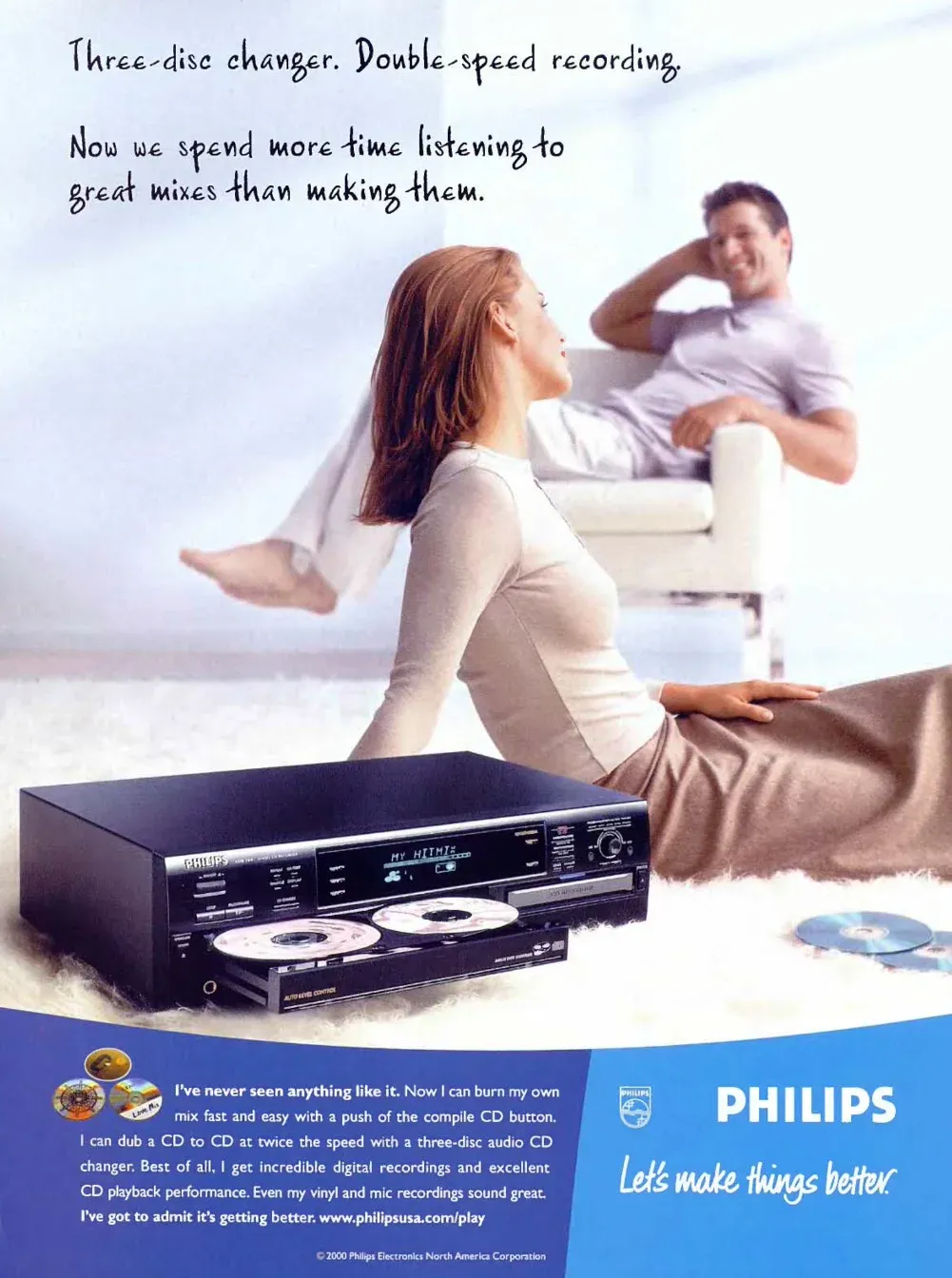
FROM THE PRINTED PAGEOriginal ad copy
OCR transcription from the archived page. Scanning and reading-order errors may remain.
Three-disc changer. Double-speed recording. Now we spend more time listening to great mixes than making them. PHILIPS MY HITMIX AUTO LEVEL CONTROL I've never seen anything like it. Now I can burn my own mix fast and easy with a push of the compile CD button. I can dub a CD to CD at twice the speed with a three-disc audio CD changer. Best of all, I get incredible digital recordings and excellent CD playback performance. Even my vinyl and mic recordings sound great. I've got to admit it's getting better. www.philipsusa.com/play © 2000 Philips Electronics North America Corporation
Commentary
The Philips ad begins with a pair of clipped specifications—“Three-disc changer. Double-speed recording.”—then immediately translates them into a change in the household’s use of time: “Now we spend more time listening to great mixes than making them.” That is the real proposition. The machine is not presented as a black box of formats and buttons; it is a way to turn the labor of compilation into a shorter prelude to enjoyment.
The photograph makes that promise social. The recorder dominates the lower foreground, but the relaxed couple occupies the room behind it: one person reclines, the other sits in profile, and neither appears to be operating anything. The product has already done its work. Loose CDs on the floor and the visible reels and controls connect the machine to a culture of home recording, while the pale room and blue sweep at the bottom make the scene feel clean, modern, and attainable rather than technical.
The copy’s evidence arrives as a sequence of small permissions: burn a mix, dub CD to CD, record from vinyl and a microphone, and do it at twice the speed. “Best of all” then moves from convenience to quality, promising “incredible digital recordings” and “excellent CD playback performance.” The ad assumes an owner with a mixed collection and enough affection for making personal compilations to care about both analog sources and digital copies.
For a young copywriter, notice how the headline uses short parallel noun phrases before the longer body copy supplies proof. The sentence “Now we spend more time listening … than making them” turns a feature into a satisfying contrast, and “I’ve never seen anything like it” gives the technical list a human voice. The lesson is practical: let the specification establish credibility, then show exactly what the saved time feels like.
The ad belongs to Philips’ long history of consumer technology and design. Philips says it was founded in Eindhoven in 1891 and now focuses on health technology and meaningful innovation in its official history. Its present consumer catalog still includes home-audio systems and wireless products, although the business emphasis is no longer the 2001 living-room component stack.
What still resonates is the promise that technology should make listening easier and more pleasurable. What has disappeared is the choreography of discs, dubbing, and a dedicated “compile CD” button: contemporary listeners usually assemble and distribute mixes through software and streaming services. The ad’s human insight survives; its physical workflow has become archival evidence.