Electronics 1996
Olympus
Olympus Digital Vision: It’s a lapdog / It’s virtually unreal
FROM THE PRINTED PAGEOriginal ad copy
OCR transcription from the archived page. Scanning and reading-order errors may remain.
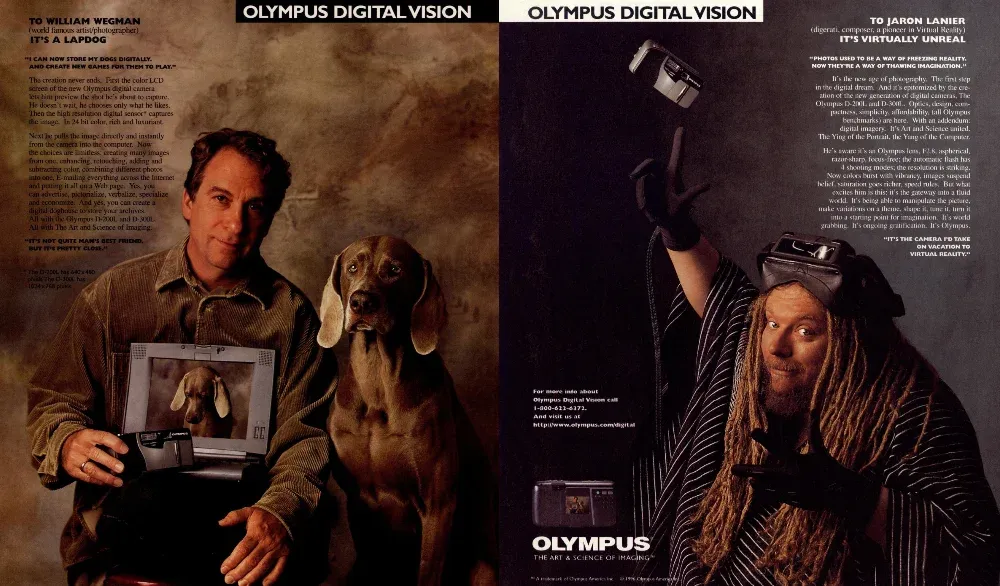
OLYMPUS DIGITAL VISION TO WILLIAM WEGMAN (world famous artist/photographer) IT’S A LAPDOG “I CAN NOW STORE MY DOGS DIGITALLY, AND CREATE NEW GAMES FOR THEM TO PLAY.” The creation never ends. First the color LCD screen of the new Olympus digital camera lets him preview the shot he’s about to capture. He doesn’t wait, he chooses only what he likes. Then the high resolution digital sensor* captures the image. In 24 bit color, rich and lustrous. Next he pulls the image directly and instantly from the camera into the computer. Now the choices are boundless: creating many images from one, enhancing, retouching, adding and subtracting color, combining different photos into one. E-mailing everything across the Internet and putting it all on a Web page. Yes, you can advertise, pictorialize, verbalize, specialize and economize. And yes, you can create a digital doghouse to store your archives. All with the Olympus D-200L and D-300L. All with The Art and Science of Imaging. “IT’S NOT QUITE MAN’S BEST FRIEND, BUT IT’S PRETTY CLOSE.” OLYMPUS DIGITAL VISION TO JARON LANIER (digerati, composer, a pioneer in Virtual Reality) IT’S VIRTUALLY UNREAL “PHOTOS USED TO BE A WAY OF FREEZING REALITY. NOW THEY’RE A WAY OF THAWING IMAGINATION.” It’s the new age of photography. The first step in the digital dream. And it’s epitomized by the creation of the new generation of digital cameras. The Olympus D-200L and D-300L. Optics, design, convenience, simplicity, affordability (all Olympus benchmarks) are here. With an addendum: digital imagery. It’s Art and Science united. The Ying of the Portrait, the Yang of the Computer. He’s aware it’s an Olympus lens, F2.8, aspherical, razor-sharp, focus-free; the automatic flash has 4 shooting modes; the resolution is striking. Now colors burst with vibrancy, images suspend belief, saturation goes richer, speed rules. But what excites him is this: it’s the gateway into a fluid world. It’s being able to manipulate the picture, make variations on a theme, shape it, tune it, turn it into a starting point for imagination. It’s world grabbing. It’s ongoing gratification. It’s Olympus. “IT’S THE CAMERA TO TAKE ON VACATION TO VIRTUAL REALITY.” For more info about Olympus Digital Vision call [illegible]. And visit us at http://www.olympus.com/digital [High-resolution sensor footnote and copyright line illegible.] OLYMPUS THE ART & SCIENCE OF IMAGING
Commentary
I first took this for two separate endorsements. The black title bars reveal a single spread: William Wegman sits beside a dog and a computer on the warm left page, while Jaron Lanier lifts a camera above a virtual-reality headset on the darker right. Olympus gives the same digital camera two creative jobs. Wegman turns photographs into material for play; Lanier turns them into material for imagining another world. The product is small in both scenes, but the artists make its possibilities look large.
The left panel is unusually specific about the workflow. Its LCD lets Wegman preview a shot; the sensor captures it in 24-bit color; the image goes to a computer for retouching, combining, e-mailing, and posting to a Web page. The dog in the photograph on the computer supplies proof of concept. On the right, the prose moves from optics and flash modes into a much less measurable promise: photographs can become a “starting point for imagination.” A reader who needs features gets them; a reader who fears digital photography is merely a technical novelty gets two people who already make images for a living.
The page also records how much work surrounded an early digital image. It must be pulled from the camera, edited on a computer, and then sent or placed online. Today the capture, edit, and distribution often happen on one device. The old sequence gives Olympus room to sell freedom at every step, though the freedom still depends on a visible chain of hardware and software.
For a new copywriter, the pair “freezing reality” and “thawing imagination” is worth studying. One verb describes the familiar purpose of a photo; the other converts it into a promise about what comes next. The two panel headlines, “lapdog” and “virtually unreal,” make the same technology feel personal and experimental. The lesson is to give an unfamiliar capability both a plain sequence of actions and a memorable change in meaning.
Olympus began as a microscope maker in 1919 and later built cameras. It transferred its imaging business to OM Digital Solutions in 2021; Olympus now focuses on medical technology.
The wish to make images quickly and reshape them survives the two cameras in this spread. Their specifications and computer transfer process are historical, but the ad’s stronger idea remains recognizable: photography can be a draft rather than a finished record.