Electronics 1996
Microsoft
Microsoft Internet Explorer 3.0
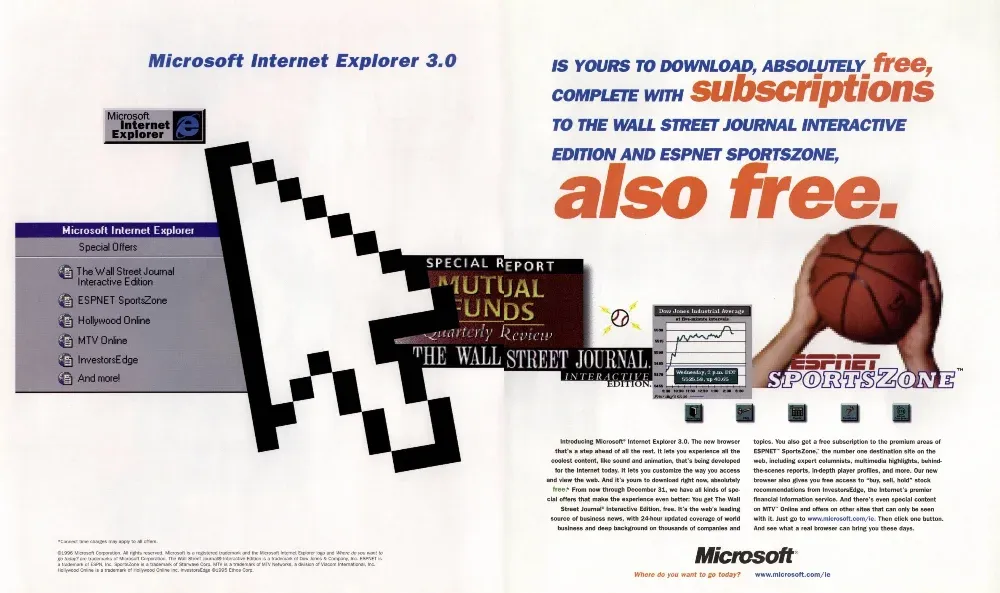
FROM THE PRINTED PAGEOriginal ad copy
OCR transcription from the archived page. Scanning and reading-order errors may remain.
Microsoft Internet Explorer 3.0 Is yours to download, absolutely free, complete with subscriptions to The Wall Street Journal Interactive Edition and ESPN SportsZone, also free. Microsoft Internet Explorer Special Offers: The Wall Street Journal Interactive Edition ESPNET SportsZone Hollywood Online MTV Online InvestorsEdge And more! Introducing Microsoft Internet Explorer 3.0. The new browser that's a step ahead of all the rest. It lets you experience all the coolest content, the sound and animation, that's being developed for the Internet today. It lets you customize the way you access and view the Web. And it's yours to download right now, absolutely free.* From now through December 31, we have all kinds of special offers that make the experience even better: You get The Wall Street Journal Interactive Edition free. It's the Web's leading source of business news, with 24-hour updated coverage of world business and deep background on thousands of companies and topics. You also get a free subscription to the premium areas of ESPNET SportsZone, the number one destination site on the Web, including expert columnists, multimedia highlights, behind-the-scenes reports, in-depth player profiles, and more. Our new browser also gives you free access to “buy, sell, hold” stock recommendations from InvestorsEdge, the Internet's premier financial information service. And there's even special content on MTV Online and offers on other sites that can only be seen with it. Just go to www.microsoft.com/ie. Then click one button. And see what a real browser can bring you these days. Microsoft. Where do you want to go today? www.microsoft.com/ie *[The fine-print offer terms at the bottom of the scan are illegible.]
Commentary
The giant pixelated pointer looks less like a tool than a route through the spread. It starts at Internet Explorer’s logo and points toward the list of destinations—The Wall Street Journal Interactive Edition, ESPN SportsZone, Hollywood Online, MTV Online, InvestorsEdge. The ad sells the browser as a doorway, then makes that doorway seem worth entering by attaching recognizable rooms to it.
The headline does the arithmetic plainly: the browser is free, and so are selected subscriptions or premium sections. The copy then changes register from access to sensation—“sound and animation”—before detailing what the destinations contain: company coverage, player profiles, stock recommendations. The fine print is too small in this scan for me to read confidently, so I leave its terms unresolved rather than imply that every offer had no conditions. The ad’s evidence is the offer language and site list; it does not tell us how many readers redeemed anything.
This is a document of a web still being introduced as a collection of destinations. In 1996, Microsoft offered the software by download and used partner content to give a first-time browser user somewhere specific to go. Today, browser choice is often settled inside the operating system or mobile device, and news, sports, and video each have their own apps and subscriptions. The change I infer is from selling an entrance to selling distinct services already familiar to an online audience.
For a young copywriter, notice the repeated “free,” made louder by the size and color of the word in the headline. It answers the obvious price objection before the smaller paragraphs ask the reader to imagine the experience. The concluding question, “Where do you want to go today?” turns a software utility into a choice of destinations. The practical lesson is to pair a clear offer with a vivid picture of what the offer lets someone do.
Microsoft launched Internet Explorer 3.0 in 1996 as a free download with content offers; Internet Explorer has since been retired, and Microsoft’s current browser is Edge. The company today offers software, cloud and AI services, and other products for personal and business use. Microsoft’s IE 3.0 launch announcement and browser history document the transition.
The lasting promise is easy access to useful information and entertainment. The specific bundle of a browser with newspaper pages, sports highlights, and stock tips belongs to the early Web’s portal-like culture; the present browser is expected to connect users to a much larger, more fragmented set of services.