Electronics 1980
Memorex
Which high bias tape wins with ‘Lucille’?
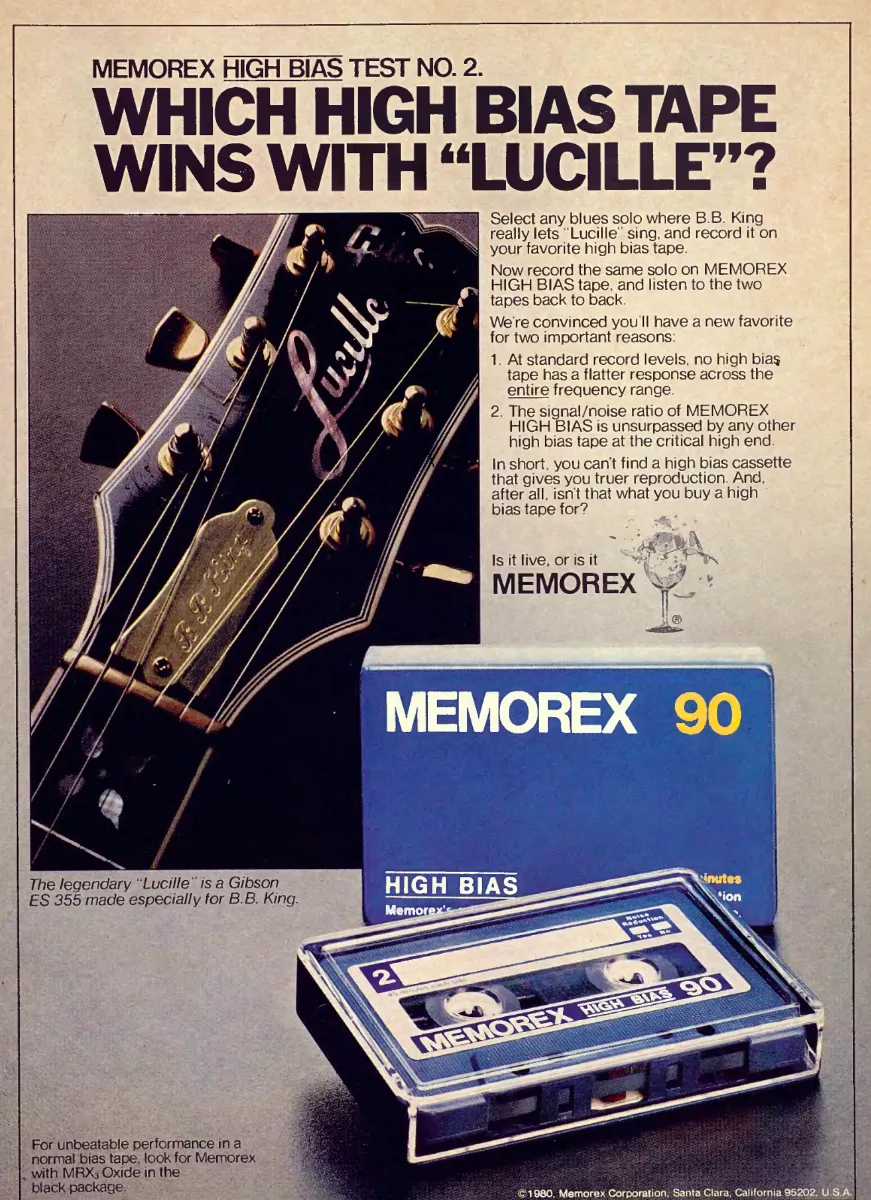
FROM THE PRINTED PAGEOriginal ad copy
OCR transcription from the archived page. Scanning and reading-order errors may remain.
MEMOREX HIGH BIAS TEST NO. 2. WHICH HIGH BIAS TAPE WINS WITH “LUCILLE”? Select any blues solo where B.B. King really lets “Lucille” sing, and record it on your favorite high bias tape. Now record the same solo on MEMOREX HIGH BIAS tape, and listen to the two tapes back to back. We're convinced you'll have a new favorite for two important reasons: 1. At standard record levels, no high bias tape has a flatter response across the entire frequency range. 2. The signal/noise ratio of MEMOREX HIGH BIAS is unsurpassed by any other high bias tape at the critical high end. In short, you can't find a high bias cassette that gives you truer reproduction. And, after all, isn't that what you buy a high bias tape for? Is it live, or is it MEMOREX The legendary “Lucille” is a Gibson ES 355 made especially for B.B. King. MEMOREX 90 HIGH BIAS For unbeatable performance in a normal bias tape, look for Memorex with MRX3 Oxide in the black package. ©1980, Memorex Corporation, Santa Clara, California 95202, U.S.A.
Commentary
The guitar headstock almost overpowers the cassette. Its script name, “Lucille,” runs diagonally through the left photograph while the blue Memorex package waits at the bottom right. The headline asks which tape wins with that instrument, then the body supplies a procedure. I can imagine a reader bringing the same B.B. King solo to two cassettes and comparing the playback. The ad turns a famous musician’s sound into the test material, though it does not claim he endorses this tape.
This is unusually explicit comparative copy. It tells the buyer to use a favorite high bias tape first, then Memorex, and listen back to back. Two numbered claims—flatter frequency response and an unsurpassed signal-to-noise ratio at the high end—give the proposed result a technical explanation. The scan provides no measurements or controlled test conditions, so those claims remain the advertiser’s. But the comparison invites the buyer to participate, which makes the promise feel less like a slogan. The famous “Is it live, or is it Memorex” line appears after the instructions, as a conclusion the listener is being asked to reach.
The ad assumes music can be recorded from a source to a blank cassette, replayed, and judged on a home system. Much listening now arrives as a file or stream without a consumer choosing recording tape. The old process made the medium visible and gave the buyer a reason to compare brands of blank media. The human question behind it—whether a recording preserves what mattered in a performance—has not disappeared.
For a young copywriter, the imperative verbs “Select,” “record,” and “listen” make the reader perform the claim instead of merely hearing it. “Lucille” adds a vivid, named example where the technical phrase “frequency range” would be abstract on its own. The numbered reasons then provide a rationale for what the ear is meant to notice. When inviting a customer to verify a promise, make the procedure simple and the expected benefit specific.
Memorex says it was founded in 1961 and built a consumer recording-media business in the 1970s. The brand now sells consumer electronics under later ownership, rather than this High Bias cassette line.
Its old promise was fidelity to a performance. That remains meaningful, but the cassette, tape-bias comparison, and home-recording ritual are products of a different distribution system. The ad’s enduring technique is to let the buyer imagine a fair test with a piece of music worth hearing closely.