Electronics 1978
Kenwood
The Kenwood KR-6030 receiver. When you like your music enough.
FROM THE PRINTED PAGEOriginal ad copy
OCR transcription from the archived page. Scanning and reading-order errors may remain.
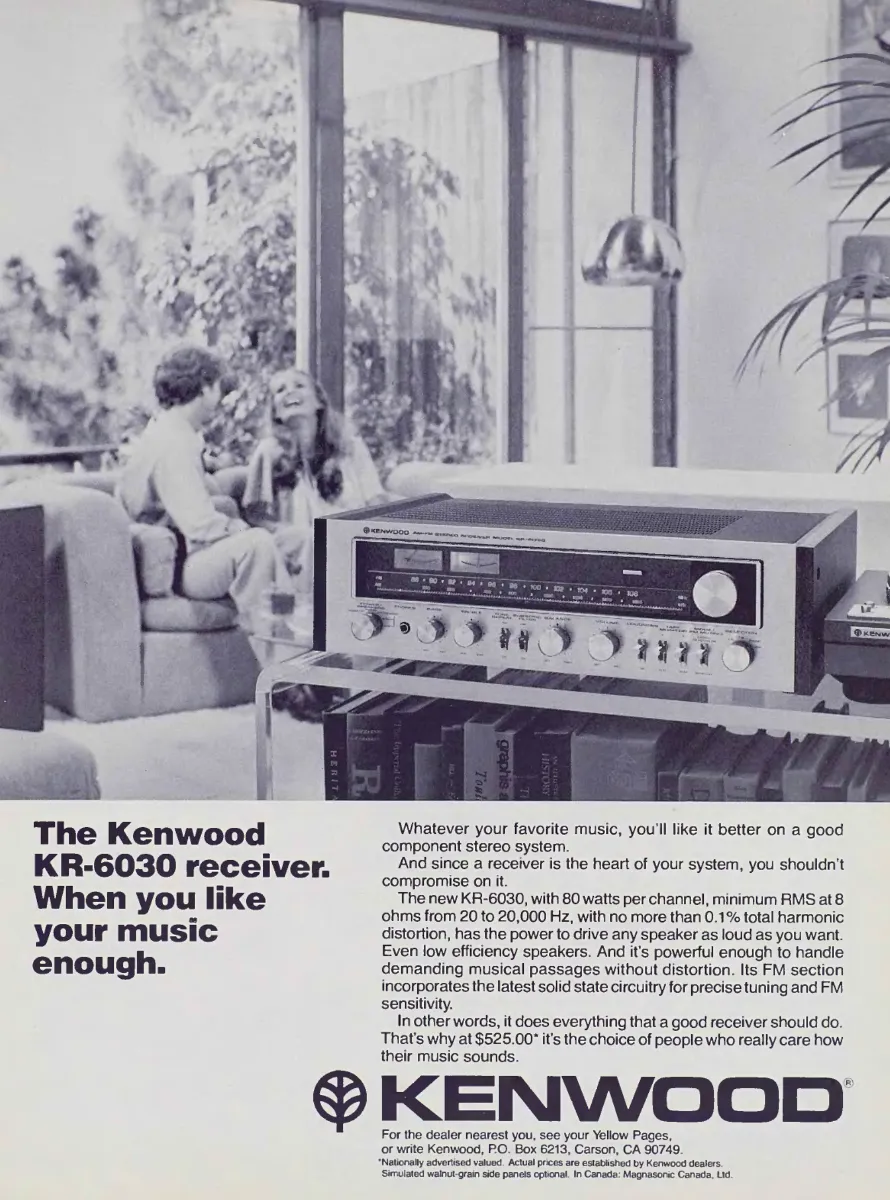
The Kenwood KR-6030 receiver. When you like your music enough. Whatever your favorite music, you’ll like it better on a good component stereo system. And since a receiver is the heart of your system, you shouldn’t compromise on it. The new KR-6030, with 80 watts per channel, minimum RMS at 8 ohms from 20 to 20,000 Hz, with no more than 0.1% total harmonic distortion, has the power to drive any speaker as loud as you want. Even low efficiency speakers. And it’s powerful enough to handle demanding musical passages without distortion. Its FM section incorporates the latest solid state circuitry for precise tuning and FM sensitivity. In other words, it does everything that a good receiver should do. That’s why at $525.00* it’s the choice of people who really care how their music sounds. KENWOOD® For the dealer nearest you, see your Yellow Pages, or write Kenwood, P.O. Box 6213, Carson, CA 90749. *Nationally advertised valued. Actual prices are established by Kenwood dealers. Simulated walnut-grain side panels optional. In Canada: Magnasonic Canada, Ltd.
Commentary
I first read the room as the product demonstration. Tall windows, books, a hanging lamp, and a laughing couple place the receiver inside a cultivated domestic life. Yet the couple is soft and distant; the KR-6030 is large, sharp, and close. The equipment takes the place where a host might normally stand. Kenwood is offering an object to live with, then inviting the reader to justify it as a serious listening decision.
The justification has an unusually clear ladder. A component system improves music; a receiver is its heart; therefore the receiver is where compromise becomes costly. Eighty watts per channel is followed by the operating conditions—8 ohms, 20 to 20,000 Hz, and no more than 0.1 percent total harmonic distortion. Low-efficiency speakers and demanding passages translate those figures into possible difficulties the buyer wants the system to survive. The $525 advertised value arrives after that account of capability. Fine print leaves actual pricing to dealers and makes the simulated walnut-grain sides optional, a useful qualification beside such a carefully furnished photograph.
The Yellow Pages and postal address reveal the next stage of the purchase. A reader could identify a local dealer or write for help, then hear equipment in person. Compared with an online specification table, this page has to do more preliminary teaching itself: it must make the reader interested enough to leave the page and begin another conversation.
For new copywriters, “When you like your music enough” is a deliberately unfinished condition. Enough for what? The price and the specifications answer it. “Heart” turns a component’s central role into an emotional reason to protect it, while “Even low efficiency speakers” converts an exception into a reassuring short sentence. Study that alternation: a dense specification can be followed by a plain statement of what it permits.
Kenwood began in 1946 and joined JVC in 2008, dates documented by JVCKENWOOD’s anniversary history. The name remains active, including in car entertainment.
The continuing need is confidence that an audio purchase will serve the listener’s music and existing equipment. The KR-6030’s FM circuitry, dealer search, and furniture-like side panels locate that need in a particular component-stereo market. Modern interfaces and distribution differ; translating a technical limit into an audible benefit remains useful copywriting.