Consumer Goods 1969
Jack Daniel's
Folks don't always agree on the best way to drink Jack Daniel's.
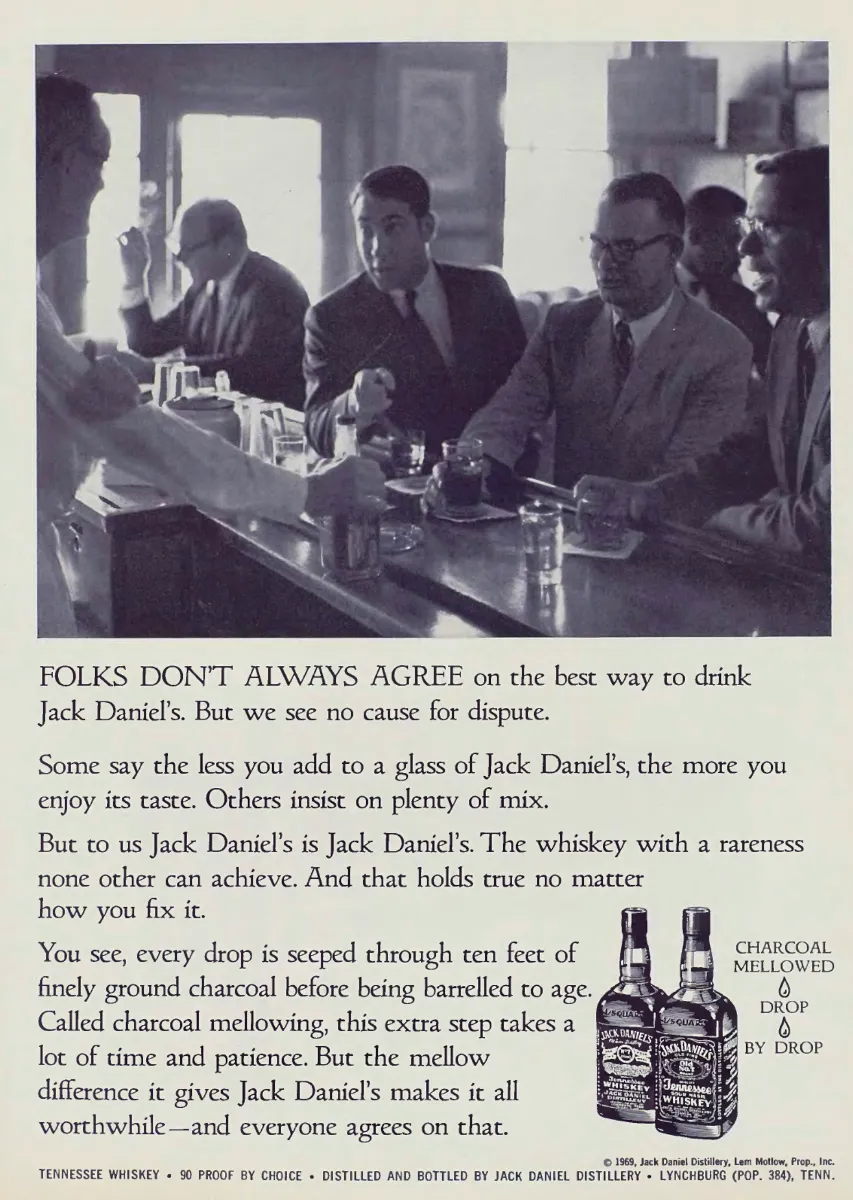
FROM THE PRINTED PAGEOriginal ad copy
OCR transcription from the archived page. Scanning and reading-order errors may remain.
FOLKS DON'T ALWAYS AGREE on the best way to drink Jack Daniel's. But we see no cause for dispute. Some say the less you add to a glass of Jack Daniel's, the more you enjoy its taste. Others insist on plenty of mix. But to us Jack Daniel's is Jack Daniel's. The whiskey with a rareness none other can achieve. And that holds true no matter how you fix it. You see, every drop is seeped through ten feet of finely ground charcoal before being barrelled to age. Called charcoal mellowing, this extra step takes a lot of time and patience. But the mellow difference it gives Jack Daniel's makes it all worthwhile—and everyone agrees on that. CHARCOAL MELLOWED DROP BY DROP TENNESSEE WHISKEY • 90 PROOF BY CHOICE • DISTILLED AND BOTTLED BY JACK DANIEL DISTILLERY • LYNCHBURG (POP. 384), TENN. © 1969, Jack Daniel Distillery, Lem Motlow, Prop., Inc.
Commentary
I begin with the bar photograph: several men in suits, each with a drink, while the bartender reaches into the scene. The image does not identify which glass contains whiskey neat and which contains a mixer. The text supplies the disagreement instead. Some drinkers want less added; others insist on “plenty of mix.” Jack Daniel’s refuses to referee, then claims that both groups share the same rare whiskey. A social argument becomes a way to assert product consistency.
The ad places its production explanation after the truce. It says every drop seeps through ten feet of charcoal before aging and calls this extra step a matter of time and patience. Two bottle images at the lower right give the claim a recognizable object, while “CHARCOAL MELLOWED DROP BY DROP” is set apart like a process seal. The ad does not provide an independent tasting comparison. Its proof is a specific method, offered as a reason that different drinkers can make their own choices without diluting the brand’s identity.
One small detail holds the period in place: the bottom line names Lynchburg and gives a population of 384. It makes the whiskey feel attached to a particular town, not an anonymous factory. The bar scene also assumes a fairly narrow social world of suited men and a male bartender. That is visible in this photograph, not a description of everyone who drank whiskey then. Modern spirits advertising can still use place and process as evidence, but the pictured idea of who belongs at the bar need not travel with it.
For a young copywriter, notice how the copy narrows the dispute. “Folks don’t always agree” invites the reader to take a side, while “no cause for dispute” keeps either side from feeling corrected. The repeated “Jack Daniel’s is Jack Daniel’s” sounds circular until the charcoal paragraph gives the repetition substance. Let a small disagreement draw people in, then reveal the single product truth both sides can accept.
Jack Daniel’s account of its history connects the Lynchburg distillery to the charcoal-mellowing process and says the whiskey is still made under Brown-Forman ownership. The brand remains a producer of Tennessee whiskey and other spirits.
The adaptable promise is that people may drink the whiskey differently while the maker controls the process before bottling. The ad’s exact proof statement, period bottle labels, and 1969 bar scene should remain evidence of this advertisement rather than timeless claims about every drinker.