Consumer Goods 1990
Jack Daniel's
A new man at Jack Daniel Distillery has a lot of listening and learning to do.
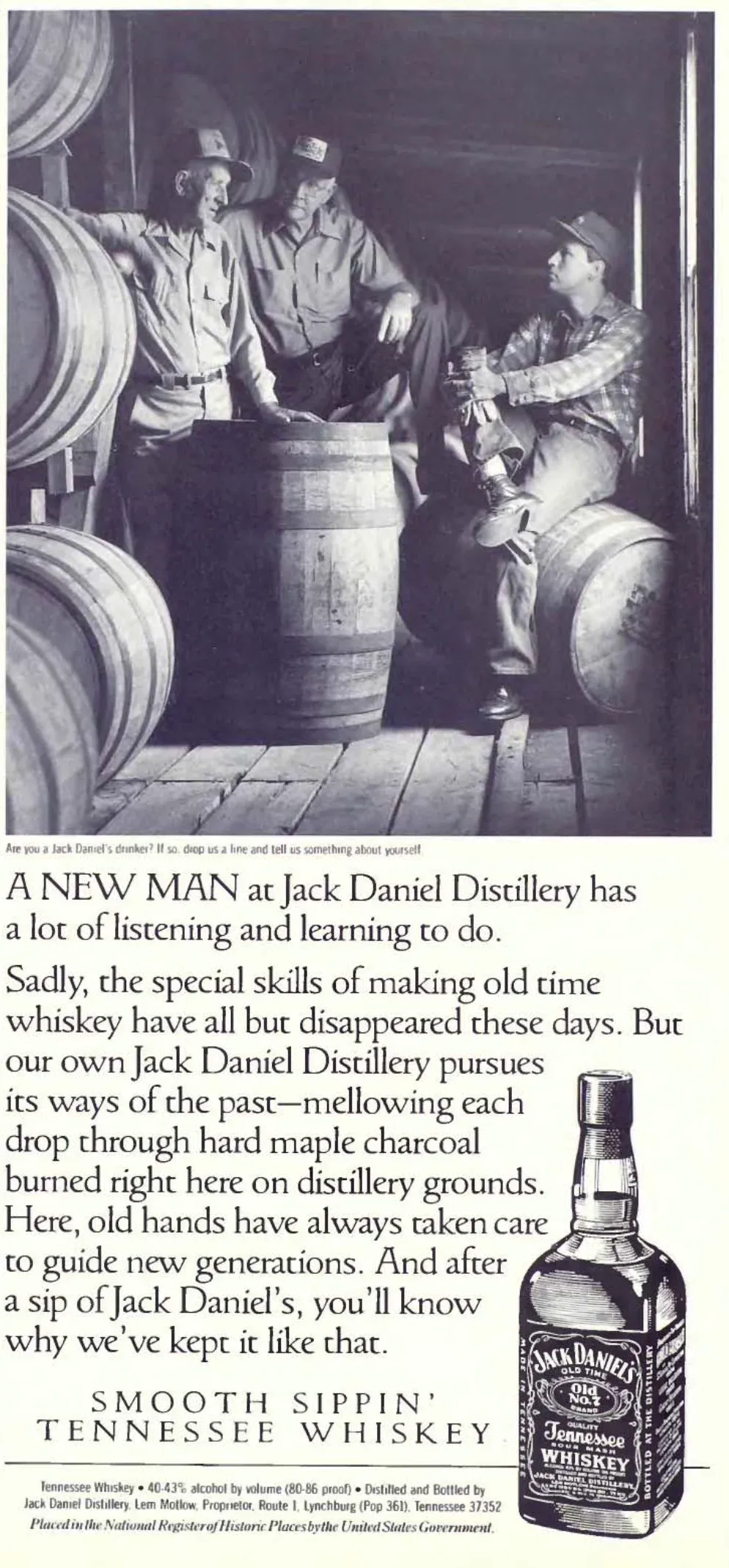
FROM THE PRINTED PAGEOriginal ad copy
OCR transcription from the archived page. Scanning and reading-order errors may remain.
Are you a Jack Daniel's drinker? If so, drop us a line and tell us something about yourself! A NEW MAN at Jack Daniel Distillery has a lot of listening and learning to do. Sadly, the special skills of making old time whiskey have all but disappeared these days. But our own Jack Daniel Distillery pursues its ways of the past—mellowing each drop through hard maple charcoal burned right here on distillery grounds. Here, old hands have always taken care to guide new generations. And after a sip of Jack Daniel's, you'll know why we've kept it like that. SMOOTH SIPPIN' TENNESSEE WHISKEY Tennessee Whiskey • 40-43% alcohol by volume (80-86 proof) • Distilled and Bottled by Jack Daniel Distillery. Lem Motlow, Proprietor. Route 1, Lynchburg (Pop 361), Tennessee 37352 Placed in the National Register of Historic Places by the United States Government.
Commentary
The scan places three men among barrels, but the headline quietly changes what we are looking at. “A new man” sounds like an employee introduction, while “listening and learning” makes the distillery’s expertise feel oral, local and difficult to download. The pictured workers are not posed as celebrities; they look like people who know the room because they work in it.
The body copy builds a miniature succession story. “Old time whiskey” is said to be disappearing, yet the distillery keeps its own method alive by mellowing every drop through hard maple charcoal burned on the grounds. The process is both material and moral: charcoal, barrels and hands become evidence of continuity. The ad asks the drinker to trust a practice because it has been taught across generations.
The closing “Smooth Sippin’ Tennessee Whiskey” is deliberately easygoing after the historical argument. It turns craft into a social reward rather than a laboratory claim. The invitation to write in and “tell us something about yourself” makes the relationship reciprocal, even though the ad is still collecting brand loyalty.
For young copywriters, notice how the language makes a production claim feel like a human relationship. “Listening,” “learning,” “old hands” and “guide” give the process verbs associated with apprenticeship. The practical lesson is to find the human action inside a technical proof; it can make a method memorable without pretending the method is magic.
Jack Daniel’s says its Lynchburg distillery was established in 1866 and remains known for charcoal mellowing; Brown-Forman has owned the distillery since 1956, according to the brand’s background. It remains a major Tennessee whiskey brand with Old No. 7 and other expressions.
The promise that survives is care made visible through repetition. What has changed is the ad’s confidence that a bottle can carry a single, stable production story without the modern need for broader responsibility and moderation language. Its strongest idea remains simple: heritage is persuasive when the work behind it can be described.