Electronics 1992
Hewlett-Packard
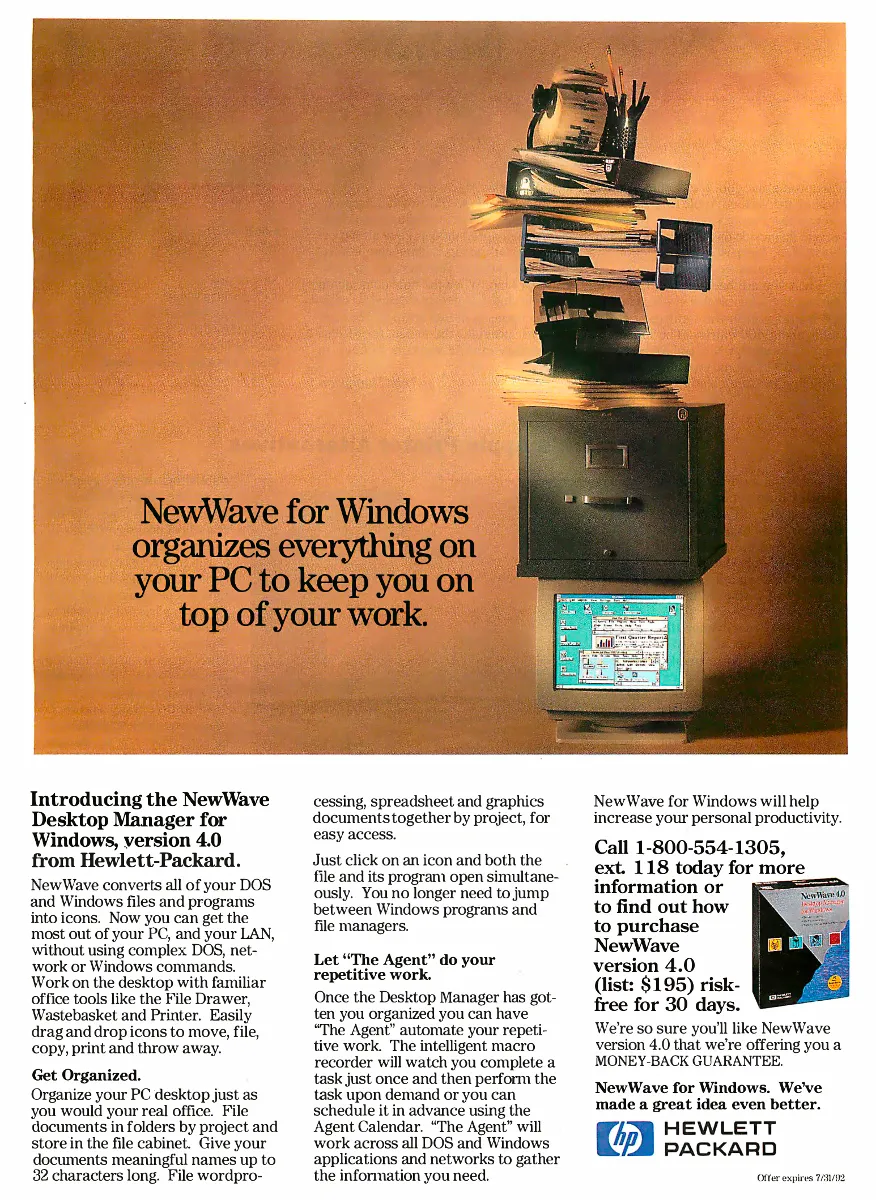
NewWave for Windows organizes everything on your PC to keep you on top of your work.
FROM THE PRINTED PAGEOriginal ad copy
OCR transcription from the archived page. Scanning and reading-order errors may remain.
NewWave for Windows organizes everything on your PC to keep you on top of your work. Introducing the NewWave Desktop Manager for Windows, version 4.0 from Hewlett-Packard. NewWave converts all of your DOS and Windows files and programs into icons. Now you can get the most out of your PC, and your LAN, without using complex DOS, network or Windows commands. Work on the desktop with familiar office tools like the File Drawer, Wastebasket and Printer. Easily drag and drop icons to move, file, copy, print and throw away. Get Organized. Organize your PC desktop just as you would your real office. File documents in folders by project and store in the file cabinet. Give your documents meaningful names up to 32 characters long. File wordprocessing, spreadsheet and graphics documents together by project, for easy access. Just click on an icon and both the file and its program open simultaneously. You no longer need to jump between Windows programs and file managers. Let “The Agent” do your repetitive work. Once the Desktop Manager has gotten you organized you can have “The Agent” automate your repetitive work. The intelligent macro recorder will watch you complete a task just once and then perform the task upon demand or you can schedule it in advance using the Agent Calendar. “The Agent” will work across all DOS and Windows applications and networks to gather the information you need. NewWave for Windows will help increase your personal productivity. Call 1-800-554-1305, ext. 118 today for more information or to find out how to purchase NewWave version 4.0 (list: $195) risk-free for 30 days. We're so sure you'll like NewWave version 4.0 that we're offering you a MONEY-BACK GUARANTEE. NewWave for Windows. We've made a great idea even better. hp HEWLETT PACKARD Offer expires 7/31/92
Commentary
At first I saw a balancing act. The computer supports a filing cabinet, which supports papers, trays and office equipment; the amber background makes the whole structure look like a still life moments before collapse. Only then did I read “on top of your work.” HP has reversed the reassuring idiom into a physical problem. The work is on top of the computer, and the person who should control it is absent.
The copy offers a way back into the picture. File Drawer, Wastebasket and Printer become familiar objects on a desktop, while documents from different programs can be grouped by project. I found the thirty-two-character filenames especially telling: a modest technical allowance is sold as the ability to give work meaningful names. This is software positioned around the worker’s understanding of a project, rather than around the separate applications that produced its parts.
Then “The Agent” arrives. The ad describes an intelligent macro recorder that watches a task once and repeats it on demand or by schedule. That description matters more than the suggestive name. A reader encountering contemporary talk of software agents can see both continuity and difference: the wish to delegate repetitive work persists, but this offer specifies recorded actions and a calendar. The scan supports that mechanism; it does not establish the broader reasoning abilities now sometimes implied by the same word.
For new copywriters, the language moves deliberately from abstraction to verbs. “Organizes everything” is expansive; “move, file, copy, print and throw away” lets a reader rehearse actual actions. “Get Organized” then becomes an instruction rather than a vague aspiration. Notice how “The Agent” receives quotation marks and an immediate explanation. A memorable name needs a plain account of what it does, especially when the product is unfamiliar.
Hewlett-Packard began in 1939 and expanded from instruments into computing. The company separated into HP Inc. and Hewlett Packard Enterprise in 2015. Today’s HP portfolio includes personal systems and printing products and services.
The desire to organize work by purpose and avoid repeated clerical actions remains immediate. DOS commands, the boxed $195 desktop manager and the dated money-back offer locate this solution in its moment. The unstable tower still communicates a recognizable fear: that tools intended to manage work may themselves become another pile to manage.