Automotive 1978
Honda
The Honda Civic. The car we designed around a shopping bag.
FROM THE PRINTED PAGEOriginal ad copy
OCR transcription from the archived page. Scanning and reading-order errors may remain.
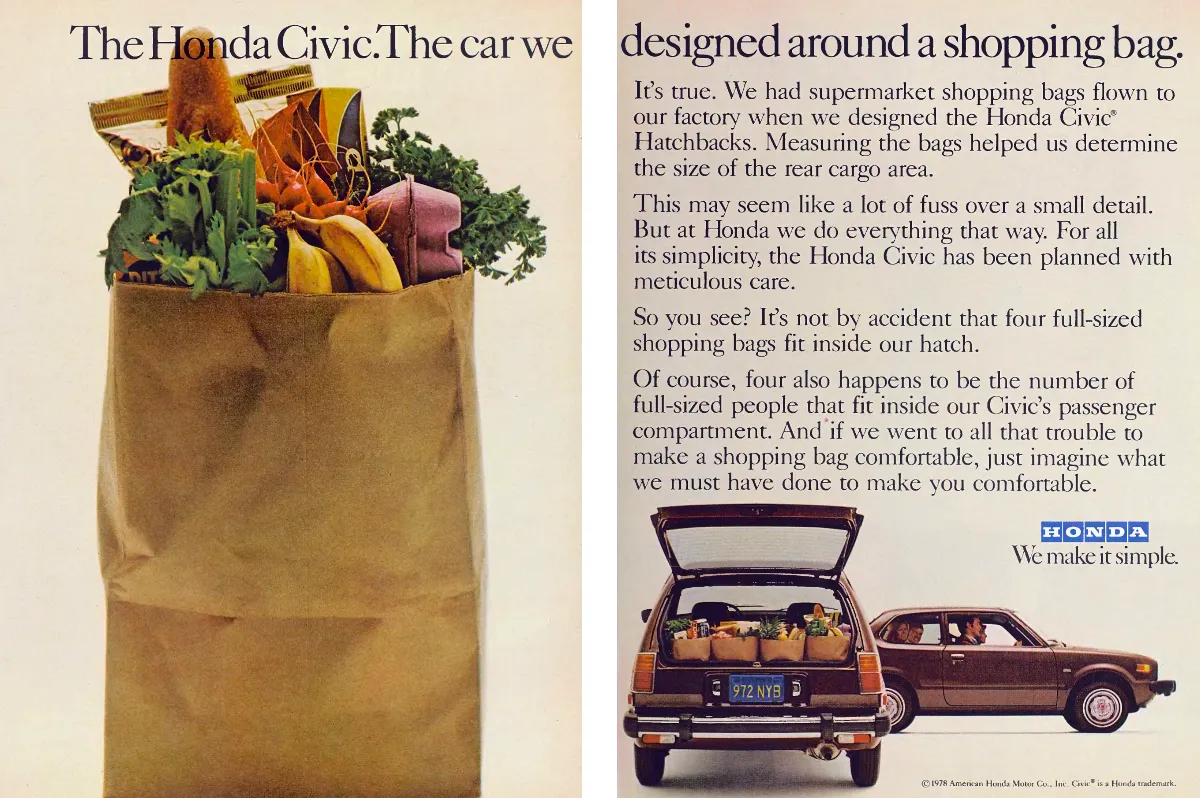
The Honda Civic. The car we designed around a shopping bag. It's true. We had supermarket shopping bags flown to our factory when we designed the Honda Civic® Hatchbacks. Measuring the bags helped us determine the size of the rear cargo area. This may seem like a lot of fuss over a small detail. But at Honda we do everything that way. For all its simplicity, the Honda Civic has been planned with meticulous care. So you see? It's not by accident that four full-sized shopping bags fit inside our hatch. Of course, four also happens to be the number of full-sized people that fit inside our Civic's passenger compartment. And if we went to all that trouble to make a shopping bag comfortable, just imagine what we must have done to make you comfortable. HONDA. We make it simple. ©1978 American Honda Motor Co., Inc. Civic® is a Honda trademark.
Commentary
The grocery bag is so large that I initially miss the car. It occupies almost the entire left panel, filled past the rim with vegetables and packaged food. The Civic appears twice, small and low on the right: one hatch open to show four bags, one side view with passengers. The imbalance is deliberate. Honda wants the reader to begin with an ordinary errand and then discover that the car has been fitted around it.
The headline sounds like a provocation: a car “designed around a shopping bag.” The body makes that literal by claiming supermarket bags were flown to the factory and measured to determine cargo space. The scan cannot verify that design process, but it does show why the story is persuasive. Four bags in the hatch become an easy, visible unit of capacity. The copy then moves from four bags to four people, turning a practicality claim into a comfort promise. The punch line asks the reader to imagine how carefully Honda treated the passenger if it lavished care on a shopping bag.
That appeal relies on a familiar rhythm of household shopping: groceries are bought, carried, and loaded into a car. Today delivery services and different shopping habits may change the trip for some households, but the useful question remains concrete: will the vehicle fit the life people actually lead? The ad demonstrates how a mundane object can become a more legible measure than a cargo-volume figure.
For a new copywriter, “It’s true” is an important second beat. It acknowledges that the headline sounds improbable and earns a moment to explain. “So you see?” then draws the reader toward the visual proof, while the repeated “four” links cargo and passengers without a specification table. “We make it simple” closes a carefully staged argument in four short words. The lesson is to let an unusual claim invite doubt, then answer it with an object the audience already knows.
Honda’s company history records the Civic’s place in its U.S. automotive business. Honda still sells Civic hatchbacks alongside other automobiles and products.
The small-car promise of useful space and attention to daily needs is still recognizable. What belongs to this page is the paper grocery bag as a design yardstick and the leap from accommodating four bags to comforting four passengers. That leap is where the practical demonstration becomes a brand story.