Electronics 1992
Compaq
At Most Computer Companies, R&D Stands For Replicate And Duplicate.
FROM THE PRINTED PAGEOriginal ad copy
OCR transcription from the archived page. Scanning and reading-order errors may remain.
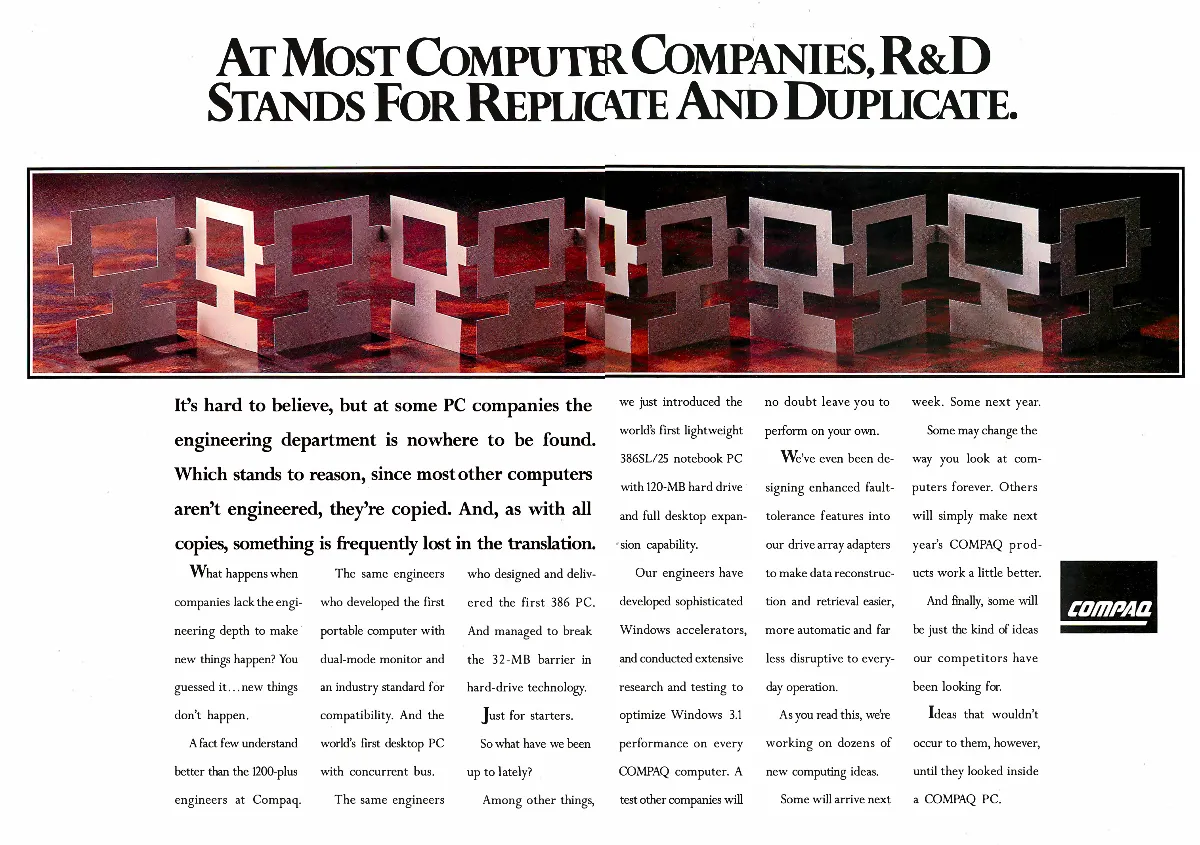
AT MOST COMPUTER COMPANIES, R&D STANDS FOR REPLICATE AND DUPLICATE. It's hard to believe, but at some PC companies the engineering department is nowhere to be found. Which stands to reason, since most other computers aren't engineered, they're copied. And, as with all copies, something is frequently lost in the translation. What happens when companies lack the engineering depth to make new things happen? You guessed it...new things don't happen. A fact few understand better than the 1200-plus engineers at Compaq. The same engineers who developed the first portable computer with dual-mode monitor and an industry standard for compatibility. And the world's first desktop PC with concurrent bus. The same engineers who designed and delivered the first 386 PC. And managed to break the 32-MB barrier in hard-drive technology. Just for starters. So what have we been up to lately? Among other things, we just introduced the world's first lightweight 386SL/25 notebook PC with 120-MB hard drive and full desktop expansion capability. Our engineers have developed sophisticated Windows accelerators, and conducted extensive research and testing to optimize Windows 3.1 performance on every COMPAQ computer. A test other companies will no doubt leave you to perform on your own. We've even been designing enhanced fault-tolerance features into our drive array adapters to make data reconstruction and retrieval easier, more automatic and far less disruptive to everyday operation. As you read this, we're working on dozens of new computing ideas. Some will arrive next week. Some next year. Some may change the way you look at computers forever. Others will simply make next year's COMPAQ products work a little better. And finally, some will be just the kind of ideas our competitors have been looking for. Ideas that wouldn't occur to them, however, until they looked inside a COMPAQ PC. COMPAQ
Commentary
I began with the row of metal computers, each reduced to the same cut-out shape. Nothing in that image suggests the intricate work inside a machine. That is its purpose: Compaq turns competitors into surfaces, repeating the silhouette until a whole market appears to consist of copies. The R&D headline tells the reader how to interpret the repetition.
Below it, the company gives engineering a head count: more than 1,200 people. The text then inventories claimed achievements, from a 386 PC and hard-drive capacity to a notebook with desktop expansion. I read the change of scale as deliberate. A broad accusation about originality is followed by details a business buyer might bring into a purchasing discussion. The archive preserves those priority claims as Compaq’s copy; the scan alone cannot establish every “first.”
The more interesting evidence concerns unglamorous work. Windows 3.1 testing, accelerators and fault-tolerant drive arrays do not look like the repeated metal ornaments. They describe the effort required to make an apparently standardized computer dependable. Compaq is asking the buyer to pay attention to development and testing that would otherwise remain invisible. The final suggestion that rivals must look inside a Compaq PC makes imitation itself into a backhanded endorsement.
The line about leaving a performance test to the customer is also a small history of transferred labour. It promises that engineers have already done work the purchaser would otherwise inherit. Buyers today can still face driver updates, compatibility checks and deployment testing, even when software arrives through very different channels. What persists is the appeal of having somebody competent absorb that uncertainty before the machine reaches your desk.
For new copywriters, “Replicate And Duplicate” turns a familiar abbreviation into an accusation without needing to name a rival. “The same engineers” then creates a repeated grammatical spine for the evidence. Near the end, the paired “Some” sentences allow modest improvements and dramatic changes to coexist. That restraint makes the claim of ongoing invention easier to understand: originality can mean making next year’s machine work a little better, not only changing the world.
Compaq began in 1982 around portable business computing. HP completed its merger with Compaq in 2002; the independent advertiser pictured here became part of HP’s history. HP today supplies personal systems and printing products and services.
The underlying position—real engineering behind outwardly similar machines—still offers a basis for differentiation. The notebook specifications and named Windows version belong to 1992. The enduring creative problem is to give otherwise hidden technical work a visible shape, which this ad solves by first showing what its competitors supposedly lack.