Energy 1981
Aramco
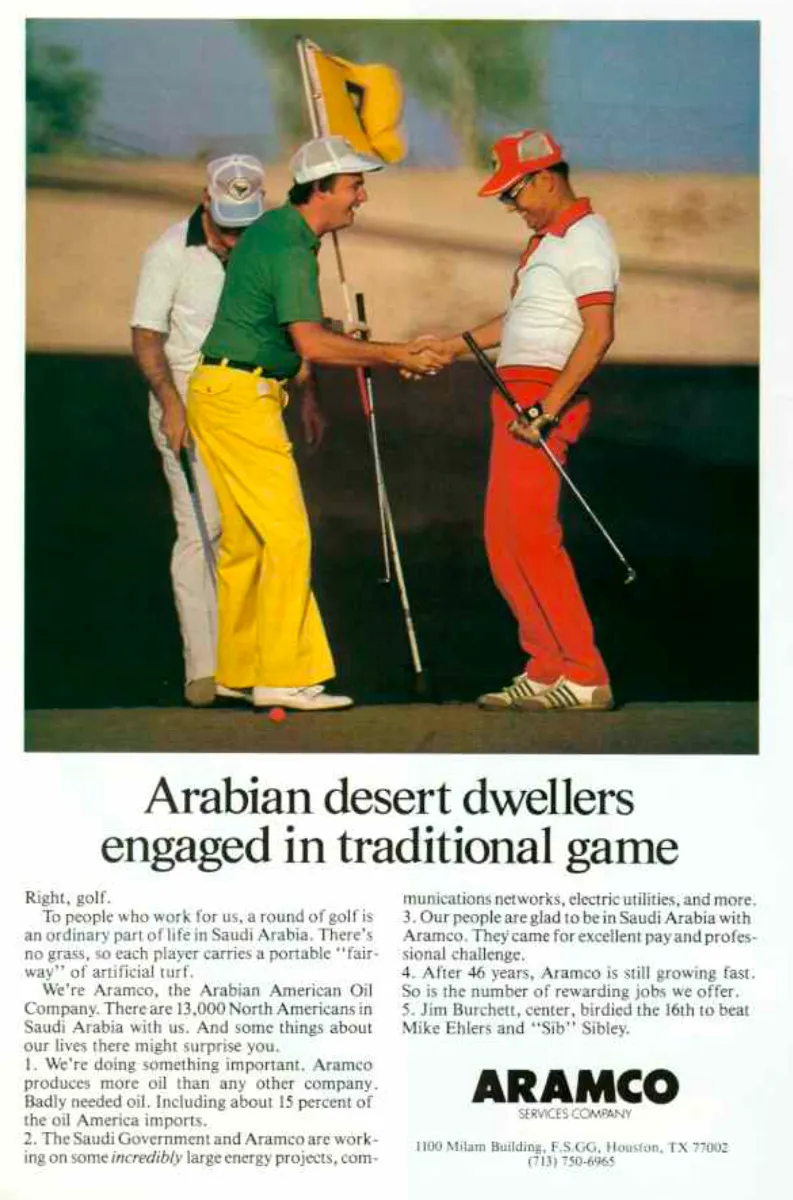
Arabian desert dwellers engaged in traditional game
FROM THE PRINTED PAGEOriginal ad copy
OCR transcription from the archived page. Scanning and reading-order errors may remain.
Arabian desert dwellers engaged in traditional game Right, golf. To people who work for us, a round of golf is an ordinary part of life in Saudi Arabia. There's no grass, so each player carries a portable “fairway” of artificial turf. We're Aramco, the Arabian American Oil Company. There are 13,000 North Americans in Saudi Arabia with us. And some things about our lives there might surprise you. 1. We're doing something important. Aramco produces more oil than any other company. Badly needed oil. Including about 15 percent of the oil America imports. 2. The Saudi Government and Aramco are working on some incredibly large energy projects, communications networks, electric utilities, and more. 3. Our people are glad to be in Saudi Arabia with Aramco. They came for excellent pay and professional challenge. 4. After 46 years, Aramco is still growing fast. So is the number of rewarding jobs we offer. 5. Jim Burchett, center, birdied the 16th to beat Mike Ehlers and “Sib” Sibley. ARAMCO SERVICES COMPANY 1100 Milam Building, F.S.G.G., Houston, TX 77002 (713) 750-6965
Commentary
The first clue is the flag on the course. Beside it, three men have stopped to shake hands, with golf clubs and bright trousers supplying the familiar look of a leisure photograph. Then the headline calls them “Arabian desert dwellers,” and the tiny answer beneath it says, “Right, golf.” The joke tries to upset a prospective recruit’s picture of life in Saudi Arabia by showing a recognizable after-work ritual in an unexpected setting.
The copy admits the difference: there is no grass, so players carry a patch of artificial turf as a portable fairway. That detail does more persuasive work than a generic assurance of comfort. It says the workers have adapted a familiar game to the landscape. The five numbered points then broaden the pitch from recreation to employment: oil output, large public projects, pay, professional challenge and growing job numbers. The last point returns to the photograph with a specific score and three names. By making a small social fact as concrete as the company claims, the ad invites readers to imagine colleagues rather than an anonymous expatriate workforce.
Its omissions are as revealing as its detail. The pictured and named employees are North Americans; the ad speaks to their possible anxieties about relocation, not to the Saudi workers or communities whose lives also shaped these projects. The claimed share of American oil imports and the count of North American employees are period claims made by the advertiser, not measures of Aramco today. A Houston address and telephone number make the recruiting path as tangible as the artificial-turf square.
For a new copywriter, notice the timing of “Right, golf.” The headline delays the familiar answer, and the short correction lets the image complete the joke. The five numbered points are less playful, but that tonal change is purposeful: surprise earns attention, then specifics give a career prospect something to investigate. The named birdie at the end restores a human voice before the contact details.
Aramco traces its roots to a 1933 oil concession, and its company history records that the Saudi government reached full ownership in 1980. The company now operates as Saudi Aramco across energy and chemicals; the “Arabian American Oil Company” name in the scan belongs to its earlier corporate period.
The recruitment need to make a distant workplace imaginable remains familiar. The ad’s American oil-import appeal, expatriate social circle and telephone route speak to a particular labor market and geopolitical moment. The portable fairway survives as the most economical piece of proof: a single object makes a broad promise of ordinary life abroad feel locally observed.