Electronics 1994
Apple
Newton connects.
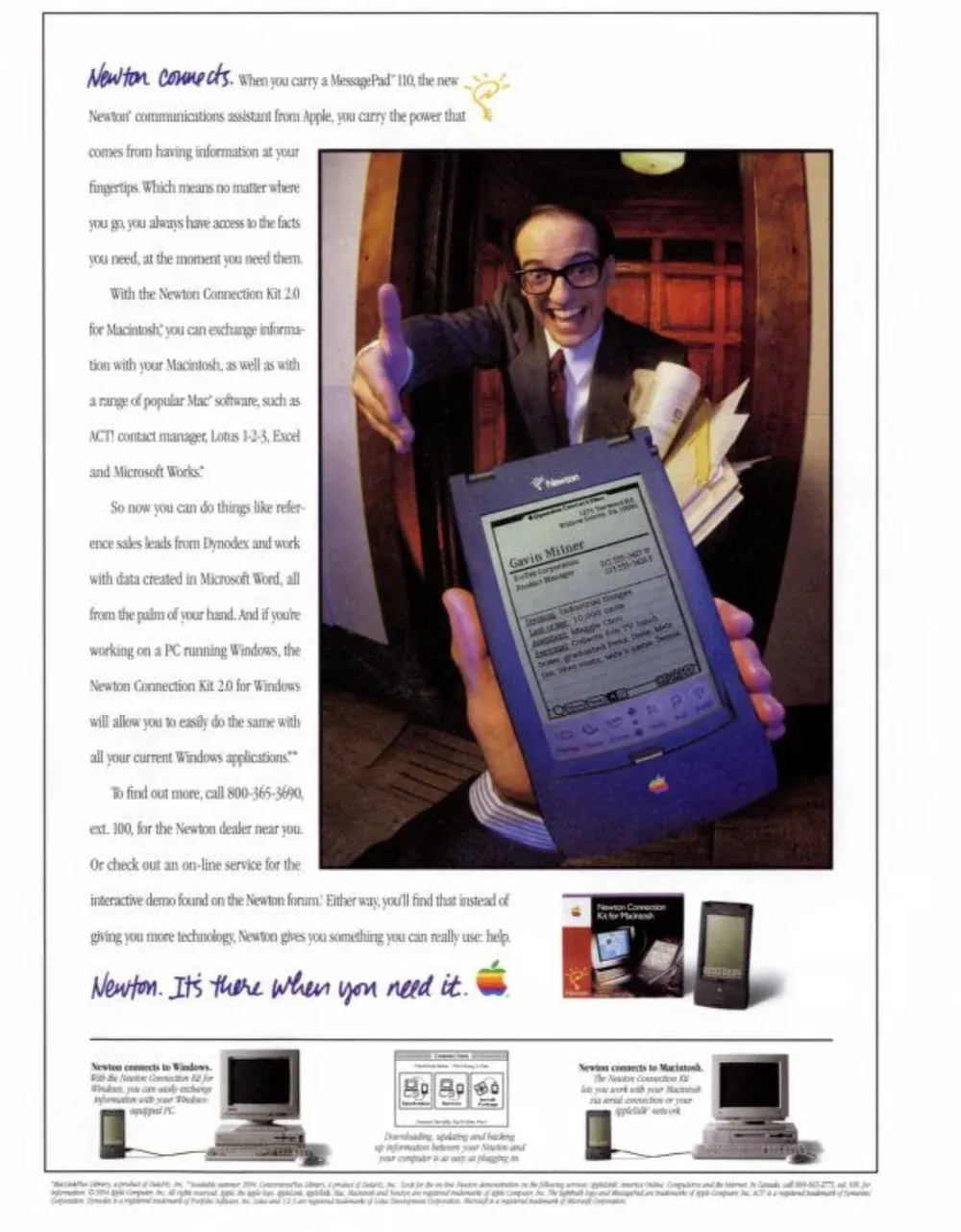
FROM THE PRINTED PAGEOriginal ad copy
OCR transcription from the archived page. Scanning and reading-order errors may remain.
Newton connects. When you carry a MessagePad™ 110, the new Newton™ communications assistant from Apple, you carry the power that comes from having information at your fingertips. Which means no matter where you go, you always have access to the facts you need, at the moment you need them. With the Newton Connection Kit 2.0 for Macintosh, you can exchange information with your Macintosh, as well as with a range of popular Mac software, such as ACT! contact manager, Lotus 1-2-3, Excel and Microsoft Works. So now you can do things like reference sales leads from Dynodex and work with data created in Microsoft Word, all from the palm of your hand. And if you're working on a PC running Windows, the Newton Connection Kit 2.0 for Windows will allow you to easily do the same with all your current Windows applications. To find out more, call 800-365-3690, ext. 100, for the Newton dealer near you. Or check out an on-line service for the interactive demo found on the Newton forum. Either way, you'll find that instead of giving you more technology, Newton gives you something you can really use: help. Newton. It's there when you need it. Newton Connection Kit for Macintosh Newton connects to Windows. Newton connects to Macintosh. [Small-print connection descriptions and trademark notice illegible.]
Commentary
I first notice the hand reaching out of the photograph. A man with glasses leans forward as if he is offering help, while another hand holds a Newton MessagePad close enough to dominate the page. The gesture is almost a sales call in miniature: human contact behind a new machine. “Newton connects” sits above it in loose script, and the copy begins by defining connection as access to facts wherever the user goes.
The page then becomes remarkably specific about what must connect to what. The MessagePad 110 can exchange information through a Newton Connection Kit with a Macintosh; named Mac programs include ACT!, Lotus 1-2-3, Excel, and Microsoft Works. The next paragraph extends the promise to a PC running Windows. At the foot of the ad, small diagrams give each computer family its own connection route. The photograph sells immediate mobility, but the supporting copy reveals a product that still depends on a desktop ecosystem to make its information useful.
The screen held toward the reader makes the promise concrete. It shows a contact record rather than a vague futuristic display. The claim is not that the device invents a new kind of work; it is that sales leads and documents already living in familiar applications can travel with a person. A dealer telephone number and an online Newton forum demo offer two ways to investigate further. Both are visible evidence of how much explanation a handheld computer still needed.
Today, carrying contacts and documents seems ordinary because phones often synchronize them automatically. This ad asks the reader to picture a more deliberate chain: software on a Mac or Windows PC, a connection kit, and a separate handheld. The wish for information at the moment it is needed survives. The work required to move it has changed.
For a new copywriter, the repetition in “Newton connects” is worth studying. It names a technical feature, then lets “connects to Windows” and “connects to Macintosh” answer a practical objection. The final line, “It’s there when you need it,” shifts from compatibility to reassurance. The ad teaches a simple sequence for unfamiliar technology: make the benefit human, name the systems it works with, and end on the user’s situation rather than the specification.
Apple was founded in 1976 and now sells devices, software, and services described in its 50th-anniversary overview. It ended further Newton OS and product development in 1998, so the MessagePad and its connection kits belong to a closed product line.
The ad’s lasting promise is portable access to useful information. Its separate kits, named desktop programs, and dealer inquiry line show how that promise had to be assembled in 1994. The reaching hand gives the technical story an enduring design lesson: a device becomes easier to understand when the page shows the person it is meant to assist.