Automotive 1969
American Motors
An unfair comparison between the AMX and...what?
FROM THE PRINTED PAGEOriginal ad copy
OCR transcription from the archived page. Scanning and reading-order errors may remain.
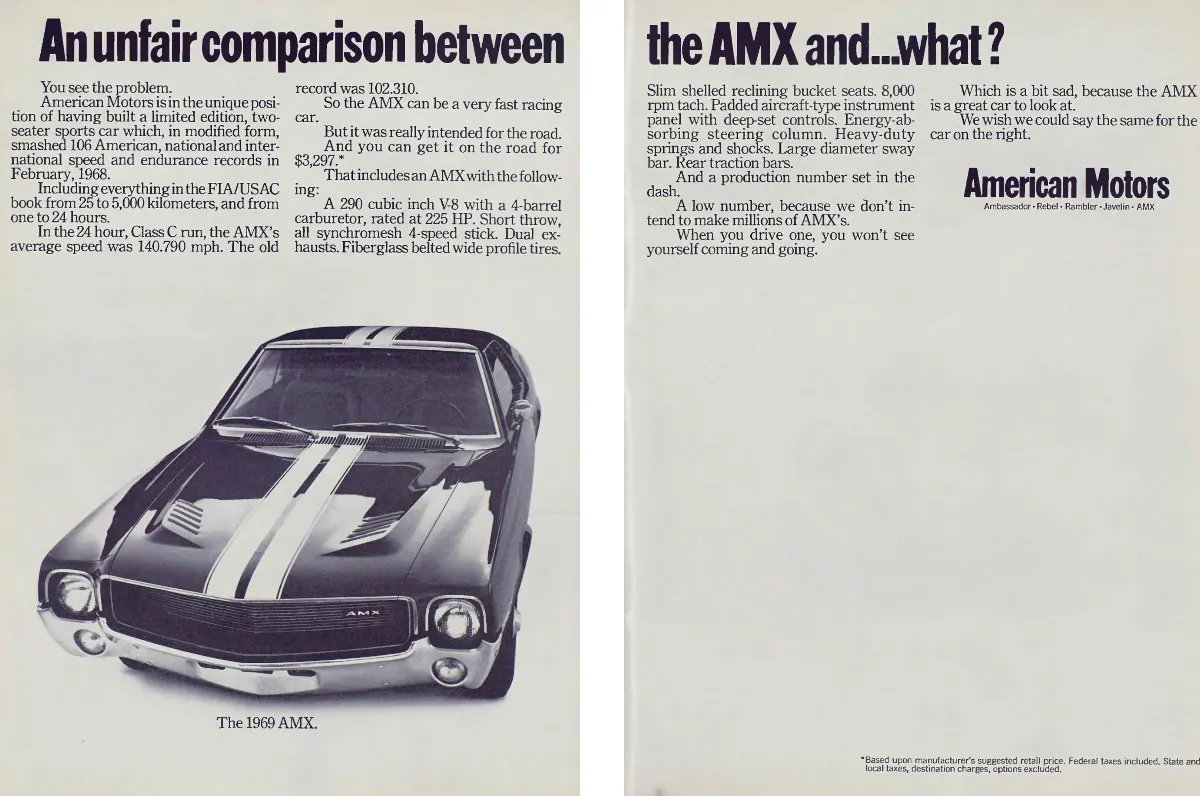
An unfair comparison between the AMX and...what? You see the problem. American Motors is in the unique position of having built a limited edition, two-seater sports car which, in modified form, smashed 106 American, national and international speed and endurance records in February, 1968. Including everything in the FIA/USAC book from 25 to 5,000 kilometers, and from one to 24 hours. In the 24 hour, Class C run, the AMX's average speed was 140.790 mph. The old record was 102.310. So the AMX can be a very fast racing car. But it was really intended for the road. And you can get it on the road for $3,297.* That includes an AMX with the following: A 290 cubic inch V-8 with a 4-barrel carburetor, rated at 225 HP. Short throw, all synchromesh 4-speed stick. Dual exhausts. Fiberglass belted wide profile tires. Slim shelled reclining bucket seats. 8,000 rpm tach. Padded aircraft-type instrument panel with deep-set controls. Energy-absorbing steering column. Heavy-duty springs and shocks. Large diameter sway bar. Rear traction bars. And a production number set in the dash. A low number, because we don't intend to make millions of AMX's. When you drive one, you won't see yourself coming and going. Which is a bit sad, because the AMX is a great car to look at. We wish we could say the same for the car on the right. AMX The 1969 AMX. American Motors Ambassador · Rebel · Rambler · Javelin · AMX *Based upon manufacturer's suggested retail price. Federal taxes included. State and local taxes, destination charges, options excluded.
Commentary
I look for the second car before reading the small type. The headline has promised a comparison; the spread supplies only one contestant. A striped AMX points toward me from the left page, while an expanse of paper waits on the right. That vacancy is the argument. American Motors is asking the reader to supply a rival and then treating the empty space as evidence that none qualifies.
The trick would be thin without the crowded paragraphs above it. Records, engine size, horsepower, transmission, tires and suspension give the joke something to stand on. I notice an important qualification near the beginning: the record-setting car was modified. The page then pivots from that racing performance to the road car and its $3,297 price. Those are connected selling points, but they are not proof that the showroom specification delivered the quoted endurance speed.
The numbered dashboard makes a second argument underneath the first. A low production number becomes an ownership benefit: the buyer will not keep encountering the same car. This is scarcity presented as individuality, not merely a statistic about manufacturing. The next sentence pretends to regret that exclusivity because the AMX deserves to be seen. At the end, the writer sends me back to inspect the nonexistent car on the right. The layout has been waiting patiently for its punchline.
What changes when I read the spread now is the ease of challenging its chosen comparison. An online shopper can open specifications and photographs of alternatives immediately; this printed page controls which competitor appears, and chooses none. The useful lesson is not that comparison has become impossible, but that a memorable assertion of uniqueness still needs defensible criteria. Here, two seats, equipment, performance claims, price and limited production establish the frame.
For young copywriters, “and…what?” is the hinge. The pause turns a conventional comparative headline into mock bewilderment. “You see the problem” then recruits the reader as a sympathetic accomplice. Short transitions carry the argument from racing to road use, before the specifications accelerate the pace. Finally, “the car on the right” makes a phrase depend on the page around it. Write with the layout: the blank space completes a sentence that words alone cannot deliver.
American Motors was formed when Hudson joined Nash in 1954. Chrysler acquired its assets in 1987, including Jeep. AMC is no longer an independent automaker; Jeep now sits within Stellantis, selling SUVs and other vehicles rather than continuing this AMX offer.
The appeal of owning something distinctive survives the advertiser. The specified price, mechanical package and promised production numbers belong to this particular car and moment. What remains useful is the creative economy: a challenger can make absence conspicuous, provided the surrounding evidence gives that absence a credible meaning.