Electronics 1989
Adobe
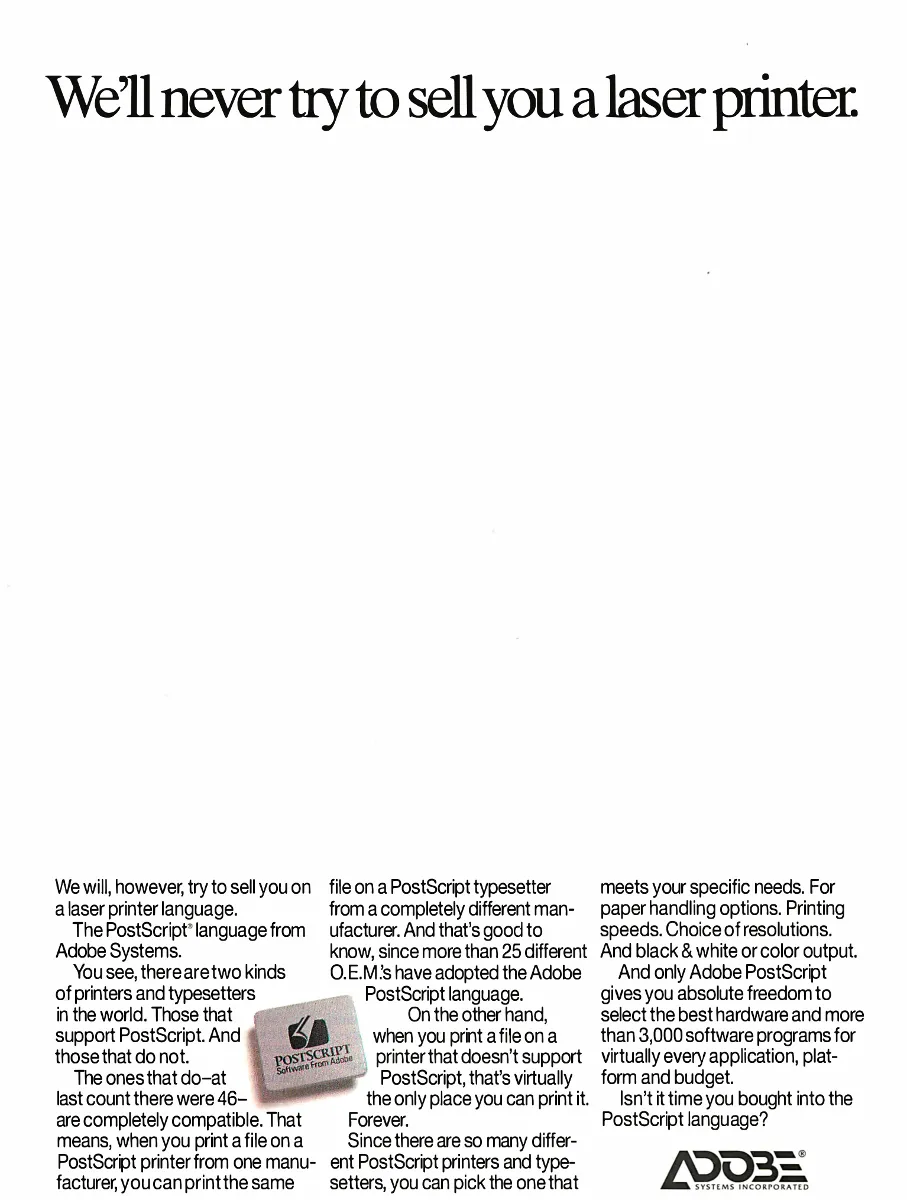
We’ll never try to sell you a laser printer.
FROM THE PRINTED PAGEOriginal ad copy
OCR transcription from the archived page. Scanning and reading-order errors may remain.
We'll never try to sell you a laser printer. We will, however, try to sell you on a laser printer language. The PostScript® language from Adobe Systems. You see, there are two kinds of printers and typesetters in the world. Those that support PostScript. And those that do not. The ones that do—at last count there were 46—are completely compatible. That means, when you print a file on a PostScript printer from one manufacturer, you can print the same file on a PostScript typesetter from a completely different manufacturer. And that's good to know, since more than 25 different O.E.M.'s have adopted the Adobe PostScript language. On the other hand, when you print a file on a printer that doesn't support PostScript, that's virtually the only place you can print it. Forever. Since there are so many different PostScript printers and typesetters, you can pick the one that meets your specific needs. For paper handling options. Printing speeds. Choice of resolutions. And black & white or color output. And only Adobe PostScript gives you absolute freedom to select the best hardware and more than 3,000 software programs for virtually every application, platform and budget. Isn't it time you bought into the PostScript language? POSTSCRIPT Software From Adobe ADOBE® SYSTEMS INCORPORATED
Commentary
I kept looking for the missing printer. Adobe leaves almost the entire sheet white, with a promise at the top and the explanation waiting at the bottom. The absence is doing persuasive work: the company says it will not sell hardware, then declines to show any. What looks like a refusal becomes a way to redirect the buying decision toward a less visible part of printing.
The small PostScript badge is the only product-like object in that expanse. Following the columns, I found the proposed buying rule: choose a common language before choosing among machines. Forty-six compatible printers and typesetters, more than twenty-five manufacturers and three thousand programs give the reader a sense of a surrounding system. Those are the advertiser’s contemporary counts and claims. The archive cannot infer universal interoperability from the page’s confident wording.
The argument is aimed at someone whose file must travel. A desktop printer and another manufacturer’s typesetter are imagined as stages in one working process. “Freedom” therefore means avoiding a future dead end, not merely having a long equipment catalogue. Adobe’s current account of PostScript’s development identifies it as a device-independent page-description language and explains its later use in commercial printing. That documented purpose helps explain why a software company would spend a page influencing hardware purchases.
For a beginning copywriter, the small change from “sell you” to “sell you on” is the hinge. One describes a transaction; the other describes an argument. The isolated “Forever” makes incompatibility feel like a sentence rather than an inconvenience. Short fragments listing speed, resolution and paper handling then give the abstract promise of choice concrete dimensions. Define what freedom allows the customer to do, and keep sweeping competitive claims recognizable as claims.
Adobe was founded in 1982 by John Warnock and Charles Geschke around digital printing and publishing. Its business now includes creative, document and marketing software. Adobe’s printing overview describes PDF as the preferred contemporary print-file format while continuing to document PostScript technology.
Files still need to survive movement between people, applications and output systems. What has changed is the familiar name of the portable document and the infrastructure around it. The page’s enduring move is to make an underlying standard feel like the purchase that protects all the others.